
Don't Stop Thinking About Tomorrow
A few reflections on the sorry state of America

History can be cruel. It reminds us of what we failed to see, the portents that we were too busy to notice because we were distracted by other exciting events. Then, suddenly, we discover that everything has changed, that our sacred truths have been trampled. How did we get here? Who is to blame?
The current crisis affecting America is so profound, so existential, that it’s only natural to seek explanation. Every week brings a new theory which tries to glue together the shards of circumstance from the past fifty or sixty years. Some of these explanations are insightful, others reductive. Part of the problem is that we crave a simple answer and there isn’t one.
What I’d like to do today is offer up a few observations gleaned from over forty years of researching postwar America. They don’t constitute a definitive explanation for America’s debacle; that’s not my intent. They’re merely designed to trigger some introspection, to remind my friends in the dis-United States about events which went unnoticed at the time but seem portentous now.
You Say You Want a Revolution
The 1960s is usually seen as a decade of radical revolt – a left wing uprising. Attention is focused, for instance, on the Students for a Democratic Society (SDS) which began, with symbolic intent, at a United Auto Workers retreat in the working class mecca of Michigan. In June 1962, young, confident students from America’s best universities gathered together to write a manifesto for the future. The Port Huron Statement was a long-winded, bombastic and utterly deluded document which purported to show the correct way forward for America. ‘We are the people of this generation’, it began, ‘bred in at least modest comfort, housed now in universities, looking uncomfortably to the world we inherit.’ The quality of expression, and the reasoning, went downhill from there. At 25,000 words, it’s a perfect example of what happens when students are not given a word limit. It also demonstrates how the intellectual ‘elite’ likes to tell the workers how to organise their lives, usually in a boring document. All in good faith, obviously.
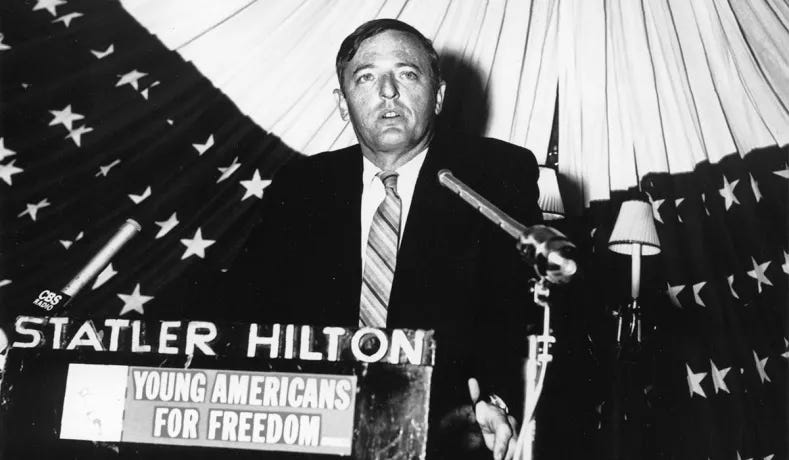
SDS gets a lot of attention from historians because the group seems to embody everything good about the Sixties. Its alter ego, the right-wing Young Americans for Freedom, is, in contrast, virtually ignored. Yet on many campuses conservative activism was more widespread and popular than the left wing variety. YAF also had more identifiable long-term influence, given the direct line from its radicalism to today’s Project 2025. The most successful student movement of the 1960s was not the one that espoused civil rights, feminism, and peace, it was a right wing group that promoted class privilege, bigotry and greed. It pains me to write this, but it’s true.
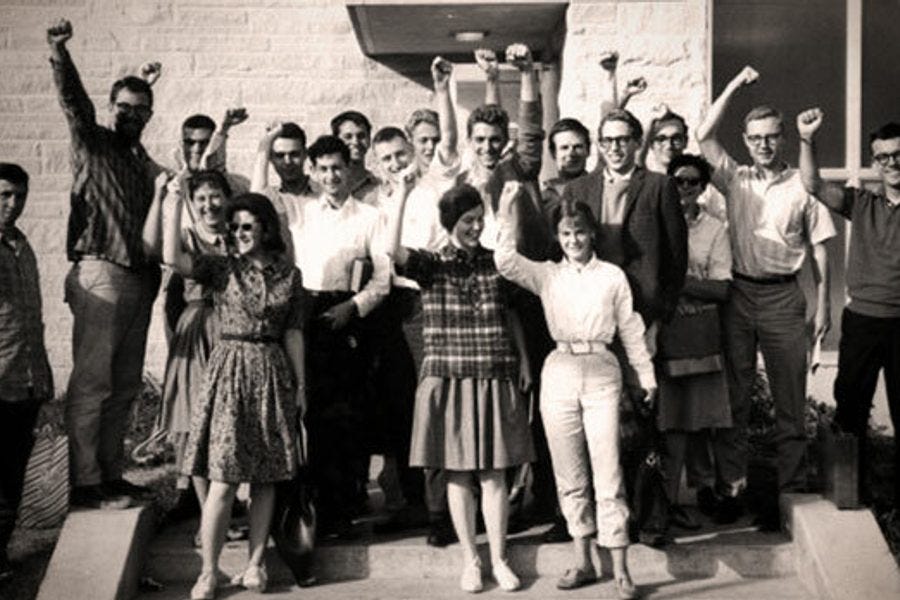
YAF began, rather appropriately, on the leafy manor of William F. Buckley in the gentrified state of Connecticut. Buckley wanted YAF to act as a counterweight to the supposedly left wing bias of universities, which he felt threatened the American way of life. By 1960, he had gathered together a core of conservative purists to whom radical right students could look for guidance. Students would provide the energy, but their mentors would provide the direction.
Aware of the dangers of youthful immaturity, Buckley had in mind an authoritarian organisation able to impose a disciplined and consistent political line on energetic students, with power the clear objective. Recognising Buckley’s threat, The Nation warned in 1961 that while the left was concentrating on issues like civil rights and free speech, the right was busily building a movement designed to win elections.
Around that time, Medford Stanton Evans, a Buckley disciple, boasted that ‘The Conservative element on … campus is now on the offensive; it is articulate, resourceful, aggressive. It represents the group which, in 15 or 20 years, will be assuming the seat of power in the United States. That is why, in my estimation, it authentically represents the future of the country.’ Sadly, he was right.
This wasn’t simply conservative bombast; American news magazines confirmed that a tidal wave of conservatism was sweeping across college campuses, largely in reaction to John Kennedy’s election in 1960. US News and World Report, Newsweek, and Time all reported a rightwing revolt, pointing out that students were no longer echoing the political prejudices of their parents. For a significant number, in fact, turning right was rebellion. ‘My parents thought Franklin D. Roosevelt was one of the greatest heroes who ever lived’, Robert Schuchman, chairman of YAF, remarked. ‘I’m rebelling from that concept.’
The charter of the YAF—‘The Sharon Statement’—was drafted in Buckley’s living room on 11 September 1960 by Evans. In contrast to the Port Huron Statement it was clear, focused and short. ‘In a time of moral and political crises, it is the responsibility of the youth of America to affirm certain moral truths’, the statement proclaimed. Foremost among these truths was free will. In the emphasis placed upon freedom, YAF and SDS had much in common, but while SDS also promoted equality, YAF never bothered with that lofty ideal. YAF maintained that ‘political freedom cannot long exist without economic freedom’. The free market was endorsed as ‘the single economic system compatible with the requirements of personal freedom … and … the most productive supplier of human needs’. They weren’t just cynics bent on rewarding the wealthy; they actually believed this stuff.
According to the YAF ideologues, big government threatened freedom. ‘When government interferes with the work of the market economy, it tends to reduce the moral and physical strength of the nation’, the statement declared. ‘When it takes from one man to bestow upon another, it diminishes the incentive of the first, the integrity of the second, and the moral autonomy of both.’ Suddenly, inequality had been given moral and intellectual justification.
The biggest threat to freedom was, however, ‘the forces of international Communism’. The protection of liberty at home required the defeat of, ‘rather than coexistence with’, the Communist menace. Thus, foreign policy became an extension of domestic affairs. ‘American foreign policy must be judged by this criterion: does it serve the just interests of the United States?’ Everything was viewed through that distorted lens.
‘What is so striking in the students who met at Sharon is their appetite for power’, Buckley later confessed. For them, politics was not a game but an intensely serious crusade. They equated conservatism with maturity and therefore saw themselves as wiser and ‘older’ than their fellow students whose cultural rebellion – sex, drugs and rock and roll – seemed trivial.
The generation gap hardly bothered them; affluence, materialism and conformism seemed worthy ideals. As a result, YAF didn’t waste its time on parochial issues relating to university life. Dissent was instead expressed in exclusively national and international terms. Nor did they court publicity, since publicity invited attack.
In stark contrast to Abbie Hoffman and Jerry Rubin, the pranksters of the left, YAF organised in secret and zealously preserved anonymity. ‘We never got the publicity and we weren’t interested in that’, one activist admitted. While the left sought immediate solutions to distinct social problems like race, sex and drug laws, the right concentrated on a gradual assumption of power which would eventually allow them to exercise authority in all realms and thus reshape America comprehensively. Some activists formulated five year plans; others, more realistically, thought in terms of a conservative Elysium decades ahead.
While the left warned its followers not to trust anyone over 30, YAF members revered ‘old fogeys’ like Barry Goldwater and the novelist John Dos Passos. Rather predictably, ‘the establishment’ loved these dorks, generously providing financial and moral backing. Benefactors like the plumbing mogul Herb Kohler gladly opened their wallets. Friends in high places also meant that YAF never had difficulty finding venues for its rallies. While SDS struggled to get a parade permit in Ann Arbor, YAF was booking (and filling) Madison Square Garden.
At its inception, YAF espoused an instinctual conservatism, untainted by pragmatism. For this reason, members despised the presidential hopeful Nelson Rockefeller, who seemed a closet liberal, and idolised Goldwater. The latter’s proclamation at the Republican convention in 1964 that ‘extremism in the cause of liberty is no vice’ seemed written for YAF.
Besotted with Goldwater’s purity, they assumed that the rest of the nation would be equally smitten. For that reason, his landslide defeat to Lyndon Johnson in 1964 left them heartbroken. Lessons were nevertheless learned. The more pragmatic members concluded that fundamentalist crusades do not harmonise well with electoral politics. They also learned that an ideology, no matter how perfect, still needs an attractive voice. Goldwater’s problem, they decided, was not so much his ideas but his personality. He scared the shit out of most people.
The lessons of 1964 explain the enthusiasm with which YAF embraced Ronald Reagan, first in the 1966 California gubernatorial campaign and then, two years later, during the Republican presidential campaign. On the surface, Reagan was not a natural YAF standard bearer since his populism contradicted the intellectual elitism of the movement. But while Reagan lacked ideological purity, he was indisputably a formidable candidate. He embodied the best of both worlds: the conservative values of Goldwater and the warmth of Rockefeller. YAF’s enthusiasm for Reagan demonstrates that, in contrast to students on the left, the group understood the importance of winning elections and was not irresistibly attracted to the purity of lost causes.
College campuses provided fertile ground for right wingers. According to a poll conducted by Newsweek in 1967, the most popular student political group was not SDS but the Young Republicans, which had over four times as many members. During that year, 49 per cent of college students surveyed considered themselves ‘hawks’ on foreign policy, while only 35 per cent were ‘doves’. At the 1968 election, Americans in their 20s preferred Nixon to Humphrey by a margin of 39 percent to 30 percent. Twenty-five percent supported the bigot George Wallace, the most enthusiastic response he received from any age group.
‘The left battled for the campus; the right won politics’, one YAF member reflected on his years of student activism. Despite its conservatism, YAF was not a collection of squares. They demonstrated that one could not automatically guess a person’s beliefs by what he wore, the length of his hair, or the music or drugs he enjoyed. Many wore the uniform of the counterculture, tasted its pleasures and shared its craving for freedom. What distinguished them was that they saw no need to indulge in left wing politics in order to be part of the Sixties ethos and did not confuse the personal with the political. They accepted sex and drugs as simple pleasures, instead of investing them with profound political meaning. Like so many of my college friends from the 1970s, they saw nothing discordant in dropping acid and supporting Nixon.
Ironically, YAF occupied a political position to which a good many left wing rebels would eventually gravitate, after their brief flirtation with socialism. After graduation came a job, marriage and a family, a journey that encouraged conservatism. As one YAF activist remarked: ‘there has been a change [in] the mainstream—[it] came to where we were … Before I was on the outside; now I’m in the middle’. As Evans rather perceptively remarked in 1961, ‘Historians may well record the decade of the 1960s as the era in which conservatism, as a viable political force, finally came into its own.’ Behind all the sound and fury of the Sixties, it was the right’s quiet planning that signified something.
Enter Reagan
The long term plan written in Buckley’s living room in 1960 came to fruition in 1980 when Reagan was elected president. Many sixties radicals were dumbfounded by this turn of events. They found it inconceivable that the man who had once played sidekick to a chimp in Bedtime for Bonzo was now president. But recall what I wrote at the beginning: it’s often the case that the most important trends in any era are those quiet ones which go unnoticed at the time. Look closer, and the rise of Reagan seems perfectly logical; the incomprehensible seems inevitable. Following the blueprint of the YAF, the Republican party of Goldwater became the party of Nixon and then of Reagan. It underwent enormous change, learning in particular how to court the white working class and how to win elections.
Reagan was the architect of some of those changes, and the beneficiary of others. As Governor of California, he established himself as the spokesman for the conservative counter-revolution of the 1960s, a movement that fed off that decade’s excesses. He sold himself as an outsider, a common man who would challenge the political elites – what Trump calls the swamp. Having established that persona, he then capitalised on the myriad problems of the Seventies — the ‘decline’ of the family, the drug crisis, the oil embargo, the Salt II ‘sell-out’, the Nicaraguan impasse and humiliation in Iran. He didn’t offer substantive solutions, but he did project golden rays of hope. ‘With God’s help’, he proclaimed, ‘we can and will resolve the problems which now confront us. … And after all, why shouldn’t we believe that? We are Americans.’
At the time, the Watergate scandal and Nixon’s resignation were assumed to be disasters for the Republican Party. Democrats confidently predicted that they would hold power for at least a generation. Some even speculated that the Republican Party would be destroyed. This triumphalism, however, camouflaged deep divisions within the Democratic Party. The much-heralded generation of dominance lasted, in fact, just four years.
The Carter presidency was an unmitigated disaster for Democrats. Reagan was the lucky benefactor of Carter’s mistakes and misfortunes. The latter’s presidency took place during the bleakest of the post-war years, a fact that did not bode well for his re-election. There was no more potent proof of a nation’s emasculation than being stuck in a long queue to buy rationed petrol during the OPEC oil embargo. Americans deeply resented Carter’s pious decrees to slow down on the freeway and wear a sweater indoors.
And then there was the humiliation of the hostage crisis in Iran. Every day during the year 1980, Walter Cronkite ended the CBS Evening News by reminding viewers precisely how long American embassy staff had been held hostage in Tehran. To those real problems were added imaginary ones. Reagan and his friends used labyrinthine (and bogus) calculations to ‘prove’ that Soviet nuclear superiority left the US vulnerable to a devastating first strike. America, he insisted, needed a massive rearmament.
Americans had grown tired of losing. Reagan’s success should not, however, be attributed entirely to Carter’s failure. His victory in 1980 was the result of a long, methodical campaign to restructure the Republican party and to woo the white working class. This process had been started with Nixon, in particular, with his Southern Strategy which played on white resentment with civil rights legislation. Before long, white working class values were synonymous with Republicanism. Distilled to its essence, the Republican success came in convincing American workers to vote contrary to their interests.
As we’ve seen, back in the 1960s, while leftist students were rioting in the streets, those on the right were quietly organising. Twenty years later, those dorks in the YAF landed prestigious positions on Reagan’s staff. They understood how politics had changed, particularly in methods of communication. Sophisticated polling was used to discover the fears of white Americans, which were then aggravated with alarmist ads. The message wasn’t all negative, however. Reagan wrapped his dire warnings in folksy platitudes, honeyed assurances and corny jokes. He was the master of the pithy soundbite, invariably trite but delivered with the tinkling melody of a babbling brook.
Meanwhile, Carter refused to sugarcoat America’s problems. He talked incessantly about an American malaise. The people, however, didn’t want to feel bad about themselves. ‘We didn’t elect [Reagan] because he knew how many barrels of oil are in Alaska’, the journalist Bill Moyers remarked. ‘We elected him because we want to feel good.’ It was morning in America.
Republicans recognised that baby boomers had grown up, put aside their fantasies of revolution and started raising families. The right cleverly rode the family wave. The anti-feminist Phyllis Schlafly and the tele-evangelist Jerry Fallwell managed, hypocritically perhaps, to argue that protection of the family was synonymous with morality and therefore with conservatism. It was not that the left denigrated the family, but many of its causes, including abortion, feminism and sexual permissiveness, seemed a threat to the family. It didn’t help that a few prominent Sixties radicals like Bernardine Dohrn and Billy Ayers had once urged followers to smash monogamy.
Anita Bryant, beauty queen, orange juice spokeswoman and queen of moralistic schmaltz, headed an effective campaign to roll back gay rights called Save Our Children, which argued that every homosexual was a potential child molester. Reagan, who wasn’t aggressively anti-gay or anti-abortion, nevertheless enthusiastically courted those who were. One third of his supporters favoured a constitutional amendment banning abortion. For the most part, however, when it came to family values, Reagan steered away from thorny specifics and stuck instead to homespun homilies.
Reagan won because voters saw him as their salvation. Sixties radicalism would be vanquished, social welfare neutered and wealth again revered. Making money could be discussed without guilt or embarrassment. The heroic archetype of the new zeitgeist was a guy named Donald Trump, feted by the New York Times as ‘tall, lean and blond, with dazzling white teeth … he looks so much like Robert Redford. He rides around town in a chauffeured silver Cadillac with his initials, DJT, on the plates. He dates slinky fashion models, belongs to the most elegant clubs, and at only 30 years of age, estimates that he is worth “more than $200 million”.’ Bedraggled Americans, it seems, were happy to fill their empty bellies with rich people’s dreams.
We’re better than this
Somewhere on the road to Reagan’s Elysium, Americans lost their way. Hope morphed into hatred, prosperity into despair. Ronnie’s folksy platitudes gave way to Donnie’s vulgar tirades.
The moral rot set in during the early 1990s, when victory in the Cold War was supposed to bring milk and honey, but instead left Americans feeling rudderless. It seems that fighting communism was the only thing upon which they could agree. Without that unifying purpose, they found themselves embroiled in endless culture wars. A new, more febrile, more frustrated, America emerged. Latent bigotry flourished. America went berserk.
Trumpism is not an aberration but instead the logical outcome of all those trends we failed to notice. In other words, America is not, as some would argue, ‘better than this’. American democracy was never actually a perfect system; the United States has always been a nation of massive inequalities governed by an unrepresentative system designed to keep those iniquities in place.
The various antagonistic visions of America were showcased in the 1992 election campaign. That was the election won by Bill Clinton, whose theme song was Fleetwood Mac’s ‘Don’t Stop’:
Don’t stop thinking about tomorrow
Don’t stop, it’ll soon be here
It’ll be better than before
Yesterday’s gone, yesterday’s gone
The song was sung at full volume, in order to drown out all the discordant realities of a divided, bigoted America.
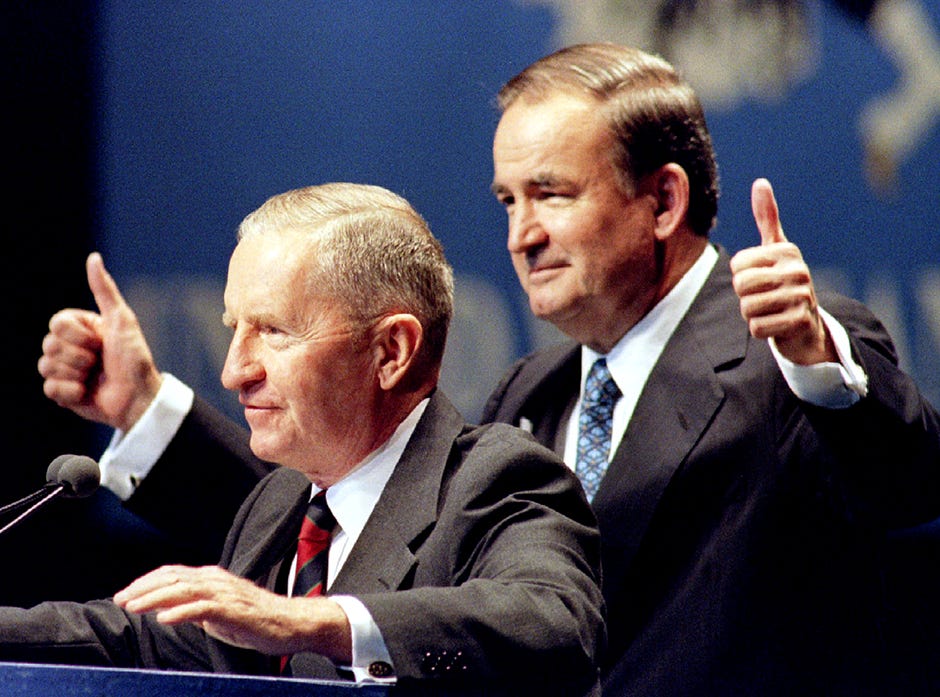
For those who have been paying attention to current American politics, that campaign in 1992 will seem familiar. There were warnings about criminals crossing the border and promises to build a wall. Complaints were made about racial quotas cheating whites out of jobs. The buzzwords of warning were globalism, liberal elites, a bloated deficit, multiculturalism and an America gone astray. A lament about the betrayal of the white working class played continuously in the background. Wild conspiracy theories were traded on talk radio. Ross Perot, a billionaire masquerading as a populist, offered solutions to everything, but details on nothing. The 1992 campaign was a dress rehearsal for 2016.
Remember David Duke, the Ku Klux Klan wizard who liked plastic surgery, sharp suits, erotica, Nazi paraphernalia and buxom Aryan babes? His popularity in Louisiana seemed frightening to some, encouraging to others. The latter group wondered if, perhaps, Duke represented a new ‘respectable’ racism. One Republican activist confessed: ‘I think like he thinks, but I’m in the closet about it.’ Pat Buchanan, the combative communications guru who challenged George H. W. Bush for the Republican nomination, urged his party to ‘expropriate Duke’.
The new radical right wrapped their bigotry in complex political theory, in order to give it legitimacy and remove its stench. ‘Now that democracy has overthrown communism’, wrote the columnist Joseph Sobran, ‘we can turn to the problem of how to overthrow democracy.’ Two other prominent thinkers were Murray Rothbard, a Jew who railed against ‘globalist Jews’, and Samuel Francis, a loathsome dirtbag whose vile racism was hidden behind big words. Rather like Stephen Miller today, both men relished being despised. A big fan of Francisco Franco, Rothbard wanted to ‘repeal the twentieth century’. ‘We shall break the clock of social democracy. We shall break the clock of the welfare state. We shall break the clock of …’ Well, you get the picture.
Railing against the ‘flabby fastidiousness of our leaders’, Francis argued that unrestrained violence was the best response to urban riots. ‘In a country where no one in government cares about their basic duty of enforcing civil order, where the leaders’ only concern is massaging the resentments of minorities, somebody has to take a nightstick in hand.’ Or a gun, I suppose. A professional pessimist, Francis was a social misfit with an unquenchable desire for revenge upon a society that had once spurned him. Yeah, that also reminds me of Miller.
Buchanan, a pal of Francis and Sobran, rejected the notion of conservatism, since it meant conserving the status quo. Bush, he argued, ‘is yesterday and we are tomorrow. He is a globalist and we are nationalists.’ To him, nationalism meant putting ‘America first’ and restoring ‘our Western heritage, which had been ‘dumped on some landfill called multiculturalism’. At the Republican convention, he spoke of a ‘war … for the soul of America’. The journalist Molly Ivins quipped: ‘Many people did not like Buchanan’s speech; it probably sounded better in the original German.’
Buchanan’s campaign stalled because his toxicity proved abhorrent. Voters much preferred Ross Perot, the smiling, joking, diminutive action man who had similar ideas but was easier to love. Perot had the advantage of being neither Republican nor Democrat at a time when both parties were despised. He built his reputation on a highly dubious campaign to free POWs from Vietnam, funding commando raids on prisons that didn’t actually exist. Much fanfare arose when an expedition produced the remains of a missing American serviceman, bones later discovered to come from a chicken. Like those bones, the Perot campaign proved to be brittle, fake, and devoid of flesh. America had entered an era in which a lie well told was more effective than a truth.
Bill Clinton won the 1992 election with a majority of 202 in the Electoral College. That might suggest that America was still in a good place, that hope had vanquished hatred. Tomorrow would indeed be better. The popular vote, however, suggests something else. Clinton got just 43 per cent, compared to Bush’s 37.5 per cent. The lopsided Democratic victory was due mainly to the fact that nearly one in five voters opted for Perot.
So what did this mean? Lurking in the background was a huge constituency of the discontented who still wanted to take back their country, but felt ignored by the ‘elites’ like Clinton and Bush. They were, according to Francis, people ‘whose material interests and most deeply held cultural codes are endangered by the national … managerial regime’ — the swamp. They had, he felt, been betrayed. ‘If there remain today any Americans who are not sheep, they’ll stop trying to hire phony populist gunfighters to save them from the wolfish bandits who run the country.’ He was, of course, referring to Perot.
For the next twenty-four years, the grievances of that group were allowed to fester. The problem lay in addressing their complaints without pandering to their hatreds. Republicans, however, have always been very good at playing a long game. That’s what those dorks in YAF understood. As it turned out, the key to victory didn’t lay in telling the discontented how to live their lives. That’s what SDS once tried. It’s what Carter did, and Clinton too. It never works. The answer, it seems, lay not in fixing their lives, but instead in making them even angrier. That’s what Republicans did so well.
Seeds sown in 1992 took root in 2016 and then blossomed in 2024. Trump was a new phony populist gunfighter. The big difference, however, was that he, unlike Reagan and Perot, realised that it wasn’t necessary to solve the problems of America’s discontented, as long as their hatred could be stoked. He succeeded because he was never encumbered by any illusions that America is ‘better than this’.
Those guys who met at Buckley’s house were mostly sincere. They actually believed in trickle down economics. They believed that everyone would prosper if freedom was extended and government shrunk to a minimum. They believed that America was founded on noble values. By 2016, however, beliefs seemed old fashioned. They’d given way to undiluted cynicism. The new Republicans , hardened by their long fight, no longer cared about America. They cared only for themselves and their billionaire paymasters. Principles were gone; power was everything.
Take heed. The Republican Party knows how to win elections. They don’t stop thinking about tomorrow, even if tomorrow is butt ugly.
I’m going to end with a song that was a huge hit in 1965. It turns out that it wasn’t actually prophetic back then. But it might be now. Here’s P. F. Sloan’s ‘Eve of Destruction’, sung by Barry McGuire.
I write because I love the harmony of words. But it’s also my main source of income. So, if you enjoyed this, consider becoming a paid subscriber, or you can …
Wow. This packs a punch. The line about students and word limits also made me laugh out loud. Please keep on fighting the good fight
I remember wanting to smash the TV the night Reagan won. At the time, I didn't realize the deeper significance of his rise to power. You've laid it out clearly, and I learned additional background to where we are now. It's not a pretty picture, and unless the DNC "gets with the program", I fear that there will continue to be more of the same.