
Epitaph on the Seventies
When I'm feeling nostalgic, I return to the decade of my youth

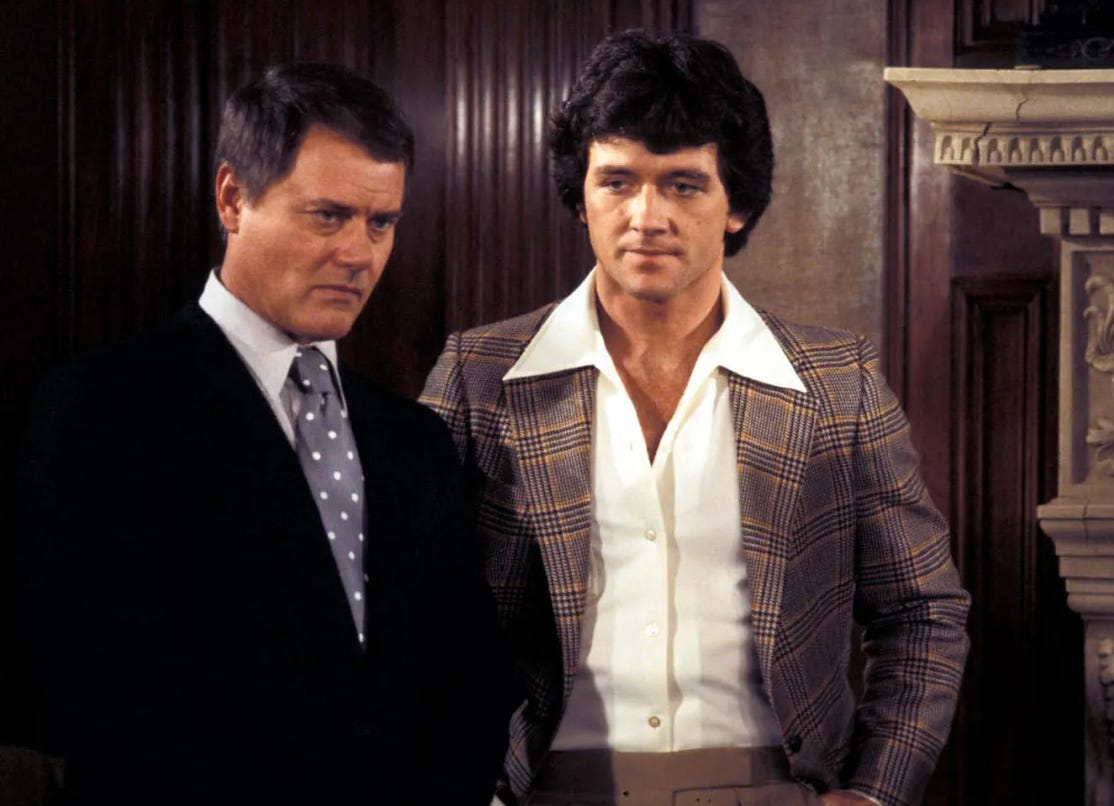
I’m feeling a little nostalgic today. That happens to me a lot lately—a consequence, I suppose, of growing old. But it’s compounded by the fact that Sharon and Josh left for the States yesterday and will be away for a fortnight. I’ve only got Humphrey and Joe to talk to, and their responses aren’t always scintillating—enthusiastic though they may be. So, my mind wanders, inevitably back to the years of my youth.
The other day I heard someone mention, probably on Substack, that they couldn’t believe that the Seventies ended 46 years ago. I have the same problem – the decade still seems recent. I started it as a boy just getting interested in girls, adventures and sex, and I ended it a young man still interested in those things but burdened by a heavy backpack full of responsibility. Forty-six years ago today I was preparing to move to Scotland to begin a Ph.D. at the University of Edinburgh. I said goodbye to my mother who could not hold back her tears. She had emigrated from Holland to the United States thirty years earlier. ‘I’ll be back Mom’, I promised. ‘That’s what I told my mother too”, she replied.
The Seventies was my decade. I remember Carole King, James Taylor, Joni Mitchell, surfing big waves at La Jolla, my first kiss, losing my virginity, passing joints, and so many other wonderful things. All that joy obscured a lot of terrible violence. True to the spirit of the ‘me’ decade, most of us retreated into the best worlds we could construct. We knew something of Jonestown, Vietnam, Palestine and Belfast, but the bloodletting in the Philippines, Chile, Zaire, Uganda and Bangladesh hardly entered our consciousness. The truth about Cambodia emerged only after the skulls were stacked away. Even today, ignorance remains endemic. How many people are aware that 8,000 acts of terrorist violence occurred in Italy during the 1970s?
In 2010, I published a book called The Seventies Unplugged, a sequel to my Sixties Unplugged. Writing about the Sixties was always a bit of a chore. Writing about the Seventies, in contrast, was sheer joy, probably because I remembered most of what happened, even if only vaguely. Yes, there were rude awakenings, but for the most part I loved taking a long hike down memory lane. When the task of writing came to an end, I had to find something meaningful to say as an epitaph on the decade. Feeling nostalgic today, I re-read that epitaph this morning and decided to reprise it here, partly to satisfy my hunger for memories, but also – perhaps – to spark a discussion about how we should remember that weird decade.
The favourite pronoun of the Sixties generation was ‘we’, as in ‘We can change the world.’ In the 1970s, that same generation favoured the pronoun ‘they’, as in ‘they killed the revolution’ or ‘I just knew they would fuck it all up.’ ‘They’ remained conveniently undefined, an omnibus enemy. In the preferred mythology, the Sixties was something the people made happen, the Seventies something that happened to the people.
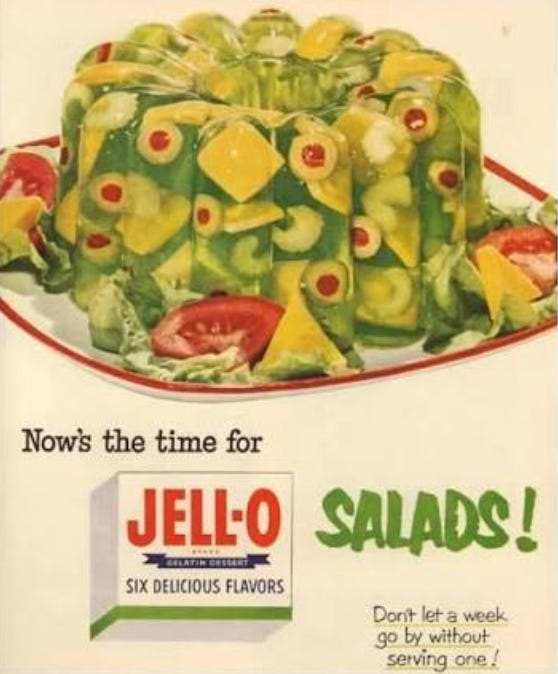
The tendency to dismiss the Seventies as an alien force, authoritarian conspiracy or even black hole arises out of the desire to venerate the Sixties, to preserve it as a time when change seemed possible and hope transcendent. The Heavenly Decade is seen as ‘natural’, typified by flowers, soulful music, naked bodies, lots of lentils, and the emphasis upon ‘free’. The Polyester Decade, on the other hand, is artificial and contrived—man-made fabrics, processed music, authoritarian rule, the tyranny of Jello, and technology out of control. The greater the contrast, the more beautiful the Sixties becomes.
Time, however, doesn’t leap. Every decade is the evolutionary product of the era that precedes it; the present is child of the past. And, while it might be comforting to talk in terms of ‘they’, it is delusion to dismiss an ethos as conspiracy—the product of a cruel ‘other’. Hard as it might be to accept, the vast majority wanted the Sixties over.
According to the social commentator Kenneth Keniston, in the Seventies, frustrated radicals came painfully to a realisation that ‘a great many young people … are primarily motivated by a desire to take part in the American system, rather than to change it’. That rude awakening was not confined to the United States, as the failure of the Angry Brigade, the Beider-Meinhof Group and the Red Army Fraction demonstrated. In this sense, the demise of rebellion might simply have been the inevitable consequence of a generation’s eventual maturity. Baby boomers like me were growing up.
During the course of my research on the Seventies, violence emerged as the predominant theme. That, too, seems like stark contrast to the decade of peace and love. Yet we so often fail to realise that in the Sixties ‘peace and love’ was more demand than defining feature. The slogan is best seen as a pained lament to a time of hate and war. Hack away the flowers and the violence of the Sixties is starkly revealed. The barbarity of the Seventies was, in other words, the continuation of a well-established trend. Same old, same old.
The violence of those times obscures another dominant theme of the 1970s, that of family. Terror and uncertainty inspired an entirely understandable turn inward, toward the home. In that sense, the ‘me’ of the ‘me decade’ was an act of self-defence, an attempt to turn away from horror and focus on things small and controllable. Leaving aside her bizarre methods, like wrapping herself in cling film to titillate her husband, there’s no denying the fact that the conservative sex guru Marabel Morgan was trying to create a better family.
The emphasis upon kith and kin was not, however, exclusively conservative, nor did those on the right alone feel the pull. Battered by the struggles of the Sixties, the radical activist Tom Hayden realised in late 1969 that he desperately wanted a home. Linda Leclair, who created a controversy at Barnard College when she insisted on living with her boyfriend, didn’t want a husband in the conventional sense, but she did want a family. In truth, the same desire motivated skinheads, though their family was more a like a tribe. Likewise, Jonestown was an attempt to escape the horrors of the world and create an extended family. The dreadful ending to that story should not obscure the fact that the community was built by lost souls desperate for a loving person to call ‘Dad’.
Even science got in on the act. The greatest scientific breakthrough of the Seventies was, arguably, the test tube baby, an attempt to give the childless an opportunity to make families of their own. The one glaring mistake of the Christian Right was its kneejerk attempt to apply rigid moral doctrine to a development so clearly pro-family.
Around the world, family was seen as the most dependable and secure fortress against evil and uncertainty. While governments certainly encouraged that retreat into the home, it was in truth voluntary. The baby boomers were now middle aged and had families of their own. As the Weatherman Billy Ayers once confessed: being parents ‘gave us something to think about besides our fucked-up selves’.
The right rode the family wave with impressive dexterity. Phyllis Schlafly and Jerry Fallwell cleverly hijacked a desire and turned it into a movement—family values. They managed, cynically but brilliantly, to establish the maxim that protection of the family was synonymous with morality and therefore conservatism. It was not that the left denigrated the family—by no means. Unfortunately, however, many left wing causes, including gay rights, feminism and sexual liberation, could be presented as a threat to the family, as the beauty queen turned bigot Anita Bryant demonstrated. Nor did it help that a few prominent Sixties radicals had once urged the young to kill their parents and smash monogamy. The Left had difficulty digging itself out of that hole. They started the game of ‘Happy Families’ five cards down.
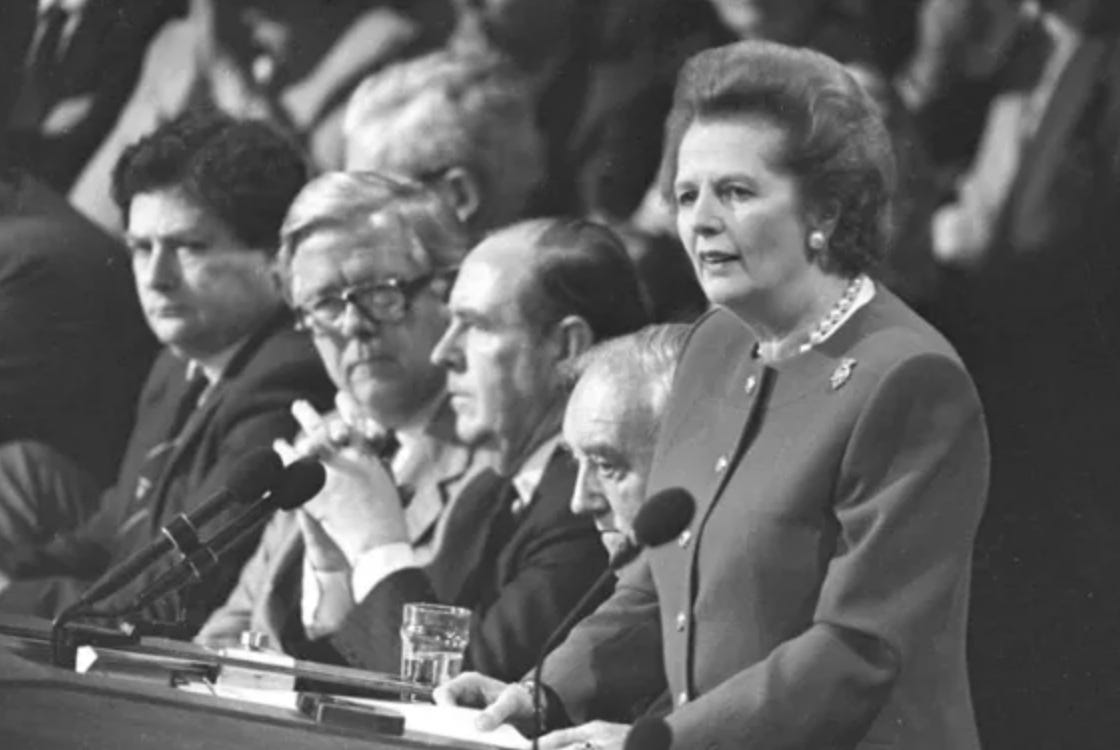
Ronald Reagan and Margaret Thatcher turned the pro-family movement into a machine for winning elections. ‘We must mobilize every asset we have—spiritual, moral, educational, economic and military—in a crusade for national renewal’, Reagan proclaimed early in his presidency. ‘We must restore to their place of honor the bedrock values handed down by families to serve as society’s compass.’
Thatcher presented the family as a fortress, a battered but still formidable institution evoking the sublime values of the past and offering the best hope for the future. While Reagan’s image of the family was cosy and warm, hers was stern and disciplined—the embodiment of her disciplinarian father Alderman Roberts. ‘We are reaping what was sown in the Sixties’, she repeatedly argued during her 1979 election campaign. ‘Fashionable theories and permissive claptrap set the scene for a society in which old values of discipline and restraint were denigrated’. Social welfare, she argued, ‘undercut the family unit’. She built a formidable populist movement by convincing the British electorate that the simple verities of the home provided the perfect philosophy for the world.
In early 1981, the BBC’s Not the Nine O’Clock News included a satirical skit in which the cast (Pamela Stevenson, Griff Rhys Jones, Mel Smith and Rowan Atkinson) sang around a campfire dressed like cowboys. Every line of the song began ‘I believe’ and every belief was preposterous. (‘I believe Nixon is not a crook.’ ‘I believe JR really loves Sue Ellen.’ ‘I believe the Ayatollah tells a good knock-knock joke.’) The last line was delivered with cruel irony: ‘But I can’t believe that Ronald Reagan is president.’
To many observers, the Reagan presidency seemed proof that America had gone mad. In retrospect, however, his election seems entirely logical—the plausible outcome of the 1970s, and as such emblematic of popular reaction to the previous two decades. Reagan had already established himself as the spokesperson for the conservative counter-revolution that had emerged from the 1960s, one which fed off the excesses of that decade. He then drew enormous political capital out of the domestic and international problems of the Seventies—the ‘decline’ of the family, the drug problem, the oil crisis, humiliation in Iran, the Salt II ‘sell-out’, Nicaragua and Afghanistan.
The journalist Bill Moyers would later remark, ‘we didn’t elect this guy because he knew how many barrels of oil are in Alaska. We elected him because we want to feel good’. The power of the Reagan-Thatcher revolution arose from the desire of so many people to see the new leaders as their salvation. Thatcher promised ‘harmony, truth, faith and hope’, Reagan a ‘new American Revolution’. ‘We have every right to dream heroic dreams, he proclaimed during his Inaugural Address on 20 January 1981. As he later told Congress, ‘All we need to begin with is a dream that we can do better than before, all we need to have is faith, and that dream will come true’. Thatcher’s dreams were embedded in the past—a return to ‘Victorian values’.
Reagan and Thatcher dominated the 1980s and, in consequence, have monopolised analysis of the period. Their ascendancy has encouraged careless assumption, namely that their radicalism was the inevitable response to Sixties excesses and Seventies turbulence. Or, as Thatcher so frequently proclaimed, ‘there is no alternative’. The experience elsewhere, however, demonstrates otherwise. In Canada, France, Australia and especially in Spain during the 1980s necessary adjustments were made without the noise and strife evident in Britain and America. Strength did not need to be quite so overt and oppressive.
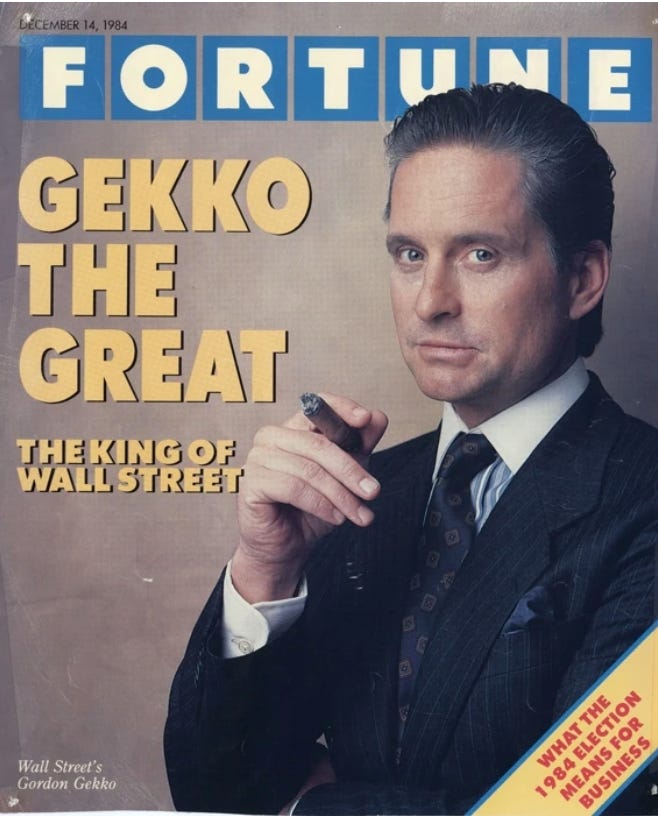
Yet while the approach in those countries was different, the result was fundamentally the same. The Sixties and Seventies were everywhere put to bed. Left wing radicalism was vanquished, socialism neutered and the ascendancy of wealth restored. Money could suddenly be discussed without guilt or embarrassment. The new hero was Gordon Gekko, the amoral financier in Wall Street, (played by Michael Douglas), a man who didn’t even try to camouflage his greed with ersatz moral intent.
Human beings are constantly inspired by belief in renewal, a belief that is most powerful at the end of a decade. Thus, New Year’s Eve, 1979, witnessed a widespread sense of relief that a horrible era was over. Popular will demanded that the Eighties would be different. Ray Bollig, a reveller in Times Square, confessed that he had come into the city to say goodbye to the ‘depressing 1970s’: ‘No more oil crisis, no more Irans—the 70s are dead!’ That, of course, seems cruelly ironic today. The passage of time would reveal that the ugliness of the 1970s could not so easily be willed away. The tone of the new decade was different, but its underlying nature was not. There was no expiry date on the problems the Seventies had revealed. Nor could the honeyed words of Reagan make them disappear. While Americans struggled through a long, dark night of the soul, the president reassured them that it was in fact ‘Morning in America’.
Perhaps, then, the Seventies is despised because of its dismal familiarity. The Sixties, in contrast, is worshipped because the myth of change predominates, effectively camouflaging the ugliness of those times. The difference appears stark: the ‘dressed up’ version of the heavenly decade offers a glorious alternative to our constraining present. The Seventies, on the other hand, seems terrible because reality predominates, we see the decade for what it was. The violence, thievery, mendacity and cynicism are painfully familiar, given the world we live in now. While the Sixties seems like our innocent and hopeful past, the Seventies looks depressingly like our present—and probably our future.
I write because I love the harmony of words. But it’s also my main source of income. So, if you enjoyed this, consider becoming a paid subscriber, or you can …
I've always said that Reagan got elected by telling Americans the lies we like to believe of ourselves - that we're the best, the most, the superlative of your choice, in everything. A fine acting job, I'd say.
I need to read this one again, but it looks like there are nuggets of hope in here for our present age. Helps me to think that what comes after this might be different. 🤞