
George and Martha
It's love, Jim, but not as we know it ...

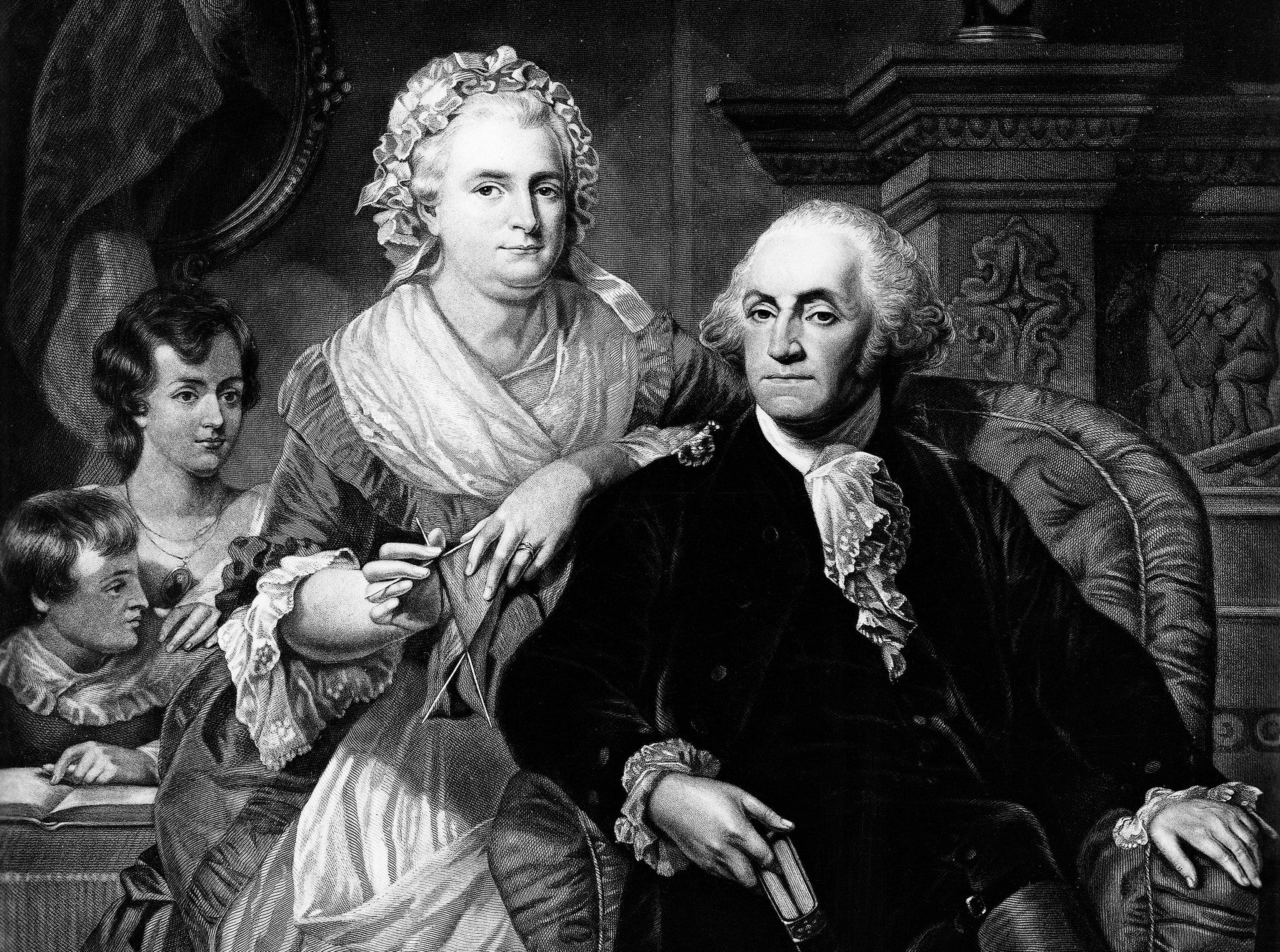
It's the 4th of July, so here's a little story of revolution. Happy birthday America.
George Washington was as romantic as a honeymoon in Chernobyl. Love and passion were stifled; he was guided not by a restlessly beating heart but by a cold, pragmatic brain. ‘Do not … in your contemplation of the marriage state, look for perfect felicity’, he once advised a relative. The ideal marriage partner should possess instead ‘good sense – good dispositions – and the means of supporting you in the way you have been brought up’. That’s the advice he followed when he asked Martha Dandridge Custis to be his wife.
George, who had the emotional depth of a toaster, does not fit the role of romantic hero. There wasn’t much raw passion at the dawn’s early light. ‘I retain an unalterable affection for you’, he once told Martha. That seems the limit of his sweet sentiment, but was apparently enough for her. He might have been impotent, or maybe he simply wasn’t very fond of sex.
In Martha, George found what he called ‘an agreeable Consort for Life’. Marriage was ‘the foundation of happiness’, not its wellspring. For him, the main purpose of matrimony was to provide the stability upon which ambition could thrive. That was the advantage of Martha. She was a sturdy, stable woman who would not make emotional demands. She was also filthy rich.
In colonial Virginia, wealth was measured in the number of slaves a person possessed. When Martha married George, she brought to the partnership 126 slaves of her own, plus another 285 that had been bequeathed to her infant son Jacky when her first husband, the mega-wealthy Daniel Custis, died. Washington was not exactly poor, but his slave force was miniscule in comparison.
He was a reluctant slave owner, though his qualms should not be assumed to mean that he believed in racial equality. He found the spectacle of public auctions repugnant and once confessed that ‘I wish to get quit of Negroes’. His desire to switch to a system of waged labour was, however, never more than a pipe dream, especially given the importance Martha assigned to slaves as a measure of status. With ownership went contempt; she advised her niece not to waste sentiment on slaves: ‘The blacks are so bad in their nature that they have not the least gratitude for the kindness that may be showed to them.’
Despite their differences on the issue of slavery, Martha was clearly devoted to George. She was, it seems, smitten with her big sturdy general. There’s little hard evidence for this, however, since Martha chose to burn their private correspondence on George’s death. One wonders why. Authors in search of romance have therefore struggled to construct a grand love story.
Martha was subservient and dutiful – the typical wife of a commander. Her job, as one contemporary noted, was to ‘soften the hours of private life … sweeten the cares of the Hero and smooth the Rugged scenes of War’. Thus, during the Revolutionary War, she endured arduous journeys from Mount Vernon to battlegrounds in the north in order to spend winters with George.
While American troops suffered indescribable misery at their winter encampments (over 2,500 men died from frostbite, disease and starvation during the winter of 1777-78), Washington and his wife lived in luxury. When, in 1776, a British cargo ship carrying citrus fruit was captured near Boston, Washington’s staff immediately confiscated the cargo for their commander. ‘The general will want … the sweetmeats and pickles that are on board, as his lady will be here today, or tomorrow’, his aide instructed. Orders were also placed for fish, meat and poultry, in addition to ‘ten baskets of oysters’, of which Martha was especially fond. (Maybe she thought them an aphrodisiac.) At the end of the war, George billed Congress £1,064 1s 0d for Martha’s travel expenses.
The luxuries enjoyed by George and Martha might seem to contradict the egalitarian ethos of the new nation, but, in truth, most Americans expected their commander to live well. Martha duly complied with that expectation. Fashionable dresses, expensive jewellery, fine European furniture, and expensive wines were badges of rank in this society. Martha was a material girl.
She didn’t protest when people started calling her ‘Lady Washington’ after George was appointed commander of the revolutionary forces. When he became president, she took a prominent role in choreographing pageantry befitting his new position, aiming for a ‘style which … upheld the dignity of the country’. Disgruntled democrats understandably wondered why they had fought so hard to rid themselves of one royal family, only to be saddled with another.
The American Revolution was crowded with men of enormous character. In comparison to the genius of Thomas Jefferson, the compassion of John Adams or the emotional intensity of Alexander Hamilton, Washington seems rather dull. Americans have always found him a cold man difficult to love. In truth, his most remarkable quality was his ability to endure.
Endurance necessitated the construction of a sturdy barrier to emotion. Thus, he avoided mourning the dead, be they his soldiers or his stepson Jacky. ‘It would only be a renewal of sorrow by recalling afresh to [the] remembrance things which had better be forgotten’, he reflected. Martha, a rock of stability in his life, buttressed his endurance. Fellow officers remarked how the otherwise grumpy George was always much more agreeable when Martha was around.
George and Martha never produced a child of their own. The internet is full of stories about George's failings in the bedchamber. There's speculation that he was impotent or even, perhaps, gay. I'm not going to go there, except to say that he was almost certainly infertile. They seem to have genuinely loved each other, even if the relationship did not set souls afire. That's ok.
On Martha’s death in 1802, a journalist wrote, ‘She was the worthy partner of the worthiest of men’. That seems a suitably bland appraisal. He endured; she served. He expected; she delivered. Theirs was a marriage typical of its time and, sadly, a type that endures to this day. It spanned the revolution, but it was hardly revolutionary.
I write because I love the harmony of words. But it’s also my main source of income. So, if you enjoyed this, consider becoming a paid subscriber, or you can …
Thanks Denise. When writing a biography of Douglas Haig, I found records of how well he ate during the Great War and how he would send army supplies of food to his wife at home so she wouldn't have to suffer the shortages. But I also found, as with Washington, that people expected him to enjoy the privileges of his position.
Refreshing to have a different view of auld George, more the gold-digging suitor than the toga-wrapped general. I recall reading long ago of the the records that have been preserved of the family's Muddy Hole Farm. Washington had written in his own hand that he separated the male and female plants in his hemp crop, presumably for some commercial advantage. But it has been speculated also that this action would have boosted THC production in the female plants, making their leaves more potent when smoked. Perhaps George's mood was lightened during Martha's visits due to her replenishing the Father of the Country's stash of weed?