
It Can't Happen Here
The British like to think that they rejected fascism because, well, they're British

Some years back, I was doing research for a biography of Sir Archibald Sinclair, the MP for Caithness and Sutherland, and leader of the Liberal Party from 1935-45. As a politician of prominence, he received hundreds of letters every week from people keen to offer their advice about the best way forward for Britain. Reading through these letters, I was astonished at how many came from right wing nutters who, by any standard, qualified as fascists. I had no idea that there were so many fascists in ultra-moderate Britain.
Some of these letters were pretty harmless, such as those of A. G. Pape, who combined a mild corporatist philosophy with an evangelical vegetarianism and a pathological hatred of the automobile. Much more sinister was the correspondence from Henry Hamilton Beamish, founder of the extreme anti-Semitic organisation The Britons. He advocated the compulsory expulsion of all British Jews to Madagascar and the denial of citizenship rights to any English person who married a Jew.
Whenever I get correspondence from an outright fascist, I invariably reply: ‘I think you should know that a lunatic has been writing to me using your name.’ Sinclair, on the other hand, answered his correspondents with a great deal more politeness than I’ve been able to manage, or than they deserved. That seemed strange to me, but then I realised that the inter-war period was much more tolerant of political extremism than most of us are today. Men like Sinclair believed sincerely in the ideal of political liberty, even if in practice it meant that some pretty vile people were allowed a voice.
Things are different now, for the very simple reason that our perspective on fascism and anti-Semitism has changed radically since the 1930s. The Second World War and the Holocaust rendered most of us justifiably intolerant of fascism even in its mildest forms. We’re aware of how a diffuse desire to restore German pride was manipulated by Hitler and his cronies, eventually resulting in a monster state. Until recently, that was a sufficiently sturdy bulwark against the return of fascism.
The fact that we know how this terrible story ends makes it difficult for us to analyse what happened at the beginning. Should we express horror that men like Beamish, Oswald Mosley, JFC Fuller, William Joyce, Admiral Barry Domvile and the like were able to walk the streets of Britain, peddling their vile philosophy? Or should we congratulate ourselves that liberalism was maintained and that the British state proved resilient to the fascist contagion? In historical terms, just how important are the British fascists?
According to the historian Martin Pugh, they’re hugely important. In his book Hurrah for the Blackshirts, published in 2013, he argues that British fascists were much more influential than is often appreciated and that the ‘victory’ over them was a close-run thing. Since he’s not simply a muckraking amateur keen to make money from a controversial topic, we have to take what he writes seriously. Pugh is one of the most well respected, diligent and honest historians of Britain. His book deserves to be read, even if his conclusions are sometimes disturbing.
The standard line on fascism in Britain runs as follows: it was not just a failure, but an inevitable failure. The British are simply too sensible and stable — too stubbornly moderate — ever to be swayed by such a radical philosophy. They have too much faith in democracy and the rule of law ever to find the corporatism, anti-liberalism, intolerance and thuggery of fascism appealing. For most of the inter-war period fascists were tolerated for the very simple reasons that they were not a threat and because civil liberties were deemed essential to maintain. When, late in the 1930s, the threat of fascism grew more serious, the culprits were dealt with through efficient policing and impeccable justice. A few of them went to prison.
That’s a wonderfully comforting story and one which, for years, has been the source of enormous national pride. The British are proud of the fact that, at a time when others in Europe were going mad, they managed to maintain their equanimity. Pugh, however, doesn’t buy this story. He feels that, while fascists were conspicuously unsuccessful at gaining power, they did manage to infiltrate the political establishment to an extent seldom appreciated. They might not have had power, but they did have influence.
Part of the reason for this failure to understand the true level of influence that fascists had back then is because they managed to infiltrate institutions which are notoriously secretive and above criticism. London clubland, the judiciary, the Conservative Party, the police force, the Anglican Church, the military and the Royal Family all, in their own way, offered sanctuary to individual fascists and took seriously their ideas. It would not, for instance, be stretching credibility to label King Edward VIII a fascist, which makes his inconvenient affection for Wallis Simpson something of a blessing, given that it forced him to abdicate after just eleven months on the throne.
After the war, when any association with fascism became an embarrassment, there was a concerted effort to cover up just how compromised hallowed British institutions were during the 1930s. One of Pugh’s more frightening revelations was how often his attempt to tell the full story was thwarted by the fact that important documents have been destroyed or remain inaccessible. Clearly, there is still cause for embarrassment.
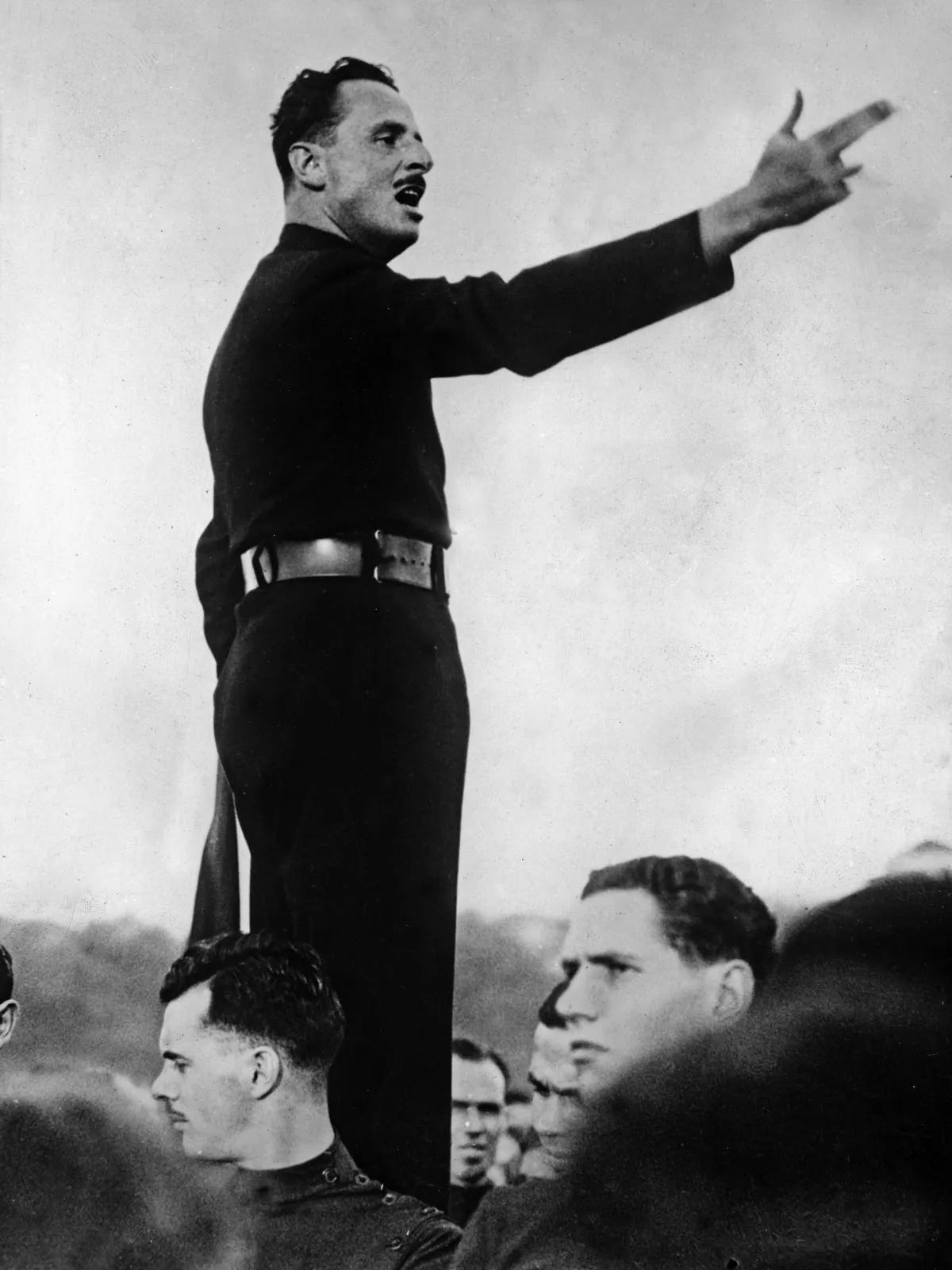
An example of how fascists were tolerated by the establishment can be seen in the case of Major General JFC Fuller. The ferociously intelligent soldier was an early advocate of mechanised warfare and wrote scathing critiques of British command in the Great War. For that crime, he was placed on the retirement list at the age of 55. In part out of disillusionment, he turned to Oswald Mosley’s British Union of Fascists, stood as a BUF parliamentary candidate and devoted himself to anti-Semitism. None of this was, however, sufficient to disqualify him from being offered the post of Deputy Chief of the Imperial General Staff when war broke out in 1939. The appointment was overruled by the War Cabinet, but whether on grounds that he was a fascist or simply an annoyance to hidebound generals is not entirely clear.
But what, precisely, is fascism? It’s a spectrum disorder of enormous breadth and depth, which makes precise identification of fascists difficult. Two individuals, both labelled fascists, might have very little in common. The label sometimes implies anti-Semitism, but not always. It sometimes suggests a fondness for violence, but not always. This amorphous nature renders it difficult to judge the strength and influence of fascist groups in a country like Britain.
Pugh sees fascism as a generational revolt by those who had experienced directly the hardships of the Great War and felt betrayed because those responsible for the war’s outbreak did not suffer the consequences. Most of them remained in power, impervious to their failure. He also argues that fascism was ‘a reaction to the perceived crisis facing liberal democracy at the end of the First World War and to its inability to handle the material hardship caused by the collapse of the nineteenth century economy’.
The problem with this definition is that it’s as roomy as a London omnibus. A lot of people in Britain back then felt a generational alienation; a lot were disenchanted with liberal democracy. Should they all be labelled fascists? No. Pugh exemplifies a problem encountered by every serious historian of fascism – the wider the definition of the disease, the more serious the infection seems. That same problem is evident today, when every right wing radical is carelessly labelled a fascist.
The nations which went fascist in the 1930s had one common, distinguishing feature, namely the fact that fascist parties, by whatever means, managed to take control of government. That didn’t happen in Britain. In this country, there was infiltration, but nothing close to a takeover.
One reason for the failure of fascism in Britain is because of the deeply ingrained two party system. The stubborn refusal of Labour and the Conservatives to introduce proportional representation has always rendered it essentially impossible for fringe parties on the right or left to gain any traction. The first-past-the-post system has meant that the Tories, and sometimes Labour, have gained huge majorities in Parliament despite attracting less than fifty percent of the popular vote. In the 2024 election, Reform got 5.8 percent of the votes nationally but ended up with only one MP. In contrast, the Scottish National Party, because its support is concentrated in Scotland, won 48 seats in Parliament, despite winning just 0.8 percent of the national vote. The system is undemocratic, but, until recently, it has successfully kept extremist parties like Reform at bay.
The safety provided by Britain’s undemocratic method of voting might, however, be a thing of the past. It was always dependent on the two parties – Labour and the Conservatives – remaining strong, or at least strong enough to gain the lion’s share of the votes and therefore the seats in Parliament. At present, that’s not the case. In opinion polls, the Tories currently sit at around 19 percent, which would give them maybe forty seats in Parliament, depending on how that support is distributed across the country. That would be the worst result in the party’s history. Labour currently attracts about 22 percent, the Greens and the Lib Dems around 12 percent. Leading the pack is Reform, at 30 percent. In other words, a far right party which was once safely consigned to the fringe is now on course to be the biggest party in Parliament when the next general election takes place sometime in 2029. The dam that once protected Britain from extremism seems to have collapsed.
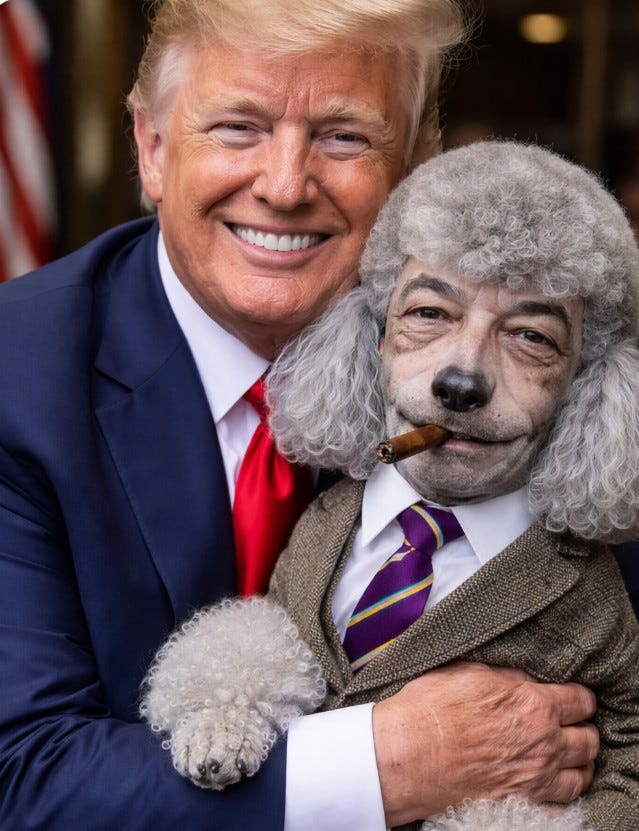
Reform is the plaything of Nigel Farage, a monumentally stupid man who, rather like Donald Trump, is a skilled populist able to fire up the hatreds of ordinary Britons. His crowning achievement was to take Britain out of the European Union, a decision which has proved disastrous for the British economy. Despite that colossal mistake, he’s still riding high. He’s a huge fan of Trump, and thinks that he can make Britain great again by copying his hero’s policies. Close the borders. Deport illegal immigrants. Privatise the NHS. Abolish all the green energy reforms. Etc., etc. If Trump can safely be labelled a fascist, then so, too, can Farage. If Trump seems a tool of Putin, then so, too, does Farage.

Speaking of fascists, sharp-eyed viewers will have noticed that a certain man named Mosley is currently enjoying a lot of air time on British TV. His name is Louis Mosley and the surname is no coincidence – he’s the grandson of Oswald Mosley, the leader of the British Union of Fascists who was imprisoned when the party was forcibly disbanded in 1940. Mosley senior, though disgraced by his association with fascism, after the war continued to promote fascist causes like repatriating black immigrants and denying the Holocaust. His grandson Louis is considerably less outspoken about his politics, but he is the UK head of Palantir, the company founded in 2003 by Peter Thiel, the mentor of J. D. Vance. Thiel is arguably the intellectual inspiration behind many of the more controversial policies of Trump’s second term. Does Louis Mosley mirror Thiel’s politics? Probably. It’s difficult to imagine a control freak like Thiel giving the UK arm of Palantir to a doe-eyed liberal. Louis’s fondness for wearing black shirts when appearing on television might not be politically significant, though it is striking.
I used to take solace in the solidity of British politics. Even though the results of elections didn’t always please me, there was an underlying rationality to the system. The hysteria that produced Trump in America seemed unlikely to happen here. But over the last few years, we’ve had our share of madness. Boris Johnson was an idiot and a dangerous narcissist. Liz Truss was a lunatic. Reform has gained strength because former Tories have switched sides, either for doctrinal or opportunistic reasons. The rats who have jumped ship include the former cabinet ministers Nadhim Zahawi and Suella Braverman, whose ethnicity most Reform voters find distasteful. That doesn’t make sense. Braverman recently announced that multiculturalism had failed in Britain, which is an interesting assertion given that she’s of Indian descent, her father is a Catholic from Kenya and her mother a Hindu from Mauritius. She was named after Sue-Ellen Ewing from the American television show Dallas, of which her mother was a huge fan. But, yeah, multiculturalism has failed.
The current popularity of Reform undermines that comforting assumption that the British are collectively too solid and sensible ever to fall for a fascist. Farage, contrary to every reasonable expectation, has successfully mined a motherlode of bigotry and hatred which was lurking under the surface of British liberal tolerance. He’s hitched his star to Trump and much therefore depends on how his hero fares over the coming months. If, as seems likely, Trump’s decline is terminal, Farage might become a casualty of MAGA’s demise. If that happens, it’s difficult to imagine the British deciding to opt for a political movement which has already brought ruin to America. Or is it? Maybe I’m just whistling in the dark. Maybe the British, fed up with being wise and sensible, will decide ‘hey, how about if we give stupid people a chance to govern?’ It happened in America. It could happen here.
I write because I love to put words together in harmony. But it’s also my main source of income. So, if you like what you’ve read, think about becoming a paid subscriber. Or you could (drumroll) …
Thanks for this. Yes, the threat certainly seems worse in Germany, France and even Holland, but I'm still very worried that Farage could actually form a government in 2029. Then again, a lot can happen in three years.
Very interesting summery of the state of the subtile elements working behind the scenes. It is a bit similar here in France where the “Blond Angle of Revanche of the Petite Bourgeois” has groomed quite an unruly bunch off followers who now want to get into some state offices. It’s overall a kind of clientele system. I see Britain far from being near to this. But Germany has very much the same tendencies with its AfD. They both collaborated quite effective in WW II. Here a nce piece I found on Bloombergs TV:
In Full: Palantir UK Head Louis Mosley on AI, Warfare, and the End of American Unipolarity
As global power dynamics shift and artificial intelligence reshapes every domain, Palantir’s UK Head Louis Mosley speaks to Bloomberg's Tom Mackenzie about how defense technology is evolving faster than ever before. From AI-driven targeting to battlefield innovation in Ukraine, Mosley reveals how software and policy are defining the next era of security.
https://www.bloomberg.com/news/videos/2025-11-14/palantir-uk-head-louis-mosley-on-the-future-of-defense-video