
Ping-Pong Diplomacy
How two table tennis players accidentally changed the world

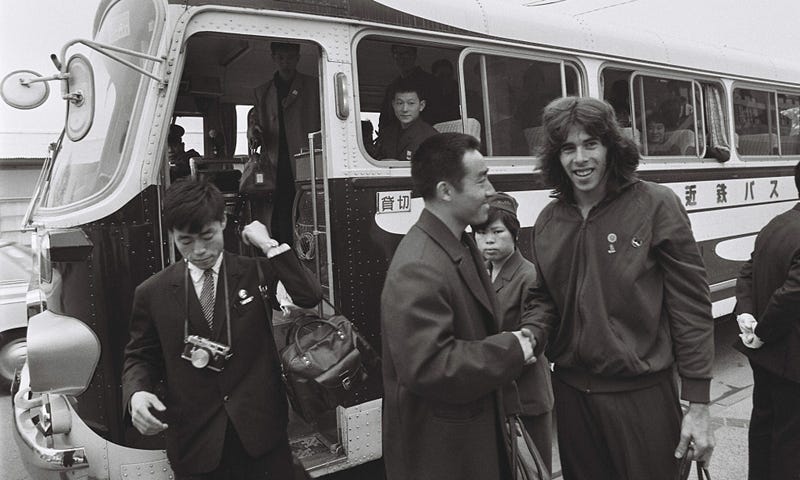
Glenn Cowan was an ordinary American nineteen-year-old—a child of his time who liked rock music, soft drugs and casual sex. His only distinguishing feature was his passion for ping-pong, but that was hardly earth shattering. Then, one day, during a tournament in Japan, Cowan boarded a bus and changed the world.
Cowan was part of the American team competing at the table tennis world championships in Nagoya, Japan in 1971. On 4 April, after finishing a practice session, he flagged down a tournament bus. To his surprise, the bus was occupied exclusively by Chinese players, coaches and officials, all flabbergasted by his sudden invasion. Cowan, who fancied himself a revolutionary, met their stares with aplomb: ‘I know all this … my hat, my hair, my clothes look funny to you. But there are many, many people who look like me and who think like me. We, too, have known oppression in our country and we are fighting against it. But just wait. Soon we will be in control because the people on top are getting more and more out of touch.’ A tremor rippled through the bus as a translator struggled with the strange words.
Since 1949, there had been an embargo on civility between the Chinese and the Americans. The US pretended that the People’s Republic didn’t exist, stubbornly maintaining that the exiled government in Taiwan was the true China. The Chinese, in turn, considered America the counter-revolutionary running dog—the epitome of capitalist evil. Then came Cowan, like the proverbial bull in a, well, china shop.
For the previous six years, China had refused to attend the world championships because, during the Cultural Revolution, international sporting competitions were derided as ‘sprouts of revisionism’. By their mere presence, this team demonstrated that a semblance of normality was returning, but every player understood that the government still held a short leash. The decision to attend had been taken only after acrimonious meetings involving the Foreign Ministry and the State Commission for Physical Culture, chaired by Premier Zhou Enlai.
The official aim was ‘friendship first, competition second’, but friendliness was not supposed to be extended to Americans. ‘During the contest, if we meet with officials of the US delegation’, official guidelines advised, ‘we do not take the initiative to talk or exchange greetings. If we compete with the US team, we do not exchange team flags’. Mao expressed the policy more graphically: ‘Regard a Ping-Pong ball as the head of your capitalist enemy. Hit it with your socialist bat, and you have won the point for the fatherland.’
That explains the consternation over Cowan. ‘We were still in the Cultural Revolution’, Zhuang Zedong, the former world champion, recalls. ‘Any exchange with Westerners would be [attacked] with vicious labels, such as “treason” or “spy”. So when this American guy got on the bus, nobody dared talk to him.’ Zhuang, however, felt torn between politeness and policy. Confucianism, burned into the neurons of every Chinese person, taught respect and harmony. ‘I was thinking, China has been well-known as a country of hospitality for more than 5,000 years. If everyone ignores that American athlete, it would be ironic.’
As the star of the Chinese team, Zhuang felt the need to set an example. ‘I looked at him and thought, he's not involved in issuing policy. He's just an athlete, an ordinary person.’ Much to the dismay of his teammates, Zhuang made his way to the front of the bus. A fellow player grabbed his sleeve, and the team manager blocked his way. ‘Take it easy’, Zhuang retorted. ‘As head of the delegation you have many concerns, but I am just a player.’ He reached Cowan and, through an interpreter, welcomed him. ‘Even now’, Zhuang recalled many years later, ‘I can't forget the naive smile on his face.’
Zhuang wanted to give Cowan something, but most of the official gifts he had seemed too insignificant. ‘Since he is an American athlete, I thought I should give him a bigger present.’ He settled upon a silk embroidery of a Yellow Mountain scene, made in Hangzhou. The American, clearly taken aback by Zhuang’s generosity, searched in his own bag, but could find only a comb. ‘Jesus Christ, I can’t give you a comb. I wish I could give you something, but I can’t.’ Cowan hesitated and then, with a wry smile, put the comb back. The interpreter, clearly bemused, asked if Cowan knew who had addressed him. ‘Yes, the world champion Zhuang Zedong’, he replied. ‘And I hope your team does well.’
As the bus arrived at the main competition venue, photographers loitered, hoping for shots of those rare Chinese. Much to their surprise, Zhuang and Cowan disembarked together, wearing wide grins. The immense symbolism of that moment was lost on no one. Photographers pushed forward and reporters fired questions, but Zhuang was quickly hustled away and given a dressing down by Chinese officials. ‘Chairman Mao told us we should differentiate between American policymakers and common people’, he retorted. ‘What was wrong with my action?’
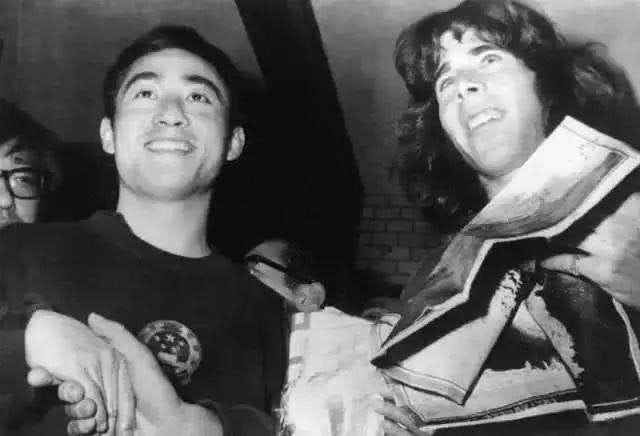
The following day, Cowan found the perfect gift for his new friend. He returned to the arena, located Zhuang and, sensing a dramatic moment, pulled him in front of some television cameras. He presented him with a T-shirt in which an image blending the American flag and peace symbol was printed below the message ‘LET IT BE’. Cowan then pulled from his bag the silk brocade picture, so that photographers got what looked like a spontaneous exchange of gifts. That image suggested that something very big was happening in Nagoya. ‘Mr. Cowan, would you like to visit China?’, a journalist shouted. He hesitated, then replied: ‘Of course’.
Meanwhile, officials back in Beijing frantically forged a response. A hastily convened meeting between the Foreign Ministry and the State Commission for Physical Culture drew up a report advising that the time was not yet ripe for an American team to visit China. That report was approved by Zhou, then sent to Mao, who took two days to concur. The Chinese were not, in principle, opposed to a visit, but they did not appreciate having their hands forced by politically naive athletes in Japan.
Photos of Zhuang and Cowan first hit the front pages of Japanese newspapers on the morning of the 5th. When the wire services picked up the story, it quickly circled the globe. The photos eventually made their way to Mao, who remarked: 'Zhuang Zedong is not only a good ping-pong player, but also a diplomat. He is quite politically sensitive.’
On the evening of the 6th, after Mao had taken his customary heavy dose of sleeping pills and gone to bed, he had a sudden change of heart about an American visit. He instructed his nurse, Wu Xujun, to order the Foreign Ministry to extend a formal invitation. Pointing to the photo, he told Wu: ‘The friendly Sino-American relationship is definitely the trend. Look, the encounter between Zhuang Zedong and Cowan is so natural. They bear no grudge against each other.’ Wu, however, was under strict instructions not to act upon decisions made after the sleeping pills were administered. Mao nevertheless insisted and forced himself to stay awake while the message was relayed to the Foreign Office.
Keen to appear in control of events, the Foreign Ministry extended an invitation worded so as to cast the Americans as supplicants. ‘Considering that the American team has made the request many times with friendly enthusiasm, it has been approved to invite it, including its leaders, to visit our country.’ The Americans would be allowed to join an already scheduled tour that included teams from Canada, Nigeria and Colombia. As a barbed aside, the message added: ‘If their traveling funds are insufficient, we can subsidize.’
Back in the US, Vice-President Spiro Agnew provided his trademark knee-jerk response, angrily dismissing the invitation as ‘propaganda’. What Agnew didn’t realize was that his boss, Richard Nixon, had been waiting anxiously for an opportunity of this sort. He immediately cabled back to Japan that the invitation must be accepted, and then told Agnew to shut up.
Prior to his election in 1968, Nixon had argued in Foreign Affairs that ‘There is no place on this small planet for a billion of its potentially most able people to live in angry isolation … we simply cannot afford to leave China forever outside the family of nations’. He reiterated that point when he told Time magazine that ‘We must always seek opportunities to talk with [China] … If there is anything I want to do before I die, it is to go to China.’ There were, however, a number of huge obstacles, among them the Vietnam War, the strident anti-communism of Nixon’s own party, and American promises to Taiwan. These obstacles were so significant that, when Nixon raised the possibility with his National Security Adviser Henry Kissinger, the latter concluded: ‘I think he has lost control of his senses’.
Nixon nevertheless remained determined. For him, normalizing relations offered an opportunity to break a logjam in foreign policy. As William Smyser, a senior analyst at the National Security Council, recalls, the administration felt that ‘we were stuck in a rut. We were stuck in a rut in Vietnam … we were stuck in a rut in the negotiations with the Soviet Union … We were also stuck in a rut with the American people, who were discouraged about whether foreign policy could ever produce anything good’. In Nixon’s view, China offered the possibility of an end run—a chance to recast foreign affairs so profoundly that adversaries would be left flailing.
Friendly relations with the Chinese would, it was anticipated, pressure the North Vietnamese to negotiate an end to the war. It would also, more importantly, drive a wedge between China and the Soviet Union, forcing the latter to make concessions, for instance at the Strategic Arms Limitation talks. The idea also harmonised with the recently formulated Nixon Doctrine, which emphasised peaceful co-existence and disengagement in Asia. Since the US no longer felt obliged to roll back Communism in every corner of the world, it no longer made sense to treat China like a pariah.
Nixon had already sent signals to the Chinese that he wanted rapprochement. In October 1970, through a Pakistani intermediary, he indicated a willingness to talk. As a mark of his sincerity, he used the term ‘People’s Republic of China’ for the first time. Nixon realized that no one was better placed to pull off such a gambit. Liberal Democrats had long wanted better relations with China, but were not in a position to act on that desire, since to do so would provoke accusations of being soft on communism. Nixon, in contrast, was singularly well suited to open doors, since his anti-communist credentials were beyond dispute.
The Americans were pushing at an open door. Like Nixon, Mao felt that something bold needed to be done to break the stalemate and allow China her rightful place on the world stage. Among China watchers, a subtle change in attitude toward Nixon was becoming apparent. While official propaganda continued to call him ‘a gangster’ with ‘a blood-dripping butcher's knife’, his conciliatory references to China were duly noted and sometimes reported in the press. On 18 December 1970, Mao told his old friend Edgar Snow that, if Nixon wanted to come to China, he would be welcome. ‘I don't think I'll wrangle with him’, he added, ‘though I'll criticize him’.
There were still huge obstacles. Neither side wanted to appear desperate for the other’s good grace. Each felt the need to appear tough and uncompromising. Negotiations therefore proceded as if through treacle. ‘There had been about a year of back and forth’, Kissinger recalls. ‘China had sent us a specific proposal to come to Beijing, and we were on course to answer favorably.’ The ping-pong incident came at the perfect moment because it opened a door, without cumbersome diplomatic fanfare. It also offered the opportunity to sidestep hardliners at home, who could hardly object to an innocent sporting exchange.
‘We wanted to play it all very low key’, Kissinger reflected. ‘As it turned out, it worked out well for us.’ He eventually concluded that the invitation was an intentional ploy by the Chinese to break the deadlock between the two sides. The invitation to the American table tennis team allowed both sides to pretend that no compromises had been made.
On 10 April, nine players, two spouses and four officials crossed into the PRC. ‘The American team could not have been more representative of the U.S. if the State Department had handpicked it’, John Roderick, the AP China correspondent, recalled. ‘It was what foreigners often thought of Americans: friendly, racially diverse, individualistic’. Suspicion and animosity were put on hold as both sides competed in a game of graciousness.
The American public, for the most part, saw their table tennis team as intrepid explorers of a strange land. A fascination for all things Chinese suddenly developed. For the first time in over 20 years, polls showed a majority in favour of Chinese membership of the United Nations. As for the Chinese, they treated the Americans like friendly extra-terrestrials. ‘We became VIPs from the moment we entered China’, the coach Jack Howard later remarked. ‘Every meal had seven or eight courses with things I never saw before in my life … I think they were trying to kill us with kindness.’
Matches were shown live on television—unusual in China at the time. ‘If we were at a site like The Great Wall … they would all crowd around and look at us like we were from another planet’, Olga Soltesz recalls. The strangest guest of all was Cowan. His match with a middling Chinese player attracted a crowd of 18,000 at Beijing’s Capital Stadium. ‘The Chinese had never seen a person with long hair and hippie ways’, a fellow player recalled. ‘Thousands of people would surround him in the streets. They loved him but were also a little terrified of him’.
In order to make the games competitive the Americans were pitted against good club players, not the national team. They were, nevertheless, no match for their Chinese opponents. Keen not to humiliate, Chinese officials instructed players to go easy on the Americans. ‘I knew they would be unlike any other games I'd ever played’, Zheng Minzhi, one of the Chinese players, recalled. ‘I knew their significance and my responsibilities. I knew I was not only there to play, but more important, to achieve what cannot be achieved through proper diplomatic channels.’
The games ironically mirrored the relationship the Chinese were trying to cultivate with America—one in which they were gracious but still dominant. Chinese self-regard was boosted when American players heaped praise on their country, much to State Department dismay. ‘I like the way the Chinese people are united’, John Tannehill told reporters. ‘In China there is no exploiting class. The workers have power. In the US, the workers are taken advantage of.’ He added that Mao was ‘the greatest moral and intellectual leader in the world today. … he reaches most of the people. His philosophy is beautiful.’ Another player, Judy Bochenski, proclaimed that women’s liberation was far advanced in China because the women ‘all wear trousers, they all have jobs, they all work like the men’. American naïveté was possible because the cruelties of the Cultural Revolution were still carefully hidden away.
‘Never before in history has a sport been used so effectively as a tool of international diplomacy’, Zhou announced. He stage-managed the spectacle perfectly, extracting maximum publicity. The climax came at a reception held at the Great Hall on 14 April. ‘You have opened a new chapter in the relations of the American and Chinese people’, Zhou told his guests. ‘I am confident that this beginning again of our friendship will certainly meet with majority support of our two peoples.’ The only diversion from a carefully prepared script came when Cowan asked Zhou what he thought about hippies. The response was perfectly crafted: ‘Young people ought to try different things. But they should try to find something in common with the great majority—remember that.’ On learning of that exchange, Cowan’s mother wrote to Zhou, thanking him for speaking sense to her son.
A few hours after Zhou’s speech, the Americans relaxed a twenty-year-old trade embargo with China. Confident of America’s good intent, Zhou sent a message to Washington on the 29th explaining that Mao would welcome ‘direct conversations’ with Nixon. The latter was beside himself with joy. 'This is the most important communication that has come to an American president since World War II’, he told Kissinger. On 17 May he formally accepted the Chinese invitation.
‘We were embarking’, Nixon remembered, ‘on a voyage of philosophical discovery as uncertain, and in some ways as perilous, as the voyages of geographical discovery of an earlier time’. Hyperbole aside, that was essentially true. Nixon’s visit to China in February 1972 was more important for the simple fact that it actually occurred than for any agreements made. Both sides wanted a new era to begin. The visit’s significance can be measured by the Soviets’ panicked reaction. ‘The news hit us like a bolt from the blue’, Georgii Arbatov, a senior adviser to Brezhnev, recalled. ‘My colleagues said, "America will be China's ally … When Nixon visits Beijing, anything could happen. All this will make things very difficult for us. Where will it all end?"’ One could argue that it ended with the demise of the Soviet Union in 1991. Rapprochement between China and the US meant that the Soviets were left to carry alone the burden of countering a rampant America. That burden eventually bankrupted her.
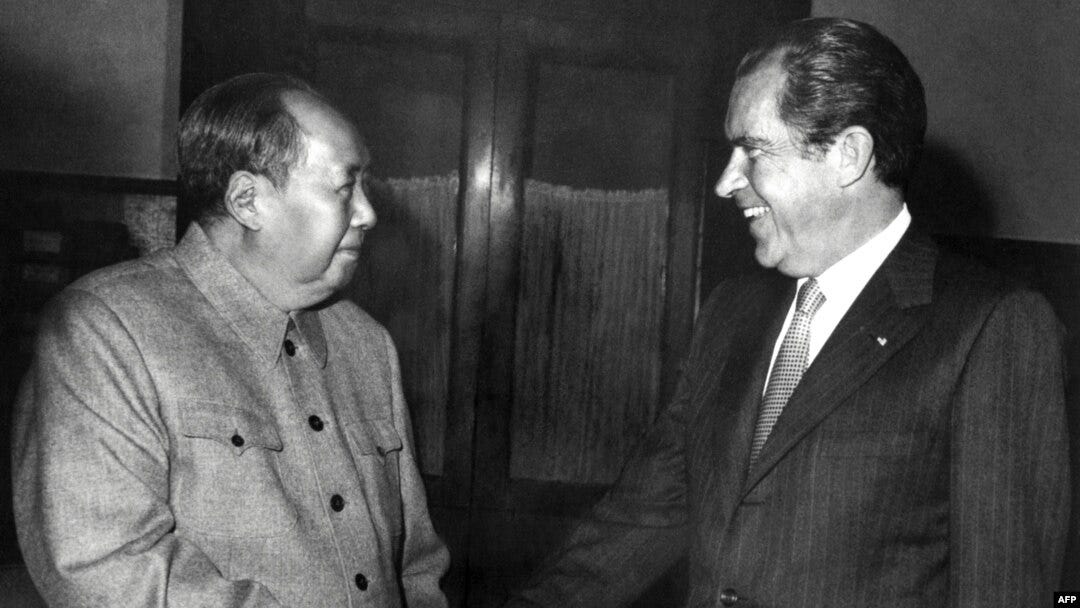
Time magazine called it ‘The ping heard round the world.’ Granted, better relations between China and the US were inevitable. But they were undoubtedly helped along by a fortuitous encounter on a bus. In his memoirs, Kissinger praised the extraordinary proficiency of the Chinese in the game of power politics. Their skill came in making ‘the meticulously planned appear spontaneous’. The perfect example, he feels, was the invitation to the American ping-pong team. ‘Only Mao could have ordered this. And only Zhou could have orchestrated it.’ While that is true to an extent, neither had the power to make Cowan board that bus, or to make Zhang decide to be friendly. Those two men forced open a door that had been jammed for years. As Zhou once said, ‘a ball bounced over the net and the whole world was shocked. The big globe was set in motion by a tiny globe—something inexplicable in physics but not impossible in politics’.
Zhuang’s life reveals in microcosm China’s turbulent history. He spent much of the Cultural Revolution in prison, watching fellow players driven to suicide. Rehabilitation came when Mao decided that table tennis was useful on the world stage. As a reward for his gesture on that bus, he became a hero and was eventually made Minister for Physical Culture and Sport. After Mao’s death, however, he again found himself caught in the crossfire of political rivalry. He went from government minister to street sweeper and was then thrown in jail for wearing a Swiss watch. Driven to despair, he tried to hang himself in 1977. When China returned to her senses in the 1980s, he enjoyed another rehabilitation and restoration of his heroic status. He died a hero in 2013, at the age of 73.
Today, the collectivist Chinese celebrate the individual heroics of Zhuang. In contrast, in America, where celebrity worship is a religion, but fame is often fleeting, Cowan was quickly forgotten. He did not take part in the return visit of the Chinese team to the US in 1972. That year, he was diagnosed as bipolar. The erratic behaviour that had once been his greatest asset became instead a dangerous liability. During the 1980s he drifted from job to job, eventually finding himself homeless. When he died of a heart attack in 2004 hardly anyone noticed. ‘He was like a comet’, says Robert Lange, his former doubles partner. ‘Flashed through the sky and then gone.’ Quite understandably, he found it difficult to be a shoe salesman after he’d helped open the door to China. ‘After China, everything seemed to be useless’, Tannehill feels. ‘How could you do better than world peace?’
This is an excerpt from my book The Seventies Unplugged, published by Macmillan.
I had totally forgotten about "ping pong diplomacy"! Thanks for the reminder, Jerry.
A piece of history that I didn't know. Fascinating!