
Remember the Maine
Trump's idea of sending a hospital ship to Greenland sounds disturbingly familiar

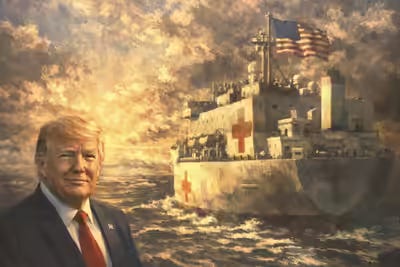
On Monday, Donald Trump posted something on Truth Social which left even his most loyal supporters flummoxed. Accompanied by an AI generated image of a hospital ship, the message read:
Working with the fantastic governor of Louisiana, Jeff Landry, we are going to send a great hospital boat to Greenland to take care of the many people who are sick and not being taken care of there. It’s on the way!!! President DJT
When reporters asked the Defense Department about the plans, they said they had no details and referred them to the White House. When the White House was asked, they said that details would be provided in due course. Two days later, nothing has materialised.
There’s so much wrong with this proposal that it’s hard to know where to begin. The chain of events seems to have started when a sailor on a US submarine patrolling off Greenland took ill and had to be rescued by, wait for it, a Danish helicopter. Did Trump get confused by that information and conclude that illness was rampant on the island? Who knows? It could also be that Trump was angry that one of his military personnel had to be rescued by the Danish. Until now, he’s been snidely remarking that the Danish military presence on Greenland consists of two dog sleds.
Further flaws in the Trump proposal quickly became apparent. For the sake of brevity and clarity, I’m going to list a few of them in bullet points:
The US has two hospital ships. Both are currently in drydock, undergoing repairs. So what is Trump planning to send?
Greenlanders enjoy access to universal health care. Those with serious conditions who cannot be treated on the island are flown to Denmark, at no cost.
Among US States, Louisiana is ranked 43rd in health care. In other words, Jeff Landry doesn’t really seem to be the appropriate guy to help out with this humanitarian effort.
Neither the Danish nor the Greenland authorities have made a request for medical assistance and neither are aware of a health crisis on the island.
Landry claims that, in the hours after the announcement, his office has been inundated with offers by doctors and nurses to serve on the ship. This raises an interesting question: since some of the best healthcare in the United States is provided by the military to its service personnel, why does Landry need volunteers from the private sector for this effort?
I could go on and on, but what’s the point? It’s a ridiculous proposal that defies coherent explanation. It seems to have emerged from one of Trump’s late night fever dreams, which are becoming all too frequent of late.
For that reason, the proposal has become a bit of a joke. There’s memes about Denmark sending a mental health ship to Mar a Lago. The satirical columnists on social media – and especially here on Substack – are having a field day. Those authors who write frequently about Trump’s cognitive decline are arguing that his complete mental collapse is imminent. We’ve been waiting for that imminent collapse for the last ten years and will probably wait for a few more. Predictions will not bring it closer.
When that Trump announcement emerged, I saw something else entirely. I first saw a propaganda trap. It goes something like this: Trump offers Greenland a hospital ship because Greenlanders are sick. Denmark refuses the ship, which proves (to the MAGA crowd at least) that the people on the island are oppressed by Denmark, which is unable to look after them properly. That then gets used to justify annexation of the island.
My second thought was more sinister. The US has a long history of stationing ships in places they covet, in the hope that those ships might then be attacked, thus justifying full-scale military action. It’s not just an American tactic – there are plenty of other examples of nations behaving in a similar manner – but let’s stick with the American case here.
The first example that comes to mind is the battleship USS Maine, which sailed into Havana Harbour in early 1898. The ship had no right to be there, since Cuba was a colony of Spain at the time. The justification given by the American government was that the ship had been sent to protect American interests on the island during a destabilising revolt by Cuban independence groups. On 15 February, a massive explosion destroyed the forward part of the ship, killing 268 sailors, or three-quarters of the crew.
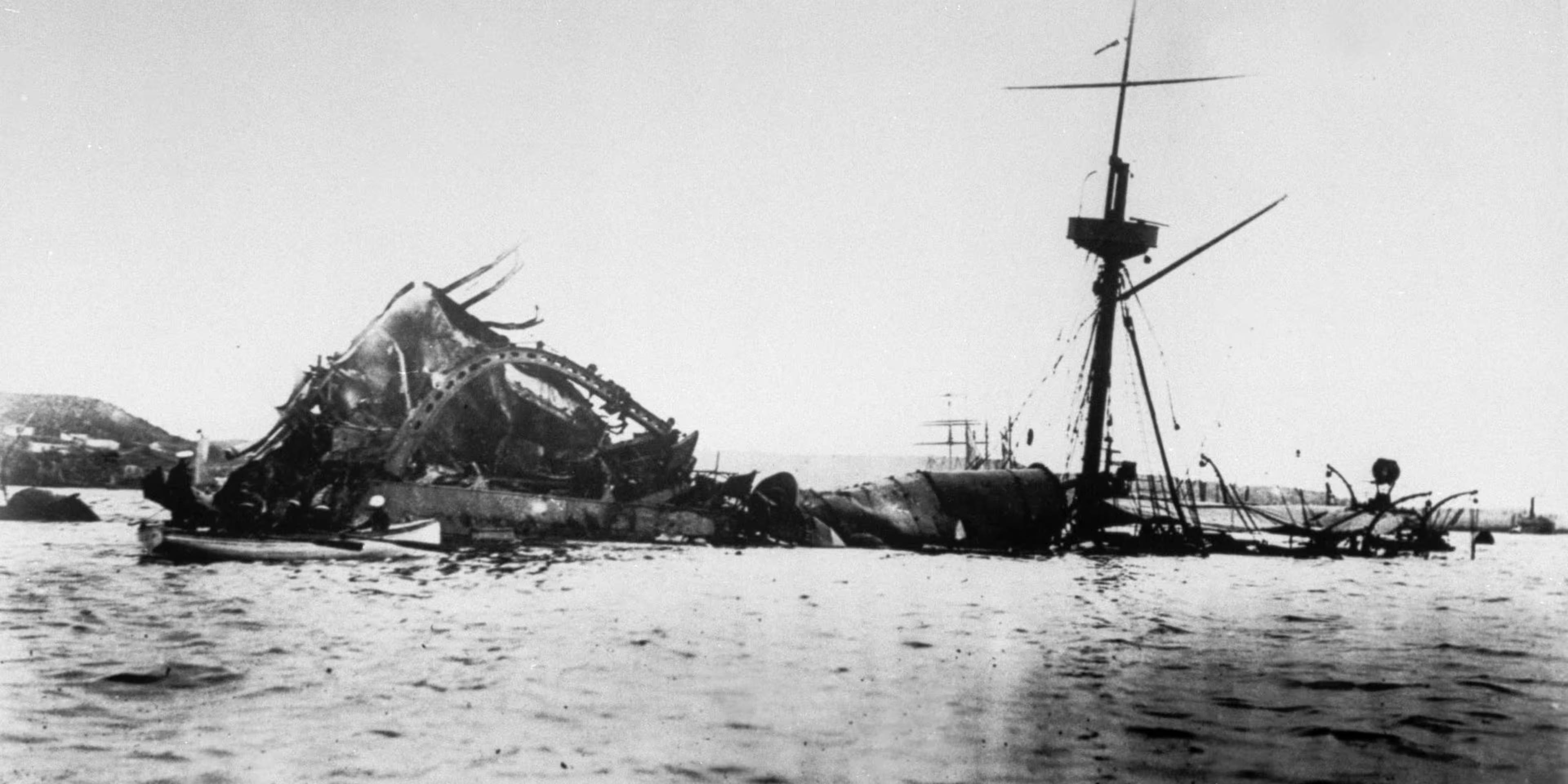
The government and the sensationalist (or ‘yellow’) press immediately concluded, without proper investigation, that the Maine had struck a mine. In fact, it appears that the explosion was caused internally, due to dangerous gases accumulating in the ship’s coal storage area. The press, in particular papers belonging to the Hearst corporation, were eager to stoke the fires of revenge. Claims were made that ‘The War Ship Maine was Split in Two by an Enemy’s Secret Infernal Machine’ – whatever that means. The slogan ‘REMEMBER THE MAINE!’ became a rallying cry for war, pulling a less enthusiastic government toward military intervention. What resulted was the Spanish-American War, which is generally seen as the starting point for American imperialism, and the death knell for the Spanish empire. The parallels with Greenland – an island close to America, controlled by a European power, with a supposedly downtrodden and rebellious native population – are too prominent to ignore.
Fast forward sixty-six years. In the early 1960s, Vietnam was a crucial point of contention in the Cold War. The country was divided between a non-communist south, supported by the United States, and a communist north which was receiving aid from China and Russia. The regime in the south was in imminent danger of collapse, due mainly to rampant corruption and a failure to recognise the urgent needs of its people. The US was desperate to prop up the regime in the south, but could not justify military intervention.
President Lyndon Johnson felt powerless, especially since, with an election in November, he was reluctant to deploy combat troops. His campaign mantra went: ‘We are not about to send American boys nine or ten thousand miles away from home to do what Asian boys ought to be doing for themselves’. In truth, however, he had already recognised the need to intervent. Nevertheless, in order to deploy American troops, he first needed a good reason.
In early August 1964, two American destroyers, the Maddox and the Turner Joy, were patrolling in the Tonkin Gulf. Neither ship should have been in the area, which constituted the territorial waters of the People’s Republic of Vietnam. It appears that both were engaging in intelligence gathering. Or they were there to bait the North Vietnamese. Or both.
On 2 August 1964 the Maddox was fired upon by North Vietnamese patrol boats. Two days later, another destroyer, the Turner Joy, spotted torpedoes approaching, though they might have been dolphins. Neither ship was damaged in any way, and there were no casualties. At the time, it wasn’t entirely clear what actually happened to those two ships, and it still isn’t today. Yet what seemed murky in the Tonkin Gulf was crystal clear in Washington: US naval forces had been attacked without provocation. That was the story the government decided to go with.
A master manipulator, Johnson realised that, in order to go to war, he needed something to fire the wrath of the American people. This was conveniently provided in the Tonkin Gulf. The fact that the incidents occurred offshore, far from prying reporters, allowed Johnson to manufacture precisely the scenario he required. While the Maddox was indeed attacked, the raid on the Turner Joy was at best an innocent misassumption, at worst an outright fabrication. In private, Johnson favoured the former explanation: ‘Hell, those dumb, stupid sailors were just shooting at flying fish.’
Still insisting that ‘we … seek no wider war’, Johnson asked Congress on 4 August, for blanket authorisation to deploy military force. The Tonkin Gulf Resolution gave the President power ‘to take all necessary measures to repel any armed attack against the forces of the United States and to prevent further aggression’. The open-ended resolution would remain in force until ‘the president shall determine that the peace and security of the area is reasonably assured’. That resolution effectively defined the Vietnam War, a conflict that Congress was virtually powerless to control.
Overwhelmed by outrage, the House unanimously approved the resolution after a forty-minute debate. In the Senate, only Ernest Greuning of Alaska and Wayne Morse of Oregon disapproved. Greuning was ‘opposed to sacrificing a single American boy’ in ‘a war in which we have no business’. Morse complained that a fundamental check upon presidential power had been squandered. ‘Within the next century, future generations will look with dismay and great disappointment upon a Congress which … [made] such a historic mistake.’ Most Americans, however, found Morse and Greuning annoying whingers. The public, offered a righteous war, bought it enthusiastically. A Harris poll found that 85 per cent supported Johnson’s policy.
If any of this sounds familiar, raise your hand. I could provide other examples of similar scenarios of American ships being sent into another country’s territorial waters, with supposedly innocent intent and then ending up becoming a pretext for war. Fabricating an attack on that hospital ship innocently floating in Nuuk harbour wouldn’t be difficult. Is this what Trump has in mind? Maybe. I don’t really know. Perhaps we can all take solace in the supposition that he’s losing his mind and that this particular crazy idea will just fade into nothingness, like most of his crazy ideas. But if we’ve learned anything over the last ten years, it’s that we should never underestimate his capacity for mischief.
This is such an interesting piece. As a history lover, I am embarrassed to admit that I did not know the entire backstory of the Maine and also of the courageous two senators that opposed LBJ’s plan to involve us in Vietnam. You rightly point out the parallels of these events with this insane administration.
Hmmmmmmm…….I could see it. I’m dubious that Trump himself has any historical knowledge upon which to make such a move as his historical knowledge is limited at best. On the other hand, his backstage handlers certainly know (or have means of knowing) historical precedent and MOST assuredly plant delusions of grandeur and outrage in his miraculously healed ear.