
The End
Is there any future for writers?

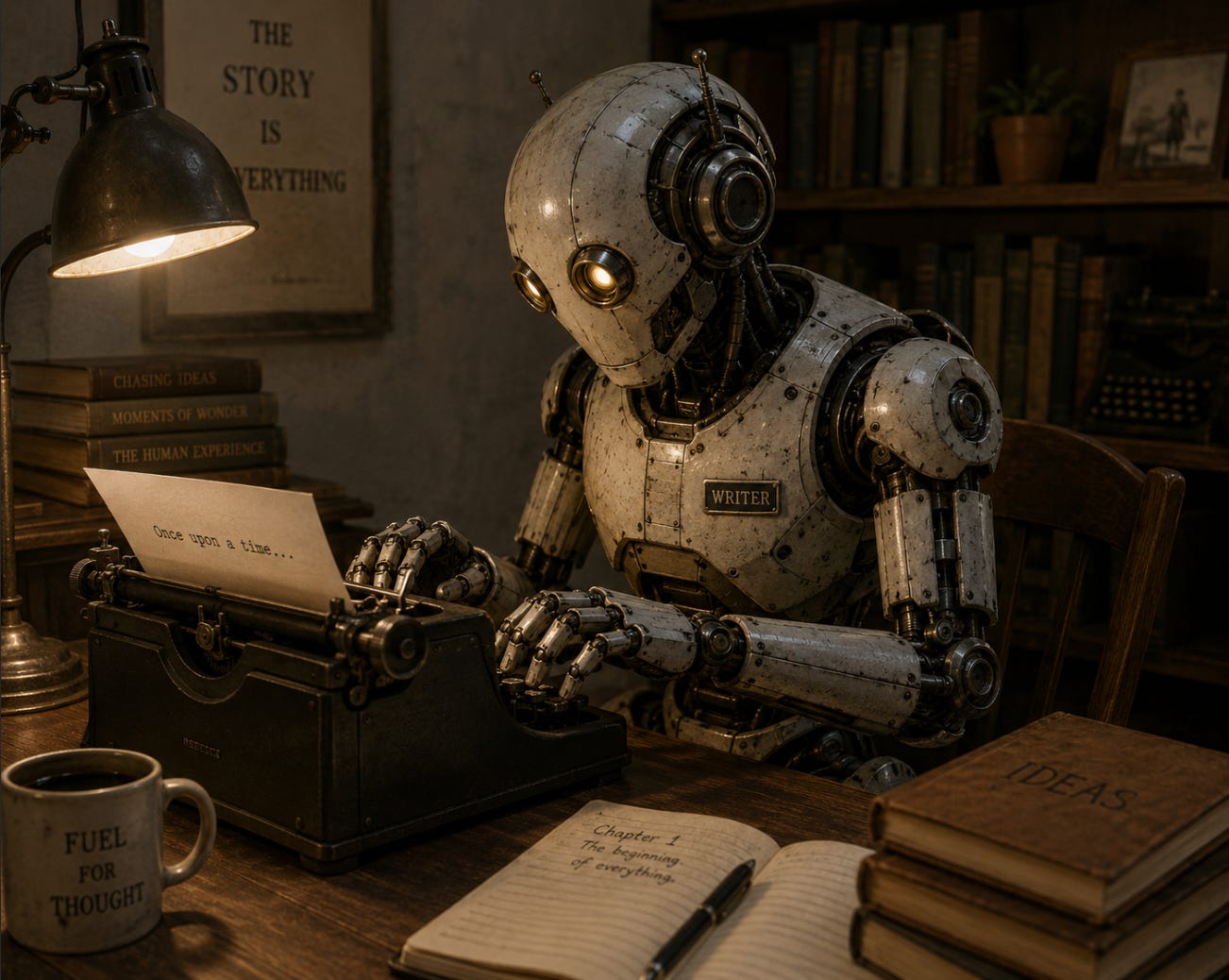
Back in the 1990s, while working at the University of St Andrews, I caught a student committing plagiarism. It was actually pretty easy; he wrote his senior thesis about General Douglas Haig, about whom I’d written my first book. Huge sections of the book were lifted from my biography of Haig, without any attempt at camouflage. The university was lenient, as they always were, but the student ever afterwards held a grudge. Five years later, long after he’d graduated, he started sending me death threats. But that’s a story for another day.
In truth, I never worried too much about plagiarism since I thought that students who engaged in it were only cheating themselves by failing to learn how to be a good writer. I always thought that the most important skill we could teach a student was how to write. Long after they’d forgotten about the origins of the First World War or the intricacies of Hammurabi’s law code, they’d remember how to construct a good sentence. That, I thought, was a transferable skill applicable to whatever career they might enter.
When I was an undergraduate, a professor assigned weekly position papers of 500 words. Those that went over that limit were penalised heavily for excessive length. The assignment taught precision, economy of style and succinctness of argument. It taught me how to be a journalist, since I’ve never encountered an editor who tolerates a writer who ignores the word limit. When I became a university lecturer, I started assigning those same position papers, precisely because I wanted to teach my students to be good writers. They grumbled at first but then came to love the assignment and the skills it nurtured.
Around about 2005, British universities starting deploying plagiarism software to detect theft from other sources, or from other students. The universities assumed that every student had a criminal streak and preferred cheating to writing. I always felt that the threat of plagiarism was grossly overblown, that most students were fundamentally honest.
The plagiarism software ruined good writing. Students became frightened of presenting an original idea, in case that idea had, unbeknownst to them, been expressed elsewhere. Writing became very formulaic, with cold emotionless statements taking the place of expressive prose. Almost every sentence ended with a footnote, even if the material cited was unremarkable. Every essay began to sound the same. In my mission to teach good writing, I was fighting a losing battle.
Meanwhile, my own career as a writer was flourishing, at the same time that I was trying to be a good teacher. It helps, when teaching students how to write, if the teacher knows how to write. I used to tell my students that the best way to learn to write well was to read voraciously. Learn what other writers do. Understand style. Develop a style of your own. Make sure that what you write reflects your individuality.
I published fourteen books and scores of articles in about twenty-four years. I could do this because I’ve always been a very fast writer. I can type as fast as I think. My last six books were written for the trade market, in other words for ordinary people interested in being entertained with stories about the past. Analytical quality was not compromised in the interests of an engaging story, despite what some scholarly critics claimed. I remember one academic review which criticised a book of mine for being too interesting.
I made a lot of money from those last six books, enough to buy a house in Spain. But then it all ended. Though the reviews of my books were great, the sales didn’t keep pace, so the publishers cut me loose. In retrospect I think it was because the marketing department couldn’t figure out how to promote me – I wasn’t glamorous. But that’s ok, since around the time the contracts dried up I was beginning to feel burned out. I actually wanted to stop writing books, so now I had a reason.
Meanwhile, I was writing a lot for newspapers and magazines. I was, for a while, Higher Education Correspondent at The Scotsman. Then I became a columnist for Scotland on Sunday, and then a feature writer for the Daily Telegraph. Then came book reviews for The Scotsman, the Christian Science Monitor, the Telegraph, the Washington Post, and, latterly, The Times. In between, I’d take whatever ad hoc assignments came my way, and a lot did. The first rule of freelance journalism, I’d tell my students, is never say ‘no’. Accept every assignment and always submit before the deadline. That’s the way to impress editors and make sure they come back. I even wrote for Marie Claire.
Nowadays, all I do is write book reviews for The Times and the occasional feature for other papers. I used to do two or three a month, but now it’s more like one. Newspapers can no longer afford a huge freelance budget. Book sections have disappeared completely and those that still exist have fewer pages. Those pages are now packed with ads. Nevertheless, I feel fortunate that there are still papers willing to pay for my writing. But I also realise that the end is nigh. Before too long, I think, book reviews will be written by AI.
At the moment, we all think that we can detect when something is written by AI, but I doubt we actually can. On the current trajectory, the computers will get better at writing and even start to develop a distinctive style. Cheap potboilers written for the holiday reading market will increasingly get written by machines, which means that royalties won’t have to be paid. There might still be a market for high quality fiction, but the run-of-the-mill stuff won’t be written by humans.
That development coincides with another disturbing trend, namely that the educational system no longer teaches good writing. Ok, there’s still creative writing courses at high schools and universities, but the development of writing skills that used to come from preparing essays for English Lit or History 101 is drawing to a halt. The first impediment came, as I’ve mentioned, with the obsession with plagiarism and the consequent rise of formulaic writing. In consequence, fewer students were in a position to discover the abundant joy that comes from writing well.
Then came AI. While universities were obsessing over plagiarism, artificial intelligence snuck up and bit them in the arse. The AI detection software is not sufficiently effective for academic institutions to trust using it on a large scale. Universities are rightly worried about the legal consequences of falsely accusing a student of using AI. Plagiarism could be proved, but AI can’t. As a result, universities are increasingly abandoning essays as a form of assessment. The only writing students will be allowed to produce will be in exam conditions where access to the internet can be controlled. Exams are timed, so there’s little opportunity to polish the writing.
And then we have the situation where universities, keen to reduce the burden of marking students’ work, are relying on AI programs for assessment. This will inevitably result in the ridiculous situation where an essay written by one AI program will be assessed by another. Maybe that’s already happened. Even more importantly, this sends a message to students that, in truth, your professors don’t really care about the quality of your writing.
Goodbye to all that. Goodbye to all that was once sublime about education. We all love good writing yet, somehow, we’re marching blindly toward a future in which writing won’t be taught and most of what is written will not be produced by humans. I used to ask my students, what makes a person human? The answer, to me, was simple and obvious: the fact that we write. How is it that we have decided to throw that away?
What prospect is there for the ever shrinking number of people who want to be good writers and those who want to read books produced by humans? I really don’t know, but yesterday I witnessed something that scares the shit out of me as a writer genuinely concerned about the future of my craft.
Yesterday I received an email from a guy named Lloyd Hamilton. He started with effusive praise of my book The Bomb: A Life. It sounded like he knew what he was talking about, that he’d actually read my book. Then came his credentials: ‘I help steward a community of readers on Goodreads, forty‑nine thousand, seven hundred and eighty‑five of them, who actively seek out books that operate at this exact intersection of cultural history, Cold War politics, and the stories of the technologies that have shaped our world. I spend my time there observing what language they use to search, what kinds of narratives they ask for by name, and which books they champion once they find them.’
Ok, but what’s in it for you Lloyd? He never got to that. In a subsequent note, he asked: ‘To better understand how I can guide you, could you share the main challenges or pain points you have been facing since publishing the book online?’
Wait a minute, who said that I’ve published that book online? This was news to me. So I did a Google search and found that my book has indeed been published on a site called Internet Archive, but not with my permission. A more thorough search of that site revealed that every single one of my fourteen books is available, entirely free to download. There’s also copies of a lot of those scholarly articles I’ve written. All this was done without my permission.
I wrote to the publishers of my Bomb book. They were also unaware of this and promised that they would put a stop to it. A woman in the Rights Department at Penguin Random House replied: ‘I want to reassure you that we take this matter very seriously, and I have notified our legal team.’ But, in truth, how serious are publishers taking this issue? There’s over five million books currently available for free download on the Internet Archive. Five fucking million. That doesn’t suggest that publishers have been very vigilant about this sort of theft.
I’m not sure what will happen. I’ll update my Substack readers as news comes in. I suspect that the Internet Archive will argue that what they’re doing is entirely legal, just an online version of a lending library. Okay, libraries actually buy the books that they lend out, but the argument has some logic.
The truth, however, is that this is yet another example of how the internet is destroying something wonderful, namely the production of good literature. And, yes, writing well is its own reward; writers get immense joy from crafting a perfect sentence. But for those who call writing a profession, as I do, there’s always been the need to make money. Yet that ability to make money is being attacked on so many fronts: by the advent of AI, by sites like Internet Archive, by the disappearance of good newspapers and by outright theft of copyrighted material. We’ve created a monster and he’s eating us up.
What hope is there for young writers who want to make a career of their craft? Sorry, but I’m not hopeful. Some will continue to write, but ever fewer will make a living from writing. We’re witnessing the demise of a profession. I had the great fortune to write at a time when newspapers and publishers were willing to pay me well. But that time is coming to an end. Who asked for this?
I’m very sad. I’ve always loved writing; it’s part of my identity as a human being. Today I feel like a best friend has died.
I write because I love the harmony of words. But it’s also my main source of income. So, if you enjoyed this, consider becoming a paid subscriber, or you can …
Two things. 1. Those blasted marketers did you dirty. 2. A good friend of mine recently published and once she hit a list, fraudulent AI copies showed up on Amazon.
Legitimate problem but please don't tell me the end is nigh :/
Now this is a very scary article you wrote. Can we still have hope? The same dilemma goes for translators. Will there still be a market for them, apart from high-level literature? This writer-less future does not appeal in the least. Machines are still dumb, but for how long?