
The Smiling Psychopath
An exploration of the elusive character of Pol Pot

On the weekends, I like to reprise a review I’ve written of a book I found really special. Today I’m going way back to 2007 and shining some light on Philip Short’s Pol Pot: The History of a Nightmare. It was published by John Murray and my review appeared in Scotland on Sunday. It’s a fascinating book about how one man took hold of a nation and how an ordinarily peaceful people were turned into hateful murderers. So here you go:
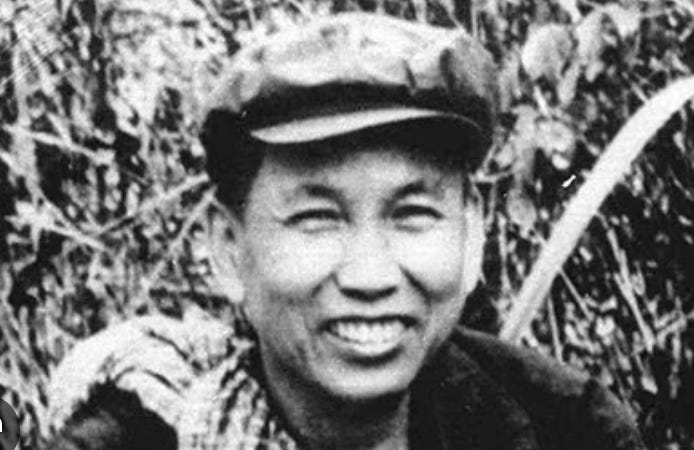
What’s in a smile? Flexing a few muscles in the face allows us to transmit all kinds of silent messages. But the way we interpret a smile depends in large part on what we know about the person in question. I can remember when Tony Blair’s grin seemed refreshing and innocent. After the Iraq War, it appeared sinister and deceitful.
Pol Pot, the man who oversaw the extermination of one fifth of the Cambodian population between 1975 and 1979, had a lovely smile. Boyhood friends found him good company – quiet but fun. One friend fondly recalled his ‘famous smile’:
He never said very much, he just had that smile of his. He liked to joke, he had a slightly mischievous way about him. And there was never the least hint of what he would become.
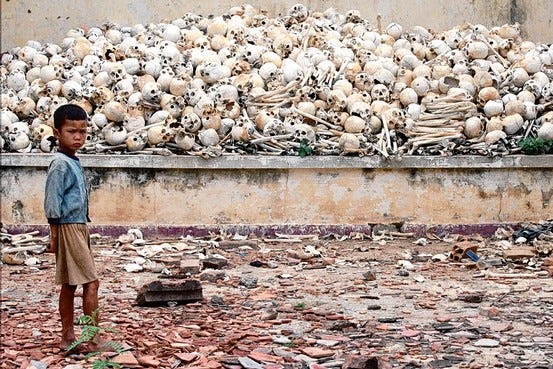
In the 1960s his revolutionary alias was ‘Pouk’, the Khmer word for ‘mattress’. He took the name because his role was to soften conflict. Only later, when skulls were stacked like cans on shelves, did the mattress become a bed of nails. Only then did the famous smile seem hollow and full of menace.
I always find it disturbing to discover that evil dictators were once normal children, boys who didn’t actually pull wings off butterflies or stuff the cat in the washing machine. According to his friends, Pol Pot (or Saloth Sâr, as he was originally known) was an ‘adorable child’ who ‘wouldn’t hurt a chicken’. He loved football and worked hard to be good at the game. Fifty years later, a friend could still remember the distinctive scissors kick he perfected by practicing endlessly.
That boy was more interested in football than in politics. He didn’t take his studies seriously. Poor exam results meant that he was sent to Technical School instead of the Lycée. He joined the school football team, a motley collection of toughs. In matches with other schools, they were derogatively called ‘the apprentices’. Matches inevitably degenerated into open brawls, whereupon Pol Pot and his pals would brandish the brass knuckles they had earlier made in metalwork class. This might have been the first step on the road to evil.
But maybe it wasn’t. It might simply be a red herring. Quite a few teenage toughs turn into well-rounded adults. The most fascinating aspect of this extraordinary and brilliant book is the way the reader is allowed to observe the author struggling to find explanation for the descent of Pol Pot and the horrors of Cambodia. One feels viscerally Short’s utter frustration in his attempt to explain the context out of which Pol Pot emerged and the torrent of barbarism he inspired.
At one point in the chaotic revolution, a mob loyal to the deposed Prince Sihanouk sacked the governor’s mansion in Kompong Cham. When local politicians arrived to mediate, they were set upon by the crowd and killed. Their livers were then cut out and borne in triumph to a local restaurant where the chef was ordered to cook them. Pieces were handed out to the crowd and eaten. When murder is ubiquitous, only the truly bizarre killings get remembered.
It would be easy to blame all the barbarity on Pol Pot. We would like to label him a psychopath and put him safely away in that closet containing Lavrenti Beria, Heinrich Himmler, Slobodan Milosevic and Saddam Hussein. But that’s too easy. Doing so assigns too much credit to a single individual in the creation of a holocaust. Pol Pot was definitely one of the most evil men in history, but he did not by himself fashion the killing fields.
Given that he was not solely to blame, a biography might seem an inappropriate mechanism for analysing the Khmer bloodfest. But this hugely impressive book is more than simply the life story of a single individual. It is also the biography of a nation and a comprehensive inquest into the murder of that nation.
Because Short rejects simplistic explanations, he struggles to find an answer to this horrible riddle. Why did such a beautiful country, where the people seemed relaxed, gentle and peace-loving, descend into utter madness? Instead of one over-riding explanation, Short offers a long list of factors which, by cruel coincidence, came together in the 1970s to produce an orgy of killing.
Some of the explanations are cultural. The educational system relied heavily on rote learning, producing a population given to respect authority and not inclined to analysis or introspection. In addition, the Khmer people, unlike their Vietnamese and Chinese neighbours, were not heavily influenced by Confucian philosophy, which holds that the errant individual can be reformed. They believed instead that enemies (or those who disagreed) were irredeemable and therefore had to be eliminated.
Short describes the Khmers as a mediaeval people forced to live in the 20th century. They believed in magic and distrusted reason. On the eve of the March 1970 coup, a white crocodile was said to have been sighted, while for three days the moon was supposedly encircled with a halo the colour of blood. When Lon Nol, who deposed Sihanouk, was on the verge of being overrun by Pol Pot’s Khmer Rouge, he set up a special bureau to teach his troops occult practices of warfare and circled Phnom Penh with a coloured line of sand, in order to give the city magical protection. That didn’t work very well.
Internal factors were magnified by external pressure. Cambodia, supposedly a neutral country, was in truth a slave nation, ruthlessly exploited by the Chinese, the Americans and the Vietnamese. The Ho Chi Minh trail ran through Cambodia, thus allowing the North Vietnamese to smuggle arms to the South through an area relatively immune from American interdiction efforts. The Americans responded by bombing; more bombs were dropped on Cambodia than fell on Japan during the entire Second World War. The bombs destroyed the agrarian economy and sent refugees flocking to the cities, where they were prey to Khmer Rouge indoctrination. The chaos caused by the B-52s was then exacerbated when Richard Nixon sent in ground forces in 1970.
Pol Pot exploited a vacuum of authority in his attempt to create a Socialist utopia. In his perverted version of the perfect society there would be no money, no law courts, no postal system. Schools would be curtailed since thought encouraged individualism. Happiness would come through uniformity: everyone would wear the same clothes and eat the same food. They were even enjoined to chew their food in a communist way.
The wholesale destruction of individuality could only be achieved by massacring individuals. But Short stresses that this was not genocide, since it was not directed at a single religious or ethnic group. Cambodians killed other Cambodians. They willingly participated in Pol Pot’s perverted mission. The most disturbing aspect of this terrible story is the comprehensive moral failure of an entire society. The people could have stopped Pol Pot, but they decided not to do so.
Pol Pot had a basketful of aliases. He changed his character to suit the times. Prior to his emergence as leader of the Khmer Rouge, intelligence agencies in China and the US had no idea that he was important. ‘If you preserve secrecy’, he once remarked, ‘half the battle is won’. Like a clever and determined detective, Short has exposed the secrets, knitting together a story which once seemed elusive. The result is horrifying, but it must be read.
I write because I love the harmony of words. But it’s also my main source of income. So, if you enjoyed this, consider becoming a paid subscriber, or you can …
A darker read than my normal Sunday, but struck by this: “Pol Pot had a basketful of aliases. He changed his character to suit the times. Prior to his emergence as leader of the Khmer Rouge, intelligence agencies in China and the US had no idea that he was important. “ — J.D. Vance, anyone?
Will add it to my list. For a fictionalized account of this time I suggest John Del Vecchio’s “For the Sake of All Living Things”. One of the most painful books I have read and keep telling myself to read again when more time has elapsed. Maybe hit time to read both.