
When Dylan went Electric
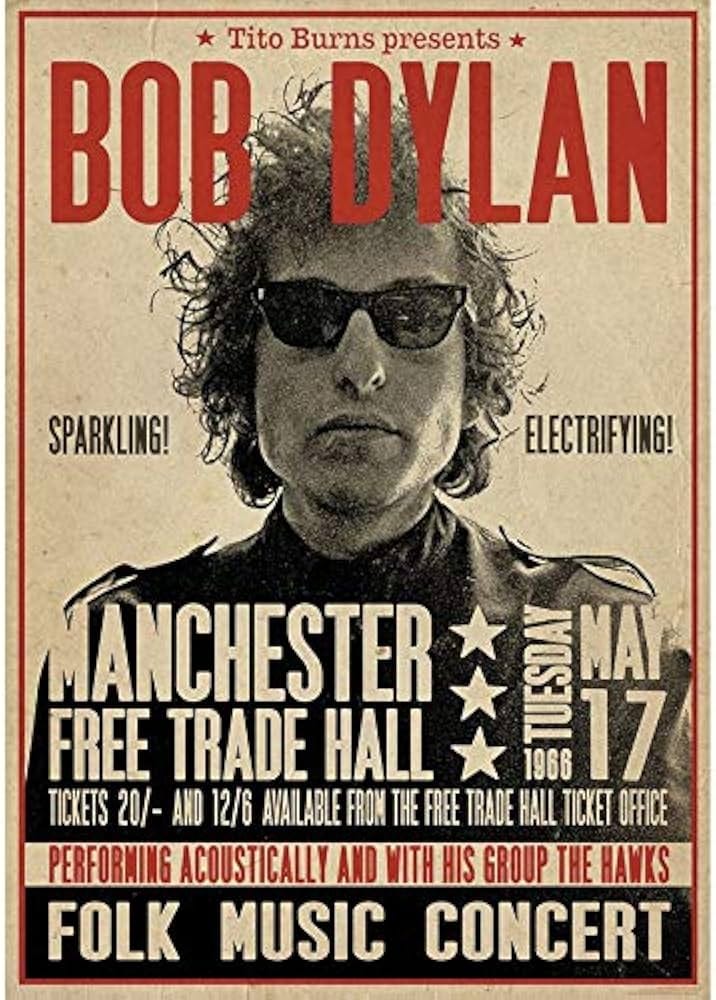
The concert at the Manchester Free Trade Hall on 17 May 1966 will forever be known as the Judas Gig.

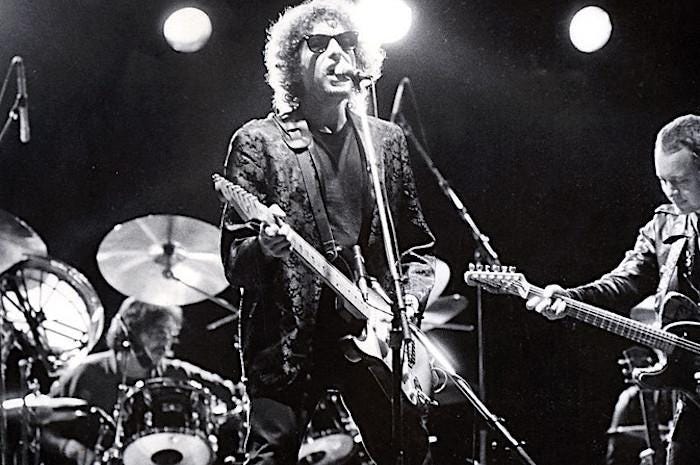
Sixty years ago. Back when a lot of people thought that the times were a’changin. The crowd in the Manchester Free Trade Hall on the night of 17 May 1966 certainly thought so — some welcomed change, others feared it. Half were folkies with rucksacks and sandals who had come to hear their Bob Dylan. The rest were rockers in jeans and black leather eager to hear theirs. A fair proportion of the audience, in other words, was destined to be disappointed.
For quite a few people, that concert was the day Dylan went electric, the day of the Great Betrayal. In fact, he’d gone electric some time before, but the folk faithful desperately denied the truth. For them, seeing Dylan plug in his Stratocaster was like watching Pontius Pilate pass judgement on Christ. The amplified wail felt like nails piercing flesh. The rockers were delighted, but the folkies grew increasingly restless as each song underlined Dylan’s treachery. And then came the most famous catcall in the history of rock. ‘JUDAS!’, someone shouted.
Dylan, it seems, was waiting for this moment, this instant of attack in a culture war. He muttered something to the five members of his band. They responded with a terrifying, ear-splitting fusillade—a seven-minute barrage of ‘Like a Rolling Stone’, played with intent to wound. ‘It was great’, the cultural activist Sue Miles felt. ‘Half the audience pissed off—all the ones that had rucksacks.’ Among the angry was Keith Butler, who left in disgust. On the way out he ran into the filmmaker D.A. Pennebaker, who was filming the event for his documentary Don’t Look Back. ‘He’s a traitor’, Butler muttered. ‘He wants shooting.’
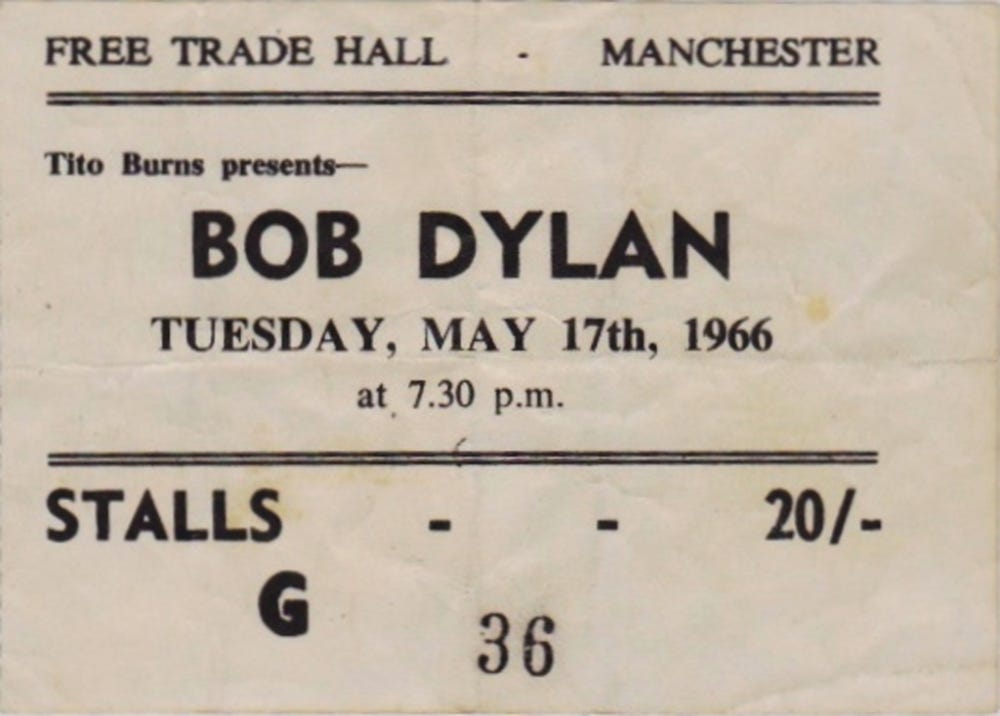
The words ‘I was there’ echo across the ages. The number who recall that seminal event, who felt personally the stab of betrayal, could fill the Free Trade Hall ten times over. That’s the nature of rock legends—those who remember an event always far exceed those who actually witnessed it. It’s the same with Woodstock. Some attended later concerts on the Dylan tour, others heard stories from friends and still others saw the Pennebaker film at the Odeon and pretended they were there in person. Some even swear the betrayal occurred at the Albert Hall in London, not in Manchester. Imagining one’s presence was easy because the emotional challenge Dylan posed was so profound. With a few wailing notes he had asked: ‘Where precisely do you stand?’
In truth, the question was first asked at the Newport Folk Festival on 25 July 1965, the day after ‘Like a Rolling Stone’ entered the American charts. Dylan came on stage with some members of the Paul Butterfield Blues Band, looking like an extra out of The Wild Bunch. He carried his Stratocaster like a Kalashnikov. On that occasion, the crowd was not evenly split; the vast majority were folkies. The new song (admittedly played badly) brought forth boos, tears, hysterics. A minuscule few cheered, but most sat in stunned silence. The air was thick with reproach: ‘Play folk music!’, ‘Sell-out’, ‘Get rid of that band!’, or epithets more abusive. Backstage, Pete Seeger, his face a deep purple, was shaking his head and kicking equipment. ‘I had never seen any trace of violence in Pete, except at that moment’, one witness remarked.
Dylan left the stage, dripping sweat and disgust. Peter Yarrow, of Peter, Paul and Mary, acting as emcee, promised that Dylan would return by himself, accompanied only by an acoustic guitar. The audience was instantly forgiving, urging him back, as if time could be stopped, as if 1962 could be relived all over again, forever into the future. Dylan obliged with ‘Mr Tambourine Man’, then went straight into ‘It’s All over Now, Baby Blue’. The message of that song was inescapable. Nevertheless, that strange encore left many Dylan fans confused. Dedicated folkies saw it as a farewell, the end of the end, but those prepared to accept that times might actually change felt the encore strangely hypocritical, an act of submission by a man who supposedly knelt to no one.
The Janus-faced concerts continued for the next year, incorporating the entire tour of Britain. Dylan, it seems, wasn’t actually being hypocritical, he was instead intentionally trying to stir, in the process asserting ownership of his own music. The audiences reflected the schism in Dylan’s music. They were, according to Greil Marcus, like ‘people who had come together to fight a cultural war. … Again and again fury coursed through the crowd like a snake, the wails of hate are beyond belief.’
Protests in the United States had been angry and raucous; in Britain, they were all that and political too. British folkies were cultural Stalinists who believed that music was an extension of class and that pop music as exemplified by the Beatles was capitalist—or, worse, fascist—exploitation. They were Luddites who believed that by shouting loud enough they could smash the machine of pop music.
After that Manchester concert, people were recruited from the folk clubs to protest; disgusted departures were carefully choreographed. That seems a waste of money, but, hey, some people are like that. In Sheffield, someone actually phoned in a bomb threat. In Scotland, the demonstrations were allegedly organised by the Communist party—allegedly. Whether or not they actually were is beside the point since the allegation demonstrates that some people genuinely felt that Dylan had sold out to capitalism. Political oppression, it seems, could only be expressed in folk harmonies.
Dylan now explains the transformation not as an evolution but rather as a conscious decision to change direction. ‘The folk music scene had been like a paradise that I had to leave, like Adam had to leave the garden’, he wrote in his memoirs.
It was just too perfect. In a few years’ time a shit storm would be unleashed. Things would begin to burn. Bras, draft cards, American flags, bridges, too—everybody would be dreaming of getting it on. The national psyche would change and in a lot of ways it would resemble Night of the Living Dead. The road out would be treacherous, and I didn’t know where it would lead but I followed it anyway. It was a strange world ahead that would unfold, a thunderhead of a world with jagged lightning edges. … I went straight into it. It was wide open.
That explanation was as obscure and confusing as the message in many of Dylan’s songs, but understanding Dylan has never been easy. His fans, and indeed his detractors, have perpetually tried to simplify him, assigning him labels that conform to their own cultural and political preconceptions. He, on the other hand, has consciously defied understanding, the message being that to comprehend is to own, and he is not for sale. In this sense, the controversy sparked by his Stratocaster in 1965 is just one skirmish in the battle for Dylan.
Dylan released ‘The Times They Are a’Changin’ in 1962, before most people quite realised that the times were changing. The world was still grooving to Elvis, Chubby Checker and Gene Vincent, and here came a skinny Jewish kid from Minnesota, not yet 21, raising painful questions about the world and telling people that the answers were blowing in the wind. The world could handle a troubadour, but it was slightly uneasy about one who doubled as soothsayer. The really unsettling thing about Dylan was that he turned out to be right about so much—war, racism, hypocrisy, greed. He seemed to anticipate so eloquently all the problems of a troubled decade. No wonder, then, that people were quick to label him the voice of a generation.
What seemed a determined, perceptive voice back then was in fact a clarion of confusion. If there is inconsistency in Dylan’s political message (and quite clearly there is), it is because he had not himself come to any decisions:
As for what time it was, it was always just beginning to be daylight and I knew a little about history, too—the history of a few nations and states—and it was always the same pattern. Some early archaic period where society grows and develops and thrives, then some classical period where the society reaches its maturation point and then a slacking off period where decadence makes things fall apart. I had no idea which one of the three stages America was in.
‘Dylan is to me the perfect symbol of the anti-artist in our society’, the folksinger Ewan MacColl once remarked rather too pompously, wearing his contempt on his sleeve. ‘He’s against everything—the last resort of someone who doesn’t really want to change the world.’ That, it seems, is the predictable wail of a man enslaved by his own pieties. MacColl sought purity in politics as much as in music.
Dylan answered MacColl so perfectly in ‘My Back Pages’, his stinging rebuke of those who claimed to have discovered truth and justice before the age of majority.
A self-ordained professor’s tongue
Too serious to fool
Spouted out that liberty
Is just equality in school
“Equality,” I spoke the word
As if a wedding vow
Ah, but I was so much older then
I’m younger than that now
For that matter, MacColl was also beautifully rebutted when Dylan first picked up his Stratocaster, an act that evoked the elusiveness of certainty, not to mention the certainty of change. Principles, Dylan seemed to be saying, are the last resort of the small-minded. Rules are an obstacle to creativity. We all crave truth but are forced to live in a world of nuance.
‘He was telling those who were listening a story they already knew’, Marcus wrote, ‘but in a manner that made the story new—that made the familiar unstable, and the comforts of familiarity unsure.’ The confusion Dylan sowed made listeners all the more eager to label him; this wild force had to be put in a box, otherwise he might blow apart the world. To many, it seemed that Dylan was an extension of the chaotic times he sang about and that understanding him might bring order to chaos.
‘Dylan’s talent evoked such an intense degree of personal participation from both his admirers and detractors that he could not be permitted so much as a random action’, his friend Paul Nelson reflected. ‘Hungry for a sign, the world used to follow him around, just waiting for him to drop a cigarette butt. When he did they’d sift through the remains, looking for significance. The scary part is they’d find it.’
Dylan struggled against the labels and the ever-intrusive analysis of his random actions. He took refuge in lies, partly to construct an image that suited his aspirations, more to build a barrier behind which to hide. During his first interview at Columbia Records, he claimed he’d come to New York on a freight train, because that is what folk singers were supposed to do. Later he lied about his age, his birthday, his hometown, the jobs he’d once had. He claimed he was an orphan when in fact he had two devoted parents. Sowing confusion was Dylan’s way of retaining title to himself. He scattered lies as he walked through life in order to put off the cultural bloodhounds trying to track him down.
Well I try my best
To be just like I am
But everybody wants you
To be just like them
Though he sang about the world, he did not feel part of it. Writing meaningful songs was not an act of service, but rather a personal statement he felt he had to make because of who he was. ‘I knew that whatever I did had to be something creative, something that was me that did it, something I could do just for me’, he once remarked.
Dylan’s intense privacy caused him to object violently to the labels fans lovingly assigned, even when those labels were rather accurate. He hated, for instance, being labelled a protest singer:
Topical songs weren’t protest songs. The term ‘protest singer’ didn’t exist any more than the term ‘singer-songwriter’. You were a performer or you weren’t, that was about it—a folksinger or not one. ‘Songs of dissent’ was a term people used but even that was rare. I tried to explain later that I didn’t think I was a protest singer, that there’d been a screwup. I didn’t think I was protesting anything … Rebellion spoke to me louder. The rebel was alive and well, romantic and honorable.
Dylan derided the bona fide protest singer Phil Ochs as a ‘singing journalist’. When asked for his political opinions, he reacted with outrage: ‘I’ll bet Tony Bennet doesn’t have to go through this kind of thing.’ A well-meaning journalist who asked him to name his favourite protest singers got the bitingly sarcastic reply: Eydie Gorme and Robert Goulet. On another occasion, he insisted he was just a ‘song and dance man’. Fans of his topical songs wondered why he avoided singing specifically about the Vietnam War. Tired of being questioned whether that was omission or betrayal, he once snapped: ‘how do you know that I’m not, as you say, for the war?’
Dylan deeply resented the way fame implied ownership, that fans expected something of him, assumed that they were entitled to a piece of him. He recalled a telling incident at the Newport Folk Festival that seemed innocent at the time, but foreboding in retrospect:
Ronnie Gilbert, one of the Weavers, had introduced me … saying, ‘and here he is … take him, you know him, he’s yours.’ I had failed to sense the ominous forebodings in the introduction. Elvis had never even been introduced like that. ‘Take him, he’s yours!’ What a crazy thing to say! Screw that. As far as I knew, I didn’t belong to anybody then or now. I had a wife and children whom I love more than anything else in the world. I was trying to provide for them, keep out of trouble, but the big bugs in the press kept promoting me as the mouthpiece, spokesman, or even conscience of a generation. That was funny. All I’d ever done was sing songs that were dead straight and expressed powerful new realities. I had very little in common with and knew even less about a generation that I was supposed to be the voice of. … I was more a cowpuncher than a pied piper.
Dylan hated the way his songs became badges of faith, as if by revering the artist, by listening to his music, one could prove one’s political credibility. ‘I really was never any more than what I was—a folk musician who gazed into the gray mist with tear-blinded eyes and made songs that floated in a luminous haze. Now it had blown up in my face and was hanging over me. I wasn’t a preacher performing miracles.’
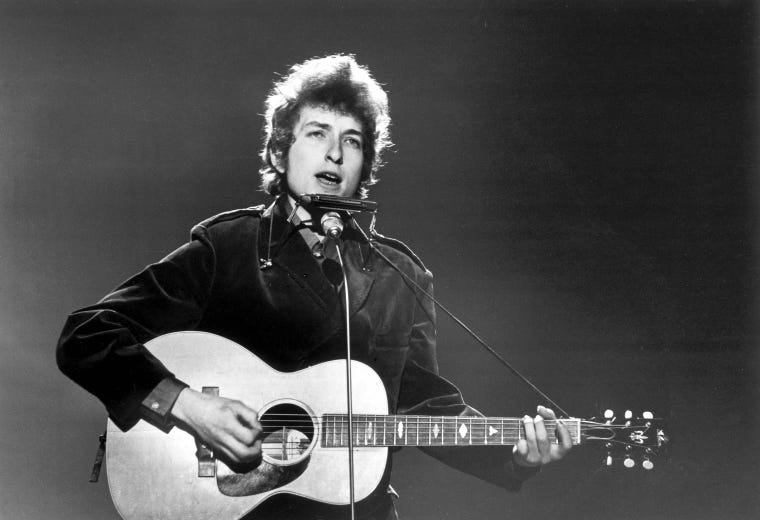
Between 1962 and 1964, Dylan matured faster than most artists do in a decade. The good causes he had so eloquently supported seemed not so simple and clear by 1964; he was, as he announced in ‘My Back Pages’, so much older then, so much younger than that now. He had also become disenchanted with liberalism. ‘Here were these people’, he later remarked, ‘who’d been all involved with the left in the thirties and now they’re supporting civil rights drives. That’s groovy, but they also had minks and jewels, and it was like they were giving their money out of guilt. … They’re doing their time. They’re chained to what they’re doing.’ Dylan, like the black nationalists and student protesters, had become disenchanted with white liberal America’s answer to social injustice, the answer that involved changing a few laws but avoided the much more important, and painful, assumption of guilt.
Dylan had shifted from the political to the personal, or, in a manner the era would eventually appreciate, had made the personal political. He was attacking conformity by showing that the movement associated with change—the liberals—were as conformist as the rest. This was not just an attack upon the political culture, but also an assertion of independence from that culture. He was exhausted at having to act out a role which America had assigned him, that of the protest singer and mouthpiece for his generation. His music would henceforth become ever more introspective and obscure, as if to frustrate those in search of meaning. The songs were carefully constructed labyrinths designed to foil those who sought the artist at their core. Meanwhile, his public utterances took on a tone of absurdity, being calculated to confuse.
No place was far enough away. I don’t know what everybody else was fantasizing about but what I was fantasizing about was a nine-to-five existence, a house on a tree-lined block with a white picket fence, pink roses in the backyard. That would have been nice. After a while you learn that privacy is something you can sell, but you can’t buy it back. … Demonstrators found our house and paraded up and down in front of it chanting and shouting, demanding for me to come out and lead them somewhere—stop shirking my duties as the conscience of a generation.
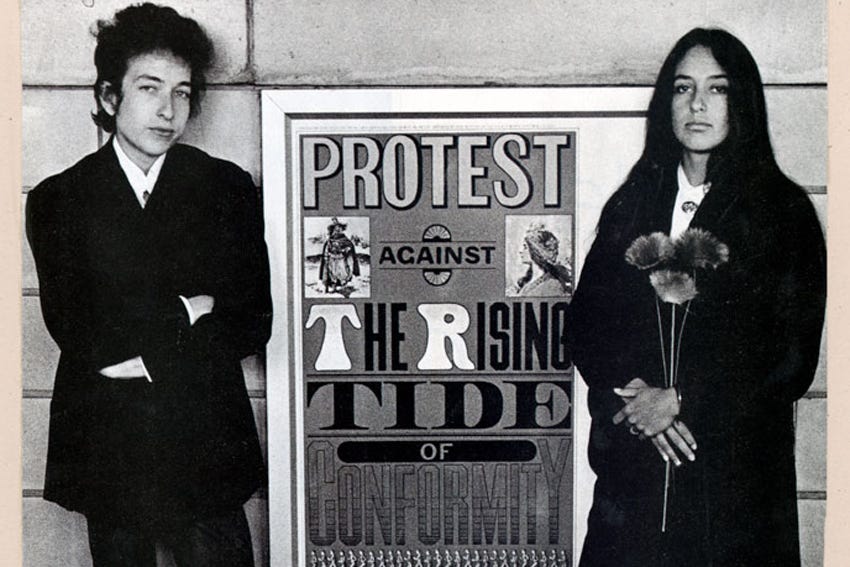
In retrospect, one is struck by how short was the soundtrack Dylan provided to the decade. The songs that most people associate with the 1960s were produced before 1965. By the time the decade laid claim to Dylan, he had already given up on the decade. ‘Whatever the counterculture was, I’d seen enough of it’, he later reflected. When the news began to conform so vividly to the images he had earlier constructed, he turned away in horror:
The events of the day, all the cultural mumbo jumbo were imprisoning my soul—nauseating me—civil rights and political leaders being gunned down, the mounting of the barricades, the government crackdowns, the student radicals and demonstrators versus the cops and the unions—the streets exploding, fire of anger boiling—the contra communes—the lying, noisy voices—the free love, the anti-money system movement—the whole shebang.
Dylan, having entered adulthood, was experiencing the inevitable shrinking of his world that every good parent and husband feels. ‘I was determined to put myself beyond the reach of it all. I was a family man now, didn’t want to be in that group portrait. … Outside of my family, nothing held any real interest for me and I was seeing everything through different glasses.’ However common that experience might be, it was not one expected of one so holy as Dylan.
Whether he liked it or not, Dylan was the voice of a generation, though not perhaps in the way people imagined. His admirers wanted him to express an opinion on every political controversy of the day, and treated his utterances as gospel, even when he was only joking. In a wider sense, however, his confusion and alienation, expressed so well in his songs, mirrored that of his generation. He tried to turn the personal into the political, but succeeded only in entangling the two. Like his generation, he swayed between outrage at the injustices of his age and deep personal hurt at the betrayals he felt in love. Like everyone else in the 1960s, and indeed in any age, he could never quite decide which—the personal or the political—was more important. That perhaps explains his longevity: had he kept to politics he would have quickly become a tiresome propagandist stuck in a bygone age — someone like P. F. Sloan.
The songwriter Gerry Goffin resisted labels when he praised Dylan: ‘[He] managed to do something that not one of us was able to do: put poetry in rock ’n’ roll, and just stand up there like a mensch and sing it.’ Others, however, could not resist labels, even if those labels were often more appropriate to themselves rather than to Dylan. The great problem with labels was that they suggested hypocrisy when Dylan defied them.
In the aftermath of that fateful concert at Newport in 1965, Jim Rooney, a musician and critic wrote:
It was disturbing to the Old Guard. … Bob is no longer a neo-Woody Guthrie … The highway he travels now is unfamiliar to those who bummed around … during the Depression. He travels by plane … the mountains and valleys he knows are those of the mind—a mind extremely aware of the violence of the inner and outer world. … They seemed to understand that night for the first time what Dylan had been trying to say for over a year—that he is not theirs or anyone else’s and they didn’t like what they heard and booed. … Must a folk song be of mountains, valleys and love between my brother and sister all over this land? … The only one who questioned our position was Bob Dylan. Maybe he didn’t put it the best way. Maybe he was rude. But he shook us. And that is why we have poets and artists.
Who was, and is, Bob Dylan? At times he was an asshole. Ok, I’ve said it. It’s possible that his recent memoirs are just another attempt at obfuscation, more bricks in the wall of lies he has constructed to protect himself. But, then, perhaps it doesn’t really matter who he was, since his importance lies in the effect he had. In the 1980s Dylan described himself as ‘a 60s troubadour, a folk-rock relic. A wordsmith from bygone days. I’m in the bottomless pit of cultural oblivion’. He was often simply what people wanted him to be. Much to his regret, it is the prerogative of any generation to choose its voice. He was a revolutionary, even though he perhaps did not want to be one. Whether a mouthpiece or not, he was a genius, one who had the good fortune to live in a time when genius could still be recognised, cultivated, recorded, and appreciated.
I write because I love the harmony of words. But it’s also my main source of income. So, if you enjoyed this, consider becoming a paid subscriber, or you can …
I was born in 1954 and too young to understand the whole thing. As an adult I have enjoyed Dylan's music. All I can say is the Nobel Prize in Literature speaks volumes.
Grew up in RI and I remember the brouhaha over Dylan’s appearance at the Newport Folk Festival. From folks I’ve spoken with, Dylan (or maybe his publicist?) has mythologized that appearance. Fans were disoriented by the electric guitar but the big disappointment was only four songs were played. I find it interesting that people are discovering Phil Ochs’ music (Dylan derisively called Ochs a journalist) during these dark times. It would’ve thrilled Phil to know his songs still had meaning.