
When Will They Ever Learn?
The extraordinary willingness to repeat the mistakes of Vietnam

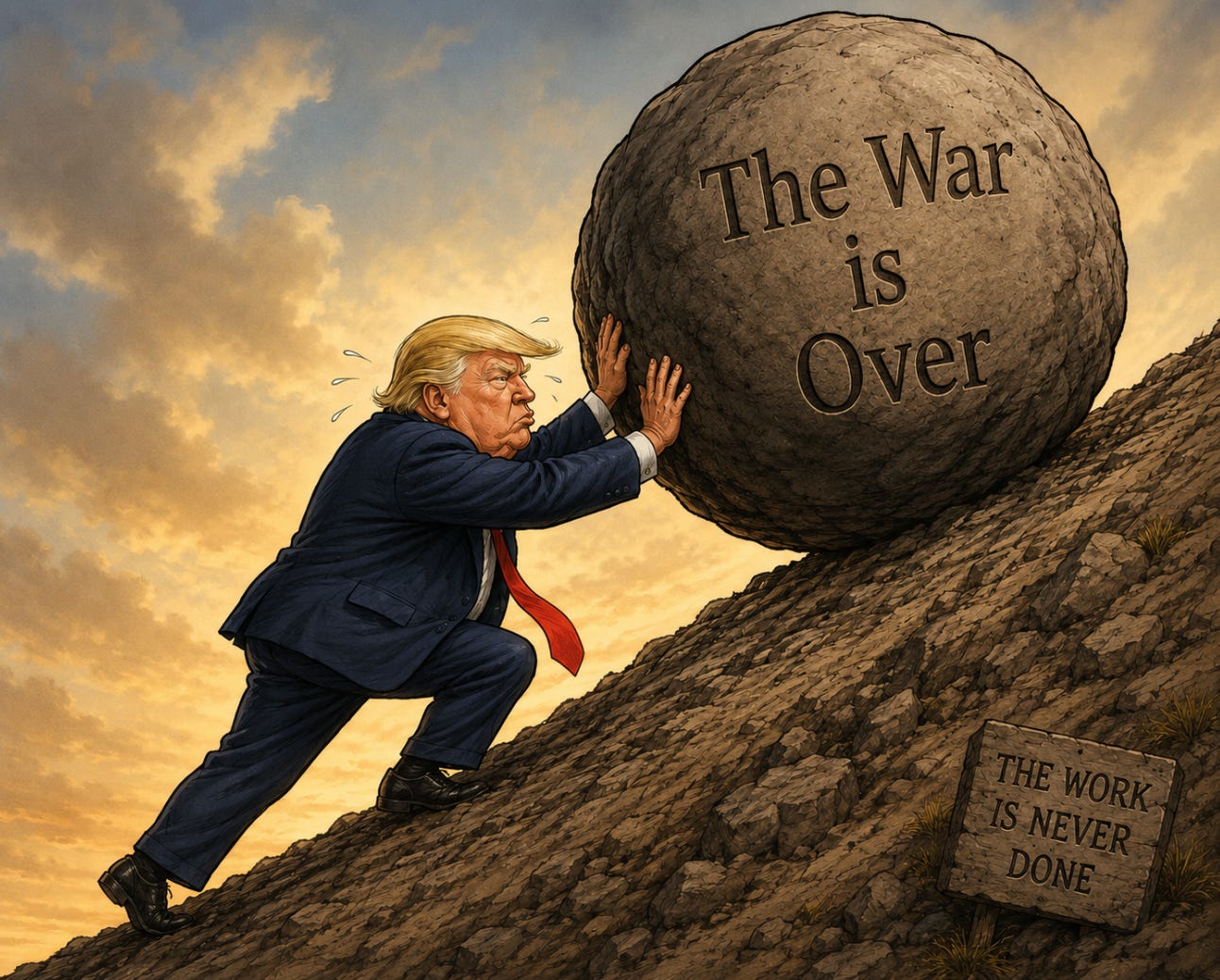
‘We need some great failures’, argued Lincoln Steffens, the famous muckraking journalist of the Progressive Era. ‘Especially we ever-successful Americans – conscious, intelligent, illuminating failures.’
By any standard, the Vietnam War was a great, illuminating failure. It was a long, horrible, futile war which killed over 58,000 Americans and ended in a humiliating withdrawal in 1973. The US spent $168 billion (Over $1 trillion in today’s money) to stop the communist takeover of Vietnam, yet two years after they left, North Vietnamese troops captured Saigon, completing their unification of the country. Vietnam was America’s worst military disaster.
America lost for a very simple reason: it never understood the war it was fighting, never understood what the Vietnamese actually wanted. Vietnam was a place where the American people acted out their vision of the postwar world and their assumed mastery of it. As Bui Diem, former South Vietnamese ambassador to the United States, recognized:
Vietnam was regarded primarily as a geopolitical abstraction, a factor in the play of American global interests. That was true about the way the United States intervened in the war with its land army. It was true about the way the United States conducted the war. And it was especially true about the way the United States left the war.
The American vision lacked logic and was impossible to realise. Yankee riches could not buy a Vietnam which the Vietnamese people didn’t want. Americans were naive, but not perhaps evil. Their purpose was idealistic — to stem the tide of communism — but the ideals were distinctly American, cleansed of the complicating Vietnamese context. In this sense, America’s failure in Vietnam was therapeutic and her postwar sense of uncertainty healthy. The American people went to war expecting that they could shape the world in their image. It’s fortunate that they did not succeed.
Defeat weakened the United States and set in motion a generation of self doubt. The war brought to an end an era in foreign policy when the American people assumed automatically that they were both uniquely virtuous and absolutely powerful. In the twenty years after the war, the US became more circumspect in its exercise of force.
Despite a lot of sabre rattling, Ronald Reagan did not send troops to El Salvador or Nicaragua. He instead launched a little war in Grenada which lasted a few months and could be called a victory. Then came George Bush. His Gulf War of 1991 lasted just seven months. The US quickly withdrew after a limited military victory, thus avoiding the quagmire of regime change. Bill Clinton launched military strikes against Iraq, Bosnia, Somalia, Kosovo and Haiti, but was careful to avoid a prolonged war. Hawkish Americans argued that the reluctance to commit to military action was limiting America’s foreign policy options. They bemoaned what was called the Vietnam Syndrome.
But that was good. The world was a better place because America lost in Vietnam. America was also a better place. Humility, it seems, is an effective deterrent to outrageous action.
American circumspection did not, however, survive into the 21st century. The period since 2001 has been one of almost continuous war. Even more disheartening, the American experiences in Afghanistan, Iraq and now Iran, are disturbingly similar – the same waste of resources, the same misguided confidence, the same abject failure. It seems as if the US has willingly repeated the mistakes of the Vietnam era, instead of learning from them.
The conflicts since 2001 have all been asymmetric wars, rather like Vietnam. In such a war there’s a great difference in resources: one side has a huge, well-funded military, the other is impoverished and logistically primitive in comparison. The imbalance is addressed by the supposedly weaker power relying on unconventional tactics and cheap weaponry. Nowadays it’s drones, back then it was booby traps made of bamboo, straw and some plastic explosive.
To provide an example from the Vietnam War, the US would regularly drop expensive listening devices along the Ho Chi Minh trail in order to detect when large concentrations of troops were travelling along it. Air strikes would then be ordered. The North Vietnamese responded with a cheap tape recorder and a couple of mobile anti-aircraft guns. They would find the listening devices, then play a tape of marching troops into the microphone. American bombers would arrive expecting a huge concentration of troops and would instead encounter lethal anti-aircraft fire.
Asymmetric wars are enormously difficult for the stronger power to win. I’ve discussed this before in an earlier Substack piece, so I won’t repeat the argument here. Suffice to say that the weaker power almost always changes the terms of engagement in such a way as to neutralise the adversary’s better weaponry. The issue then becomes not one of military strength, but of willpower, commitment and time. The stronger power, in this case the US, is impatient for victory and unwilling to endure a huge loss of life. The weaker power responds by making the war long and costly. The supposedly stronger power slowly bleeds to death.
Ho Chi Minh famously told the Americans, early in the Vietnam war, ‘you can kill ten of my soldiers for every one of yours. But I will still win. You can kill one hundred of my soldiers for every one of yours. But I will still win.’ He was absolutely right, and he knew it. He also understood a basic fact of asymmetric war, namely that the application of force by the stronger power increases the commitment of the weaker one.
Every American bombing resulted in an upsurge in recruitment in Vietnam – more patriots willing to defend their country. That was, in truth, the only American success – their remarkable ability to inspire ordinary Vietnamese peasants to join the fight. That’s what happens when you bomb people for reasons they can’t understand. Every American escalation between 1965 and 1973 made the challenge more difficult and the war itself more distasteful at home. Ho knew that eventually the Americans would grow tired of the war. He gave them a quagmire and watched as they tried desperately to extract themselves.
In Vietnam, the US won almost every battle, but still managed to lose the war. This is because the conflict was nine-tenths political and the Vietnamese communists excelled in that area. They concentrated the vast proportion of their forces on indoctrinating the local population, promising land, food and independence. They also won the propaganda war in America by sowing doubt about the morality of this war. The US could not hope to compete with the Vietnamese mastery of the political battlefield. Unable to win the struggle for hearts and minds, unable to capture territory, they eventually took to measuring progress merely by the number of Vietnamese insurgents they had killed or by the payload of bombs they had dropped.
So why have Americans, since 2001, been so dismissive of the lessons of the Vietnam War, so eager to repeat those fatal mistakes? In truth, the denial of history’s lessons began long before that date. There was a slow and ultimately successful effort to reinterpret the war and thus ignore its lessons. This began even before the last Americans had left Vietnam. As North Vietnamese troops closed on Saigon in 1975, the US Secretary of Defence James Schlesinger sent a message to all members of the American armed forces:
For many of you, the tragedy of Southeast Asia is more than a distant and abstract event. You have fought there; you have lost comrades there; you have suffered there. In this hour of pain and reflection you may feel that your efforts and sacrifices have gone for naught.
That is not the case. When the passions have muted and the history is written, Americans will recall that their armed forces served them well. Under circumstances more difficult than ever before faced by our military services, you accomplished the mission assigned to you by higher authority. In combat you were victorious and you left the field with honor.
Schlesinger’s statement was not untrue, but it was grossly irrelevant. It bore no relation to what had happened in Vietnam, nor to the reasons the US had lost the war. It was, however, an effective way of papering over the cracks in the American military edifice, thus preventing an honest analysis of how force should be used in the future.
Vietnam veterans had the misfortune of fighting an immoral war and also of losing. ‘The left hated us for killing’, one veteran remarked, ‘and the right hated us for not killing enough’. This led to a tragic neglect of their postwar plight and a failure to recognise their suffering. Never one to miss an opportunity, Reagan perceived an advantage in rehabilitating the Vietnam vet and the war itself. During his 1980 presidential election campaign he told 5,000 delegates gathered at the Veterans of Foreign Wars Convention that ‘It’s time we recognized that ours was, in truth, a noble cause’. Delegates responded with sustained, enthusiastic applause. The statement offered nothing concrete to bedraggled veterans suffering from PTSD, but it did allow the American people to cast away their moral doubts about the war. For the first time in its history, the VFW officially endorsed a presidential candidate. A reinterpretation of the war had begun.
Reagan’s ‘Noble Cause’ speech certainly pleased the constituency to which it was addressed and the millions of like-minded veterans of earlier wars. It also gave a signal, to the American people and the world beyond, that a more robust foreign policy was coming. America, Reagan promised, would no longer be ashamed of her anti-communist instincts nor would she be afraid of following them forcefully. Granted, as has been mentioned, Reagan stopped short of active military engagement in places like Nicaragua, but he did signal that the US would no longer be burdened with the moral doubts that had plagued them during and since the war.
It’s no coincidence that the Rambo films and Reagan were popular at the same time. Both suggested that America had recovered from the ‘profound moral crisis’ of the Carter years. As Sylvester Stallone explained:
This country has really needed to flex its muscles. This country is like a child that developed too quickly and became self-conscious of its power. The other little nations were pulling at us, saying, ‘You’re bullying. Don’t tread on us.’ So we pulled back. … And what happened, as usual, is people took kindness for weakness, and America lost its esteem. Right now, it’s just flexing. You might say America has gone back to the gym.
During a ceremony at the White House during which he bestowed the Medal of Honor upon the Vietnam veteran Sergeant Roy Benavidez, Reagan said of the veterans, ‘they were greeted by no parades, no bands, no waving of the flag they so nobly served … they came home without victory because they had been denied permission to win. … Never again do we send an active fighting force to a country unless it is for a cause we intend to win’.
A myth was born. It’s yet another version of the classic ‘stab in the back’ concoction seen whenever a great power manages to lose a war. In the 1980s context, it went like this: America is the greatest military power in the world. She could have won in Vietnam rather easily. She was prevented from winning by traitorous protesters, a disloyal press and a pusillanimous president (Lyndon Johnson) fearful of the moral consequences of exercising power.
That reinterpretation of the war was so much more appealing than all that hand-wringing, all that doubt. Americans could feel good about themselves again. The myth has been surprisingly resistant to the evidence of history; it turns a blind eye toward the realities of asymmetric war. That’s precisely why it’s been so enormously popular. It has restored a comforting certainty, namely that overwhelming power always wins a war. When I wrote my last piece on Vietnam, a few readers insisted that America could have won, if her leaders had not placed limits on the use of her righteous power, preventing the soldiers from doing their jobs. Such is the power of the myth. The war has been conveniently reduced to a military equation, removing all that confusing political nuance.
Reagan made belligerence respectable again. It was acceptable once more to believe in America’s right to enforce her will around the globe, since her cause was always ‘noble’. But the bravado which Reagan encouraged was in the end as dangerous as the neurotic insecurity of the immediate post-Vietnam era. Though Reagan was cautious about committing troops, he had no qualms about engineering a three-way deal involving arms, drugs and hostages in order to undermine the Sandinista regime in Nicaragua. In the new zeitgeist, the morally bankrupt Iran-Contra deal seemed perfectly justifiable. Meanwhile, Reagan did nothing for the bedraggled Vietnam vets aside from exploiting their martyrdom.
The Vietnam myth has survived because it has restored the faith Americans feel in themselves. American foreign policy has always been intertwined with American exceptionalism. The confidence that the United States is the best country on earth allows Americans to believe that their cause is always just. The fact that they have the a military larger than that of the next twenty nations combined also convinces them that they are destined to win, despite all the hard evidence to the contrary. Thus, the cruel lessons of Vietnam are comfortably ignored – again, and again, and again.
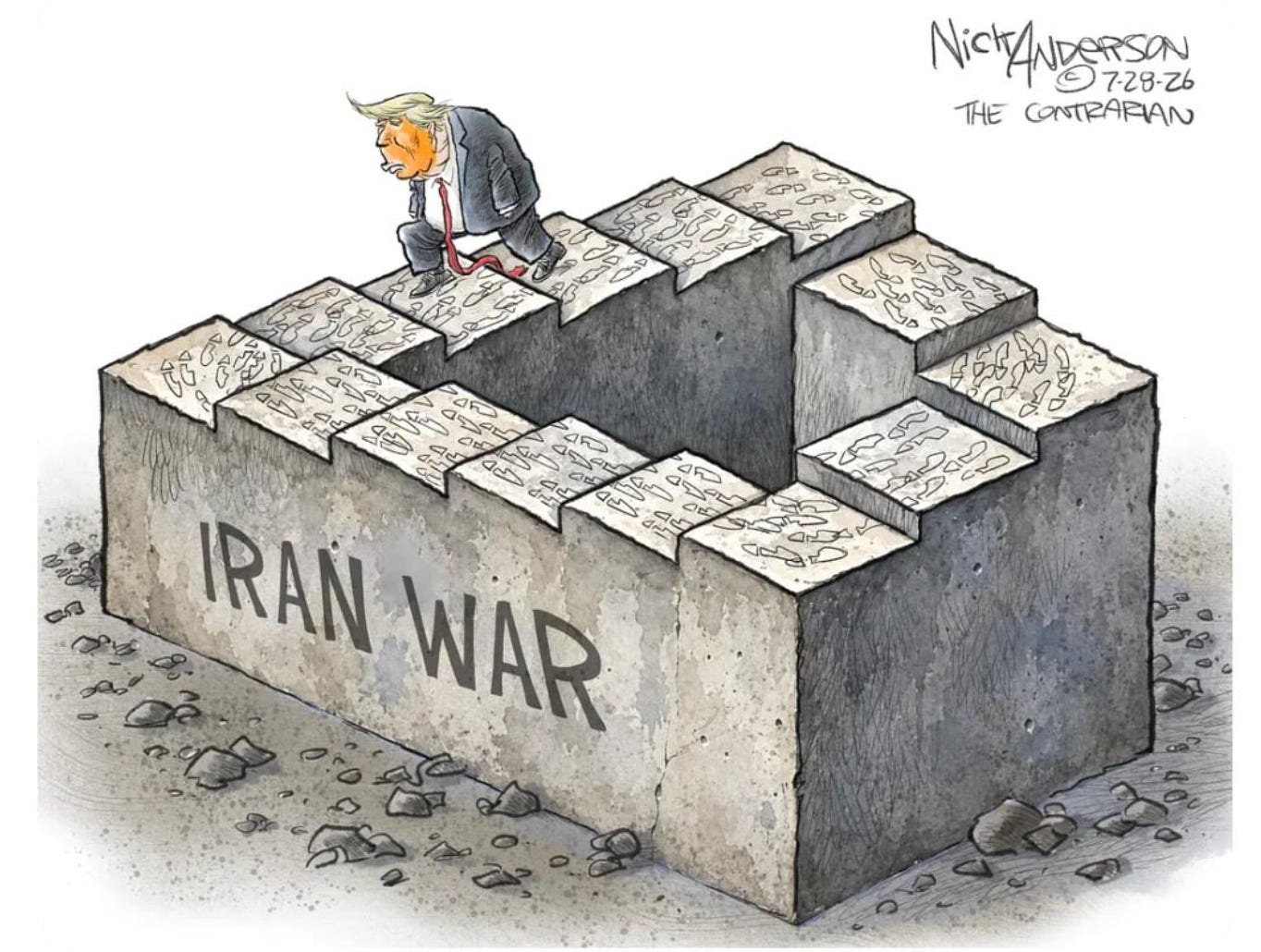
Which brings us to the current situation in Iran. The same mistakes have been repeated, as they were in Iraq, Afghanistan and Vietnam. We are told that the Iranian military has been completely destroyed, just as we were once told that Vietnamese strength had been severely depleted by all the bombing and by all those ground offensives. Yet the Iranians keep fighting, keep causing damage, just like the Vietnamese once did. It’s deja vu all over again. America now finds itself in a quagmire in Iran, one that looks a lot like the previous quagmires. There’s no apparent escape from a war that is supposed to be over.
When will they ever learn? When will the basic lessons of Vietnam sink in? I have to say that there’s something distinctly male in this insistence on ignoring past experience, this refusal to learn from the wisdom of the ages. Men tend to assume that the rules of the past don’t apply to them, that there’s no need to seek guidance when lost on a lonely road. It’s not manly to ask for advice; men automatically assume that they will succeed where others have failed.
Yet there’s something different about this current iteration of the Vietnam myth. To the usual stubbornness has been added a new element, namely a colossal imbecility. ‘Most of their weaponry is gone’, Trump claimed on Tuesday, as he has on so many occasions before. ‘I could take out most of their bridges in less than an hour … I could knock out all of their power plants within one day … they know I’m going to do that if they don’t make a deal. The bridges are going to be gone.’ Thus, the errors of the past are enthusiastically repeated, but this time by men of gargantuan stupidity. Never in the field of human conflict has so much military force been deployed by men of such limited intelligence. God help us all.
I write because I love the harmony of words. But it’s also my main source of income. So, if you enjoyed this, consider becoming a paid subscriber, or you can …
A very strong piece. I just re-read "The Best and the Brightest", which I'd last read (gulp) fifty years ago. Those were different times - very intelligent people making stupid decisions whereas now, as you describe, we have stupid, unqualified and inexperienced people making stupid decisions. The result is the same. I hope your piece gets wide dissemination.
This is a cracking article!
Can I add another example of asymmetric warfare? An occasion where the more powerful army found itself in a quagmire? The original guerrilla, the war of Napoleon's army in Spain.