
No Ordinary War
In my weekend review, I'm featuring a sublime book about the American revolution

It’s the weekend, when I like to dig out an old review I wrote and give it a little more light. Today, in a nod to the upcoming 250th anniversary of the Declaration of Independence, I’m reprising a review I wrote for The Times in 2019. The book is Rick Atkinson’s The British are Coming, published by Henry Holt and Co. It presents a distinctly different picture of the Revolutionary War than the one I was taught in school in San Diego 60 years ago. This is a wonderful book and a very sensitive examination of the reality of war. That’s a topic that has always been so important to me. As I suggested in my last article, it’s criminal to romanticise war.
By the way, having read through this review six years after I first wrote it, I can’t help but wonder what those brave men who fought back in 1776 would think of the way the anniversary is going to be celebrated in Trump’s Washington.
On a journey from Kew Palace to Portsmouth in June 1773, King George III did not stop at Lotheby Manor. According to Rick Atkinson, this was because ‘an ancient English custom required that if a monarch visited Lotheby, the lord of the manor was “to present His Majesty with three whores”.’
One might ask what this has to do with the American Revolutionary War, the subject of this book. To be honest, not much. Atkinson, however, is a lover of detail. The British are Coming requires 550 densely packed pages to cover only the first two years of the war. The author is never afraid to digress; he interrupts meticulous battle narratives with detours about the treatment of smallpox or about George Washington’s fondness for Spanish fly, an aphrodisiac made from crushed beetles. This is not, in other words, a book for anyone in a hurry. Atkinson takes his time, but there’s enormous delight in the detail.
The American Revolution, Atkinson feels, was no ordinary war. Out of it emerged the American republic – ‘surely among mankind’s most remarkable achievements’. In other words, the war is a creation story deserving careful narration. It’s ‘a tale of heroes and knaves, of sacrifice and blunder, of redemption and profound suffering. Beyond the battlefield, then and forever, stood a shining city on a hill.’
‘The cause of America’, wrote Thomas Paine, ‘is in great measure the cause of all mankind.’ Americans are good at assigning themselves transcendence – that deep belief in exceptionalism remains powerful to this day. Even during this brutal war, ordinary rebels sensed redemption. ‘Heaven [has] … something very great in store for America’, the artilleryman Samuel Shaw reassured himself after the bitterly disappointing New York campaign. Scribbled in the orderly book of one regiment were words that read like a hymn: ‘The rising world shall sing of us a thousand years to come/And tell our children’s children the wonders we have done.’
Central to every good creation myth is the idea of progress, and better still if that progress is erratic, interrupted by edifying misfortune. In the war’s first skirmish, a handful of Americans were massacred at Lexington by British redcoats bent on teaching them a lesson. Then, a combination of American hope and British hubris shifted the momentum toward the rebels. After Bunker Hill and the 333-day siege of Boston, the British were driven from Massachusetts. Americans believed themselves blessed.
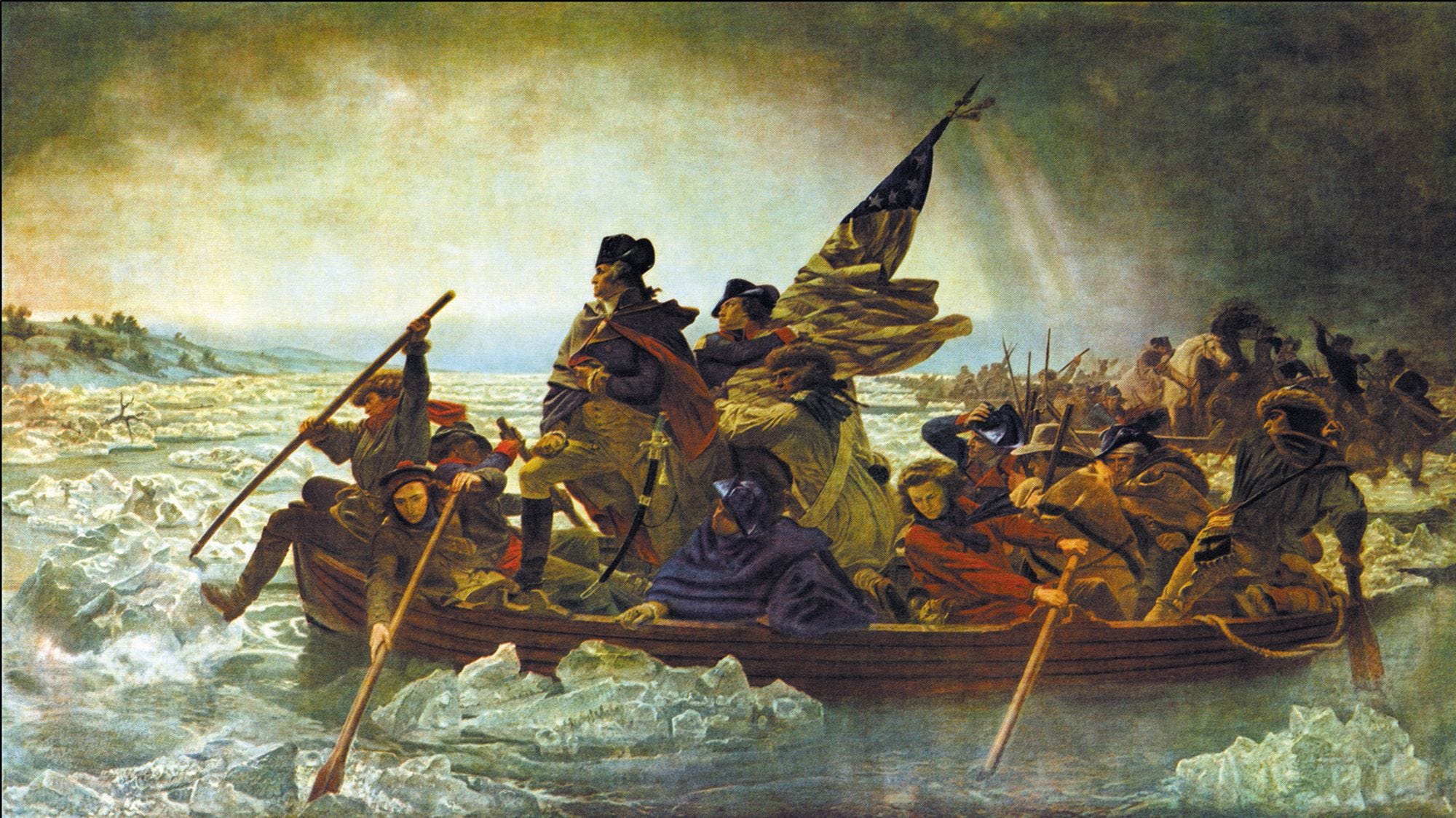
Washington, it seemed, could do no wrong. The might of the British Army and Royal Navy ‘had been driven off by a rabblement of farmers and shopkeeps’, he boasted. But then came humiliation in New York, where, writes Atkinson, ‘Washington and his generals … nearly lost the war … through miscalculation, misfortune, imprudence, and deficient military skills.’ The British crowed that victory was near. After that disaster, Washington’s crossing of the Delaware seemed like Moses parting the waters. Fortune shifted again to the rebel side.
American calamity during these years was not confined to the battlefield. ‘We are in want of almost everything’, Joseph Warren complained to the Continental Congress in May 1775. Since munitions had to be smuggled past a Royal Navy blockade, there was a perennial shortage of gunpowder and lead. American supplies were often stolen or scavenged from British ships. Lead was collected from fishing weights, clocks, sash cords, downpipes, stained glass windows and pewter dishes.
Equally worrying was the problem of manpower. These citizen soldiers would drop arms to return to their fields, factories or shops. Others were taken away by disease. Smallpox was ‘the pestilence that walketh in darkness’, dysentery ‘the destruction that wasteth at noonday’. Helpless doctors watched good men waste away. ‘We had nothing to give them’, one surgeon recalled, ‘It broke my heart, and I wept till I had not more power to weep.’
Many simply starved. Americans fighting in Canada in the autumn of 1775 were creative in filling their bellies. ‘Stews were boiled from rawhide thongs, moose-skin breeches, and the rough hides that lined the bateaux floors’, writes Atkinson. ‘Men gnawed on shaving soap, birch bark and lip balm.’ Rifleman George Morison feasted on his leather shot pouch; John Henry ate stew made from a dog and Jeremiah Greenman enjoyed a fine casserole of a squirrel’s head and candlewicks, though he felt it needed salt.
The British also suffered, though their misfortune arose from that hubris, that tendency to underestimate their enemy. ‘They advanced toward us in order to swallow us up’, Private Peter Brown told his mother after Bunker Hill; ‘but they found a choaky mouthful.’ The British learned quickly how difficult it is to supply an army across a vast ocean. Thirty-six ships left Britain in October and November 1775, but fewer than half reached Boston. Of the 550 Lancashire sheep sent out on that flotilla, only 40 arrived. Hessian mercenaries found themselves without footwear when a large shipment arriving from Portsmouth turned out to be ‘fine, thin dancing pumps … so small that no use can be made of them’. Troops deserted at a frightening rate, enticed by the American offer of land. Fourteen per cent of Royal Navy sailors absconded during the war.
Americans like their history books BIG. The reader is often pummelled by a relentless fusillade of facts, which are sometimes mistaken for historical truth. Books of this sort often seem assembled with little regard for eloquence. Not so this one. Atkinson is a superb researcher but more importantly a sublime writer. On occasion I re-read sentences simply to feast on their elegance. Take, for instance: ‘Plunging fire gashed the column; grazing fire raked it. Men primed, loaded and shot as fast as their fumbling hands allowed. … Bullets nickered and pinged, and some hit flesh with the dull thump of a club beating a heavy rug.’ In his previous life Atkinson was probably a Romantic poet.
That creation myth, he writes, has ‘sometimes resembled a garish cartoon, a melodramatic tale of doughty yeomen resisting moronic, brutal lobsterbacks’. That’s certainly the myth I was fed at school in San Diego. The British are Coming is something entirely different; pages are packed with nuance. Yes, the British raped, brutalised and pillaged, but they were also capable of sublime valour. The Americans were pretty much the same, but they were fired by that peculiarly American hope. That was sometimes all they possessed.
The war would last 3,059 days. It would involve more than 1300 hostile actions and 241 naval engagements. This book covers only the period from the first shots at Lexington to the invigorating American success at Princeton in January 1777. After eighteen months of command, Washington had learned that ‘war was rarely linear, preferring a path of fits and starts, ups and downs, triumphs and cataclysms’. This book is simply a start down that path. There’s two more to come. Terrible years of killing lay ahead. A war of such transcendence deserves a writer like Atkinson.
I write because I love the harmony of words. But it’s also my main source of income. So, if you enjoyed this, please consider becoming a paid subscriber, or you can …
I finished it about a month ago. It was great.
Now I’m in trouble because I must read another wonderful tome by Rick Atkinson. I throughly enjoyed his three part work on the WWII so I’m looking forward to this.