
Sawdust Caesars
When Mods fought Rockers in sleepy seaside towns

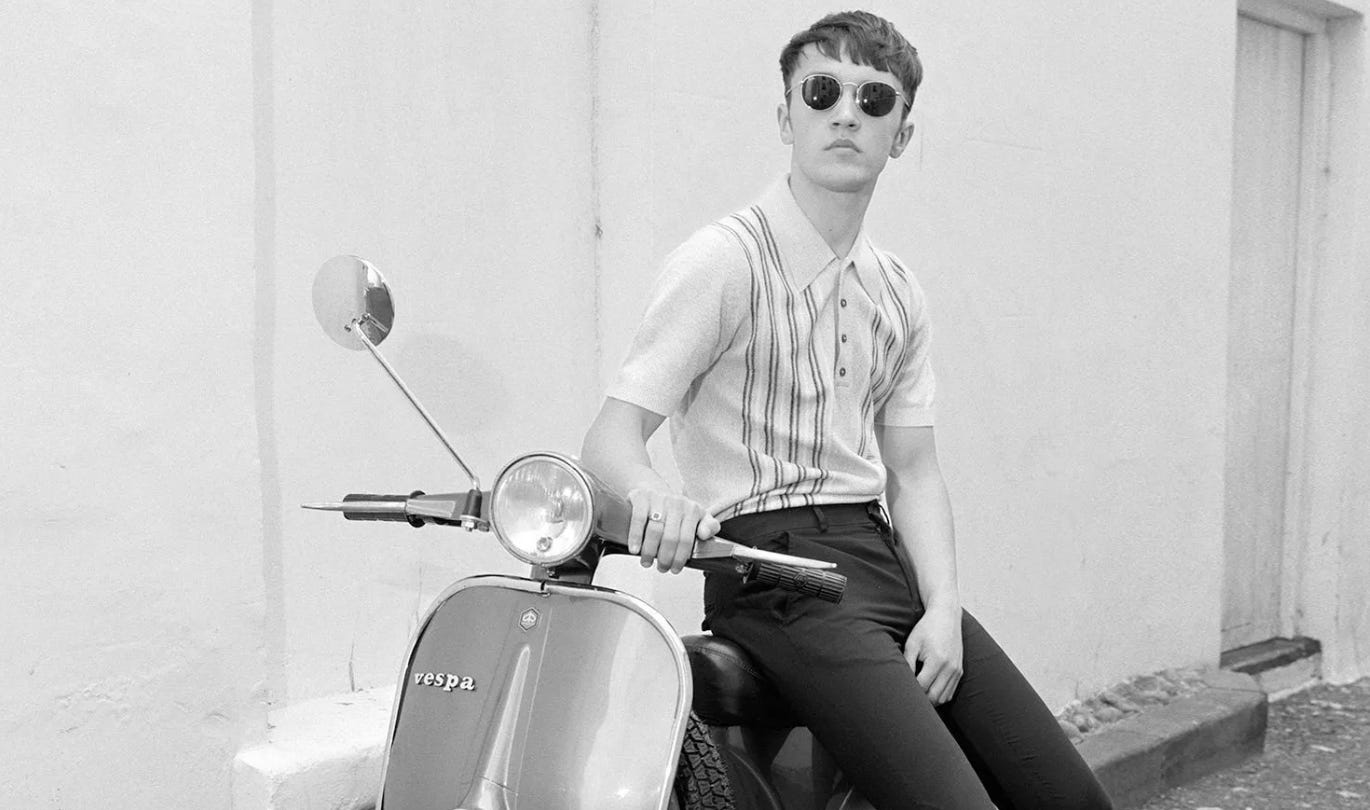
On the morning of 17 May 1964, a gang of youths suddenly started breaking the windows of a trackside buffet at the Margate railway station. ‘The boy who started it was so good looking and nicely dressed’, the manageress subsequently remarked. ‘You wouldn’t have thought he was a nasty type.’
That boy was a Mod, a subculture defined almost exclusively by their natty dress and their taste for violence. Mods might have been just another passing fashion in Britain if not for the fact that, around 1963, they started strutting in seaside towns like Brighton and Clacton. What originated as an innocent bit of fun turned into a style war and then a social problem—the kind of molehill Britain’s tabloids love to turn into a mountain.
Youthful rebellion is seldom genuinely political. Most of the time, disagreements between children and their parents are fought on the battlefield of culture—in particular music, cosmetics and clothes. Every child perceives a generation gap; nearly every one rejects parental advice and seeks to learn life’s lessons independently. Alienation is a word few fourteen year olds can define and most sixteen year olds feel deeply. To establish a distinct identity requires doing things differently than Mum and Dad—reject their authority, spurn their moral outlook, and scorn their material trappings. For teenagers, the quickest way to demonstrate independence is, ironically, to join a gang and slavishly copy the latest fashion trend.
In Britain, the history of youth culture can be traced by the evolution of sartorial styles—Spivs, Bohemians, Beatniks, Teds, Punks, Skinheads, Casuals, etc. In the midst of that continuum lie the Mods, and their mortal enemies, the Rockers, who frightened polite society in the early 1960s. The Mods morphed from the Teds, who were themselves descendants of the pre-war Dandies. Teds were narcissistic posers who passed their time in small groups standing on sidewalks, chewing gum, smoking fags, causing outrage, and admiring their own reflection in shop windows. The shallowness of the Ted ethos meant that it quickly grew stale. Standing around looking pretty eventually got boring, and was cold in winter. In time, most Teds found girls, got married, had kids and combed out their quiffs.
Into the vacuum strode the Modernists, or Mods, who first appeared around 1958. The new trend began with a few tailors’ sons in the East End of London, many of them Jewish, who were sufficiently confident to start a new style and sufficiently well off to create one. Their dads whipped together a customised set of clothes that was an amalgamation of Italian and French designs. ‘I used to knock around with this Jewish guy’, one former Mod recalled. ‘He had a couple of other Jewish friends and one of their fathers was in the rag trade. They started getting into clothes very seriously. It was almost like a religion.’
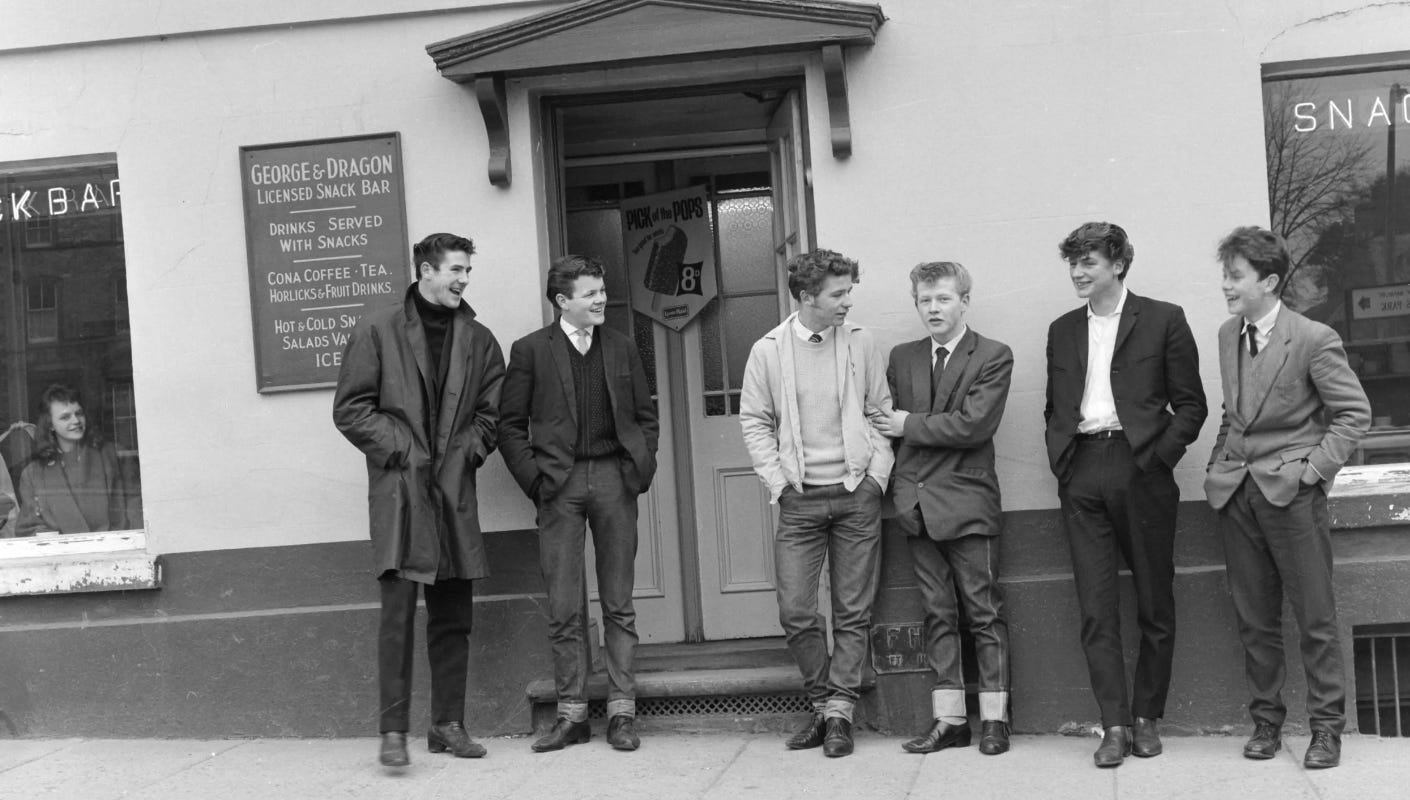
At first, Mods wore suits, but not what most people would call suits. These were tightly tailored, with narrow lapels and sharp lines. Shirts had pointed collars and were invariably buttoned to the neck, whether a tie was worn or not. Jackets were worn with just the top button fastened. Trousers, tapered to a narrow ankle, had creases sharp enough to shave with and were hemmed high in order to show off the winkle-pickers—narrow shoes, often made of patent leather, with pointed toes and tassels.
In time, the fashion broadened. Mods took to wearing Fred Perry polo shirts, preferably with stripes. Sweaters were usually V-necked, thin and close-fitting. If a tie was worn, it was always thin, and usually black. Eventually, they started wearing Levis, which were shrunk to fit in the bathtub. The defining feature of Mod wear was its minimalism—all the lines were straight. Everything was perfectly ironed, and impeccably clean. Hair was short, closely cropped, and neat.
Most of us had terrific hair, French style, and you spent a lot of time on it. You had to use sugar water. What you do was wash your hair, then get a bowl of hot water and put sugar in it. Let the water cool and keep stirring it up and then plaster the water on your head and shape your hair. We used to leave it on all night. The longer you left it on the better it was. … It was horrible stuff.
Mods craved attention, but most of the attention they got was from one another. The only reason to go out was to look good, which meant that the slightest blemish could ruin an evening.
I put on my suit and my shoes were a bit dirty so I got the polish out and—disaster—I looked in the mirror and I’d splashed my shirt. So I got the hump and didn’t go out that evening. … I knew guys who’d get on the bus with a sheet of brown paper so they could put it on the seat so they didn’t get any dirt on their suit. And they’d sit bolt upright so they were not touching the back of the seat. … you had to be immaculate.
Styles would shift with each passing week, but changes came from within, not at the instigation of a clothes designer or fashion outlet. New designs were part of the ethic of improvisation usually inspired by a self-appointed ‘Face’ who wanted to assert his leadership. Fashion was a stylised dominance ritual—power expressed through clothes.
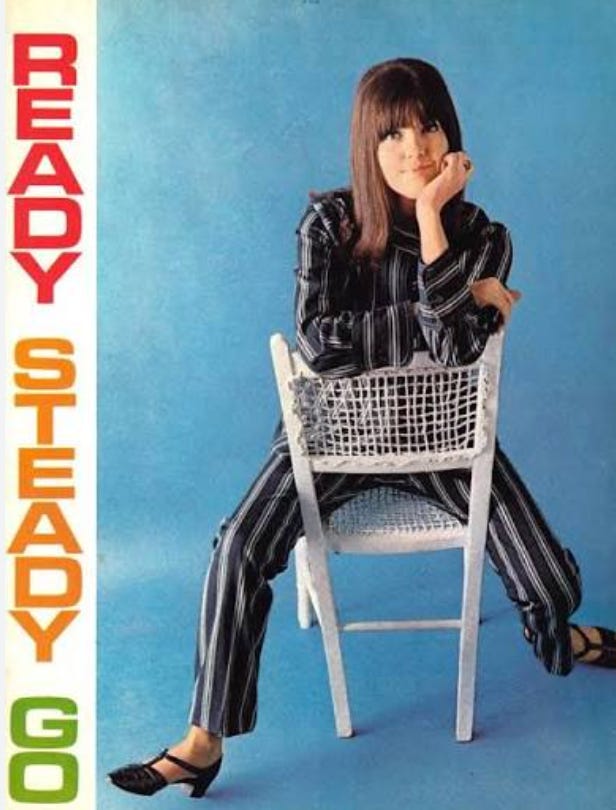
Life imitated art which in turn imitated life. Mod style was quite similar to the costumes worn in Bond films and in television programmes like The Avengers and The Saint —though who was copying whom was never very clear. The most popular showcase for Mod style was undoubtedly Ready, Steady Go!, the Friday night pop extravaganza hosted by Cathy McGowan. Aspiring Mods tuned in faithfully in order to learn the latest dance moves and to absorb fashion trends. The show’s popularity inevitably meant that Mod style spread far beyond its East End birthplace. Eventually, not all those who dressed like Mods were actually Mods.
At first, their music was as clean as their clothes. In the early days, they went for modern jazz—cool and uncluttered. They also liked R&B—artists like Booker T, Fats Domino, the Impressions and James Brown—an affinity which caused them to be labelled ‘white niggers’ by their detractors. When Mods took up rock after 1960, they went for bands that evoked their image—groups like Herman’s Hermits, The Small Faces, The Yardbirds, and The Who.
Early in their career, The Who were known as The High Numbers, a Mod expression which meant prominence within the ethos. Pete Townsend and Roger Daltry perfectly embodied the Mod ethos—its fashion, its cynicism, its improvisation and especially its violence. ‘My Generation’ became a Mod theme song. The sound filled a room, shook the bones and rattled the teeth. ‘The Who are clearly a new form of crime, anti-social and armed against the bourgeoisie’, the Daily Telegraph warned, as it always does.
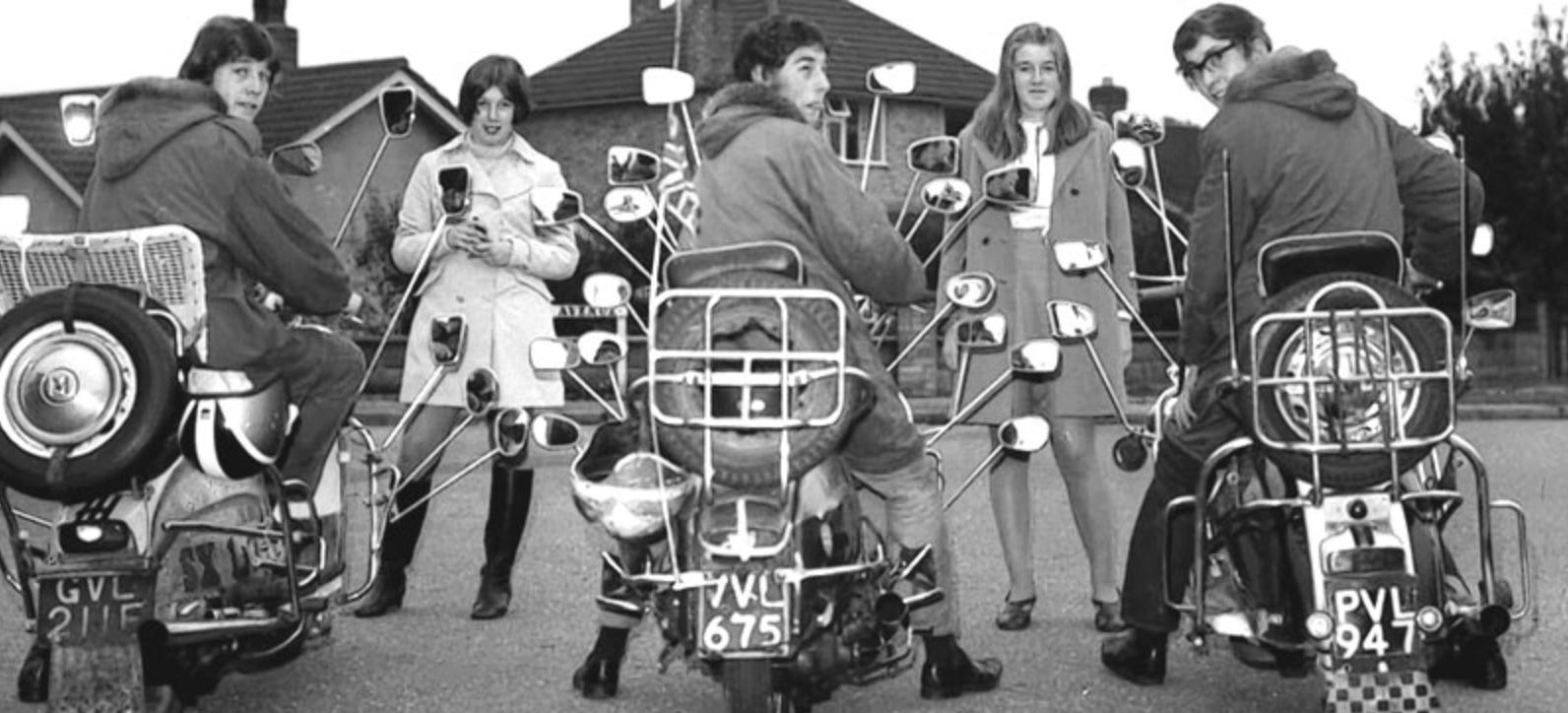
For transportation, Mods chose sleek scooters like Vespas and Lambrettas. These shiny Italian chariots were perfect because, unlike motorbikes, they weren’t greasy; riding one didn’t dirty one’s clothes. Thanks to new hire purchase rules, they could be bought for just £20 down. They could also be personalised in an infinite variety of ways, but always according to a rigid fashion code. An array of lights would be added, in addition to ornaments and fancy covers for the seat. The most popular accessory was the mirror, with sometimes as many as twenty arrayed in neat lines on either side, like legs on a centipede. These were the perfect accessory for boys obsessed with staring narcissistically at their reflections. Since riding a scooter in the British winter could get chilly, anoraks and Army parkas were seamlessly added to the Mod ensemble. Parkas were usually regulation Army green, though some Mods dyed theirs to match their scooters. No way would a Mod ever wear a helmet.
Scooters weren’t fast, but that didn’t matter since speed was provided chemically. Mods were amphetamine freaks who lived life on fast forward. ‘Most of us popped a few pills’, one confessed. ‘You could get pills nearly anywhere, from people on the street, in the café you’d buy a cup of tea “with or without” … It was easy to get hold of drugs, and being Mods, we took loads of them.’ Uppers called Purple Hearts, black bombers and French blues were perfect for a group that craved sharp corners and clean lines. In contrast, drugs that deadened the senses, like marijuana, didn’t harmonise with the rhythm of Mod life.
Amphetamines were essential in order to keep up with a hectic schedule of acting Mod. A huge amount of energy was expended on sustaining a fantasy. Every Mod imagined that he lived in a gangster world of fast cars, beautiful women, expensive clothes and endless posh parties, even if in reality his life consisted of a second hand Vespa, fish suppers, and the occasional grope with Madge in the alley behind the Lyceum. Dressing up provided escape from humdrum lives of limited opportunity.
Sex was not a big part of the ethos, since all those amphetamines deadened the libido. Most Mods were simply too busy admiring themselves to pay much attention to ‘birds’. ‘The guys were so preoccupied with clothes’, one female camp follower remembered. ‘It got to be a big deal to have a conversation with a guy and we thought we were lucky if one of those gorgeous creatures actually danced with us.’ Involvement with a woman inevitably implied a tug of loyalties: it wasn’t easy to be part of the group and be some gal’s bloke.
Mods evoked postwar social mobility, or at least the illusion of such. In truth, Britain was a deeply stratified society and the original Mods, despite their dress, were as working class as pork pies and pigeons. But the important point was that they didn’t seem working class, especially since their style was enthusiastically imitated by the well healed who shopped at Biba. Even though Mods had to work for a living, they didn’t usually get their hands dirty; most were shop assistants, minor clerks and office boys. The postwar boom kept them in jobs and meant that they had more disposable income than their fathers ever dreamt of having. Extra money was inevitably spent sharpening the image.
Since parading was an intrinsic part of Mod culture, it was perhaps inevitable that they should eventually decide to take their show on the road. Trips to the seaside started as a bit of a lark, a sardonic reference to the English obsession for spending Bank Holiday weekends in Brighton or Blackpool. ‘It was the first time most of us had done anything like that since we were kids’, Charlie Steel, a former Mod, remembers.
Now we could do what we wanted, go where we wanted, and have it all on our own terms. We ate whelks and ice cream and pissed about on the pier. It was a different buzz to the smoke [London]. To be honest, we downed so many pills and were full on so often that going away was a welcome break … Even getting there was a chuckle.
Heading for the seaside was not originally meant to be confrontational. Unfortunately, the coast was Rocker territory. According to Alfredo Marcantonio, a former Mod, Rockers were drawn to seaside funfairs like bees to candy floss. ‘Every rocker … dreamt of working on the dodgems, with the sound of Del Shannon echoing past the helter-skelter. So a lot of us turning up on scooters, it was asking for trouble.’ He insists, however, that Mods were not itching for a fight. ‘Real Mods were far too concerned about their clothing. I mean, we’re talking about possibly losing buttons—you know, creasing or tearing clothing you’d saved for!’
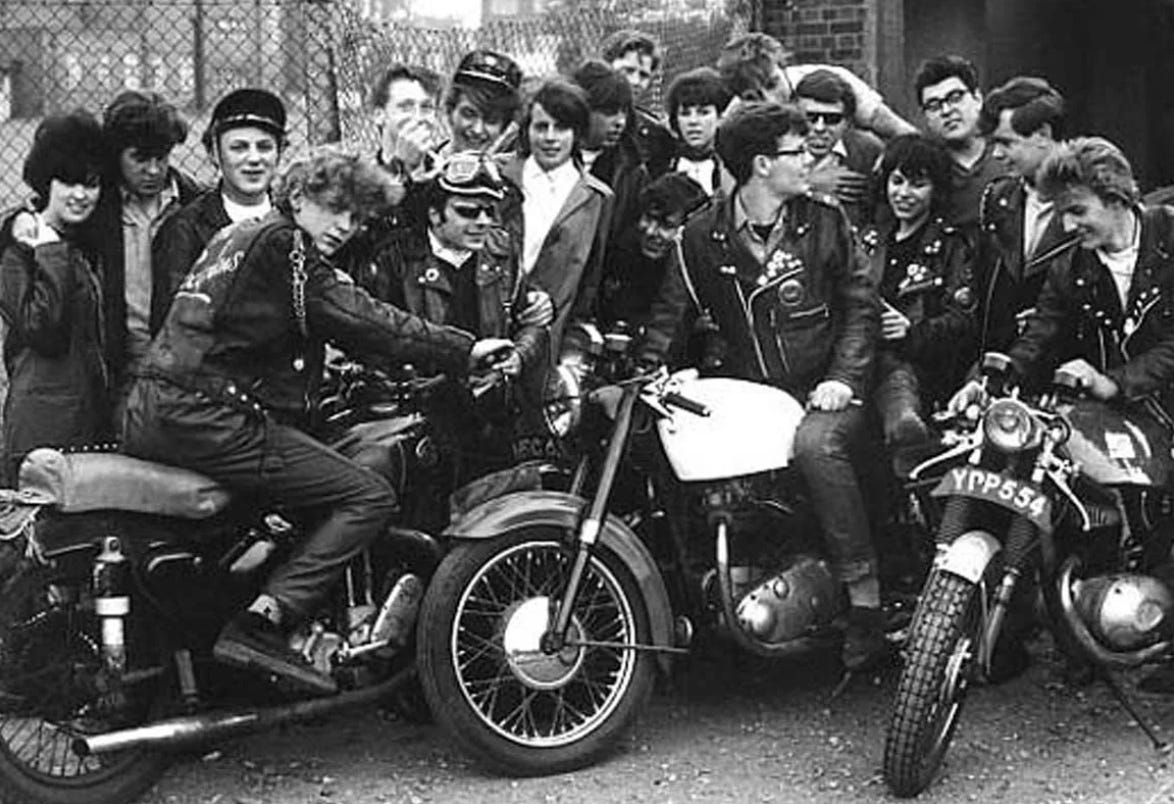
Rockers were so named for their love of Rock and Roll. They were Fifties throwbacks, young men frozen in time who still revered Marlon Brando and James Dean, even though the rest of the world had moved on. They listened to Elvis (of course), Eddie Cochrane and Gene Vincent. Like the Mods, they were descendants of the Teds, but on a distinctly different branch of the family tree. They were dirty, loud and vulgar boys for whom motor oil was a fashion accessory. They wore lots of leather, silver studs and big heavy boots and drove motorcycles—the bigger, louder and dirtier the better. Since violence was an intrinsic part of Rocker culture, they considered it their duty to defend their seaside territory from the Mod invasion. Quiffs and coifs met in stylised combat.
Rockers wore their aggression on their sleeves—rolled up with their packet of fags. Even the gentle ones (and they were the majority) looked threatening. The Mods, in contrast, looked polite and well-dressed, but that was simply camouflage. Underneath the surface lurked an arrogant, sneering, cynic with a taste for menace. Both groups saw a good fistfight or a bit of petty vandalism as a nice way to pass the time on a slow evening. It also provided an opportunity to demonstrate their masculinity.
If Mods and Rockers had kept apart, they might now be remembered as simply two fashion and music trends. When their orbits intersected, however, confrontation became inevitable. Rockers came armed with bike chains and bottles. Mods had flick knives and coshes. The real sadists among them sewed fishhooks into the cuffs of their jackets, the better to slice an opponent’s face. Opportunists on both sides took advantage of the weapons the seaside provided–-deck chairs, umbrella poles, and rocks.
The real trouble started in Clacton on Easter weekend, 1964, which happened to be the coldest for eighty years. Since most of the regular holidaymakers stayed away, Mods and Rockers had the town to themselves. They kept warm by running amok. Paul Barker, then a reporter for New Society, saw something most observers missed: ‘What struck me most, as I went up and down the beaches, was the ritual nature of the supposed battle. Mods and Rockers were like flocks of pigeons, clustering, flying up, dispersing. The main point was this: both of them were against the police.’
Later, the local Clacton paper estimated the damage at about £513. Fleet Street took that figure and multiplied it tenfold. Headlines in the Daily Mirror shouted: ‘Wild Ones Invade Seaside Town’—a direct and intentional reference to Brando. In contrast, The East Essex Gazette reported: ‘The troubles … were not so horrific as the flood of national press, television and radio publicity suggested. The town was not wrecked, no one, apart from some of the young hooligans themselves, was really hurt and Clacton housewives did not, as one early morning broadcaster said, spend Tuesday “sweeping up glass from their broken windows”.’
Fifty-one people were arrested. Dr George Simpson, chairman of the magistrates, jailed four men and imposed fines totalling £1,900 on 36 people. He made himself forever famous by condemning the ‘long-haired, mentally unstable, petty little hoodlums, these sawdust Caesars who can only find courage like rats hunting in packs’. While journalists praised Simpson, the sentences he imposed seemed too lenient to most people. ‘They all ought to be put in gaol—an old-fashioned gaol’, one woman told The Times. ‘They are all a nasty dirty lot.’
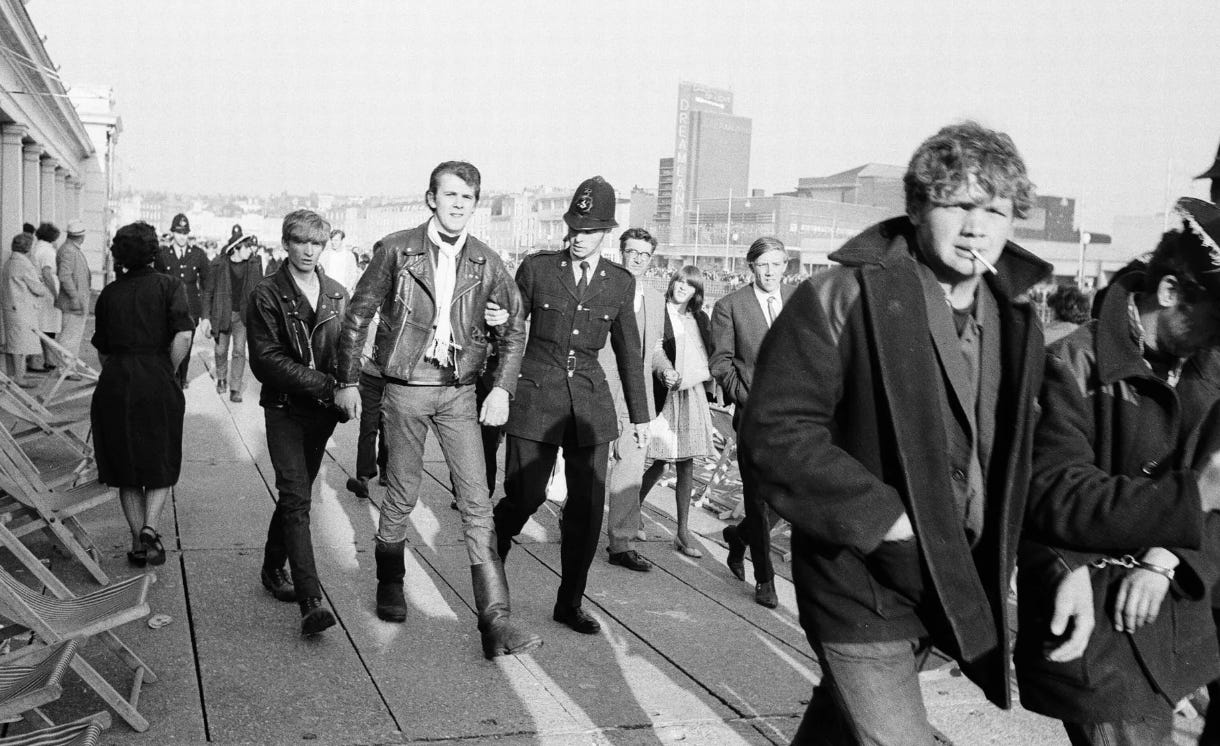
The press provided the oxygen of publicity to what otherwise might have been an isolated event. Front-page reports, accompanied by shocking photos, were like advertisements for future Mod vs Rocker prizefights. ‘The whole history of Mod was changed after that’, Steele felt.
Definitely the publicity was very much a defining moment, all of a sudden … we were surrounded by a lot of prats jumping up and down in tacky clothes shouting out they were Mods, they didn’t know anything about the Mod ethos, they just bought some clothes and got a haircut … I did use to wonder how much more creative energy the Mod thing could have produced if it wasn’t tarnished with the fighting.
David Cooke, a mod revivalist and amateur historian of the movement, claims that some of the famous photographs of rioting were faked. ‘The photographer paid the lads a few shillings’, he claims. The novelist Howard Baker, once a Mod, agrees: ‘Reporters and photographers were paying a lot of kids. … We’d get pissed on it.’ The public, the press and rebellious youths played in three-part harmony.
After Margate came an expectation of trouble, rather like the nation waiting eagerly for the next episode of Dixon of Dock Green. The violence reached a crescendo at the next bank holiday weekend, on 17 May. Since Mods, Rockers, police and press all expected a confrontation, they willed it to happen. Afterwards, came a predictable competition to condemn. David James, the M.P. for Brighton Kemptown, told Parliament that he found in his constituency ‘a sense of horror and outrage … It was almost as if … all the conventions and values of life had been completely flouted.’ ‘It spreads like a disease’, W. R. Rees-Davies, the M.P. for Margate, warned. ‘If we want to stop it, we have to be able to get rid of these children from the school, and quickly … We must immediately get rid of the bad children so that they cannot infect the good.’
Violence continued for the rest of the summer, with youths automatically interpreting a Bank Holiday weekend as an opportunity for aggro. In response to rioting in Hastings on 3 August, The Times opined:
The first lesson to be learnt from this weekend is that the popular explanation of Mods and Rockers as the only troublemakers should be ended. The fact is that over three-quarters of the youngsters from 15-22 who descended on this town over the weekend, clearly admittedly knowing there would be trouble, were to outward appearances at least perfectly ordinary. They did not come by scooter or motor cycle, they did not wear fancy clothes, nor did they have long hair. Of the 3,000 to 5,000 youths here over the holiday, fewer than 300 could be classed as Mods or Rockers. … The extraordinary thing is that none of them seems to know why they are doing this. … Boredom is the likeliest explanation. ‘We just go with the gang’, two young lads said.
Former Rocker Phil Bradley echoes the mindless nature of the violence. ‘I haven’t the foggiest idea why there was any fighting with the mods. I really don’t know.’ In fact, to label it Mods vs Rockers assigns the violence an order and purpose which is misleading. ‘It really wasn’t mods versus rockers, as the press put it’, Cooke argued. ‘Mods were fighting each other. The north London mods hated south London mods. South London mods hated north London mods, and east London mods hated everybody, and everybody hated them.’
Perhaps the most ironic aspect of that summer of violence was that it brought Mods and Rockers national attention at a time when both were in decline. By 1964, Mod style had been hijacked and turned into a mass market phenomenon that could be bought off the rack at boutiques like Biba.
As it evolved, Mod mirrored the class divisions of British society, an ironic development given that it had once pretended to be classless. At the top were the people who didn’t have to work and could afford a cashmere V-neck. No scooters for them—they had their own cars or took taxis. They went to the right London parties, places where Mary Quant, David Bailey or Twiggy appeared. They were called, appropriately, the Aces. Below them were the Tickets or Numbers, the descendants of the original East London Mods, who rode around on scooters and were tied to dull jobs. In time, they could hardly afford the style that they had once invented.
In the midst of the mayhem, a Sussex vicar confidently proclaimed that young people ‘are as normal and healthy as ever before but they are in revolt. They are in revolt against a society which has lost its values and found no new ones. I believe their revolt to be the healthiest sign.’ Needless to say, most people disagreed. The Times remarked:
Whatever enlightened opinion in the rest of England may think, there is probably not an adult here but would welcome a return to the days when a good thrashing would have discouraged the young people’s sheep-like hysteria and a massive display of childishness. In the hotels, cafes, public houses and shops along the seafront, there is complete agreement that this is the solution.
Whenever youths misbehave in Britain, the right wing press calls for the return of corporal punishment or a restoration of conscription. Like nodding donkeys, they claim that hooliganism is a new phenomenon, and that liberal permissiveness has destroyed the moral stability of the past. ‘Law and order’ is something the older generation fondly remembers but can never figure out how to restore. Yet ‘hooligan’ is an old word invented to describe an old problem—namely the propensity of youths toward mindless violence. In the 1890s, a music hall song went:
Oh, the Hooligans! Oh, the Hooligans!
Always on the riot,
Cannot keep them quiet,
Oh, the Hooligans! Oh, the Hooligans!
They are the boys
To make a noise
In our backyard.
So it was, and so it will continue. Youths revolt, adults over-react. Rinse and repeat.
Mods have been largely ignored by historians, perhaps because they espoused no coherent political programme. There was no body politic underneath the sharp clothes. Yet they were perhaps the most honest of Sixties subcultures. They were superficial and proud of it. All they wanted was some fun and an occasional bit of aggro. They saw no need to complicate their style with ersatz substance. None of them sought to change the world. As Simpson remarked, they were indeed ‘Sawdust Caesars’, but in being so, they displayed a characteristic of youth that should not seem unfamiliar. Britain would see their like again, though in different clothes.
‘It was something to do’, one young man confessed rather perfectly after the Battle of Margate. Something to do.
I write because I love the harmony of words. But it’s also my main source of income. So, if you enjoyed this, consider becoming a paid subscriber, or you can …
Was there any kind of music associated with the Mods — OK just reread it and see “The Who”. I always find these very much English tribal “feuds” fascinating. I suspect there is an equivalent in US society but I have no idea what it would be?? Maybe because the US wasn’t as “class” conscious, it came out in a different way than stylistic dress and attitude?