
When a President Dies
Hoping for something seldom hastens its arrival

On 4 March 1841, General William Henry Harrison, the hero of the Battle of Tippecanoe, was sworn in as the 8th President of the United States. It was a cold, wet day and Harrison, who considered himself a tough guy (even at the age of 68), gave his two hour inaugural address without wearing a coat or hat. Over the next three weeks, he exhausted himself in endless meetings with office seekers and continued that silly habit of going outside without bundling up. On the 26th, he came down with a cold which then turned into a ‘severe chill’. He might have had pneumonia. Doctors at first treated him by applying a mustard plaster to his stomach and then gave him a laxative. When his condition didn’t improve, they resorted to a bit of bloodletting, as was the fashion.
Despite the attention of some of America’s ‘best’ doctors, Harrison’s condition steadily worsened. Over subsequent days, he was treated with laudanum, camphor and opium, not to mention wine and brandy. Nothing, however, seemed to work and the president died on 4 April. In 2014, two scientists, after examining his medical records, concluded that Harrison probably died not from pneumonia, but from typhoid, perhaps caused by the sewage that seeped into the White House water supply. Harrison holds the distinction for serving the shortest time in office, but is otherwise an unremarkable president. He didn’t have time to do much harm, nor indeed much good.
Of the forty-five men who have held the job of president, eight have died in office. In actuarial terms, that suggests a high-risk profession, right up there with fighter pilots. Presidents tend to be old, the pressures of the job are huge and, since this is America, they quite often get shot.
When I was growing up, history nerds like me would talk about the curse of the presidency, or, specifically, the fact that, starting with Harrison, every president elected in a year ending in zero died in office. Harrison was elected in 1840, Abraham Lincoln in 1860, James Garfield in 1880, William McKinley in 1900, Warren Harding in 1920, Franklin Roosevelt (for the third time) in 1940 and John Kennedy in 1960. All those guys died in office. The curse ended with Ronald Reagan who, though elected in 1980, managed to serve two full terms, despite an assassination attempt, two bouts of cancer and the onset of Alzheimer’s. More on him later.
The joker in the pack is Zachary Taylor who was not elected in a year ending in zero, but did manage to die in 1850, after sixteen months in office. It seems he consumed copious amounts of cherries and iced milk during July 4th celebrations and then came down with explosive diarrhoea, as did a few of his cabinet members. Food poisoning from contaminated milk might have been the cause, or it might have been those noxious sewers once again. His physician eventually diagnosed cholera, which fits in with the sewers being the culprit. Conspiracy theorists have speculated that Taylor was poisoned, but the evidence for that is weak.
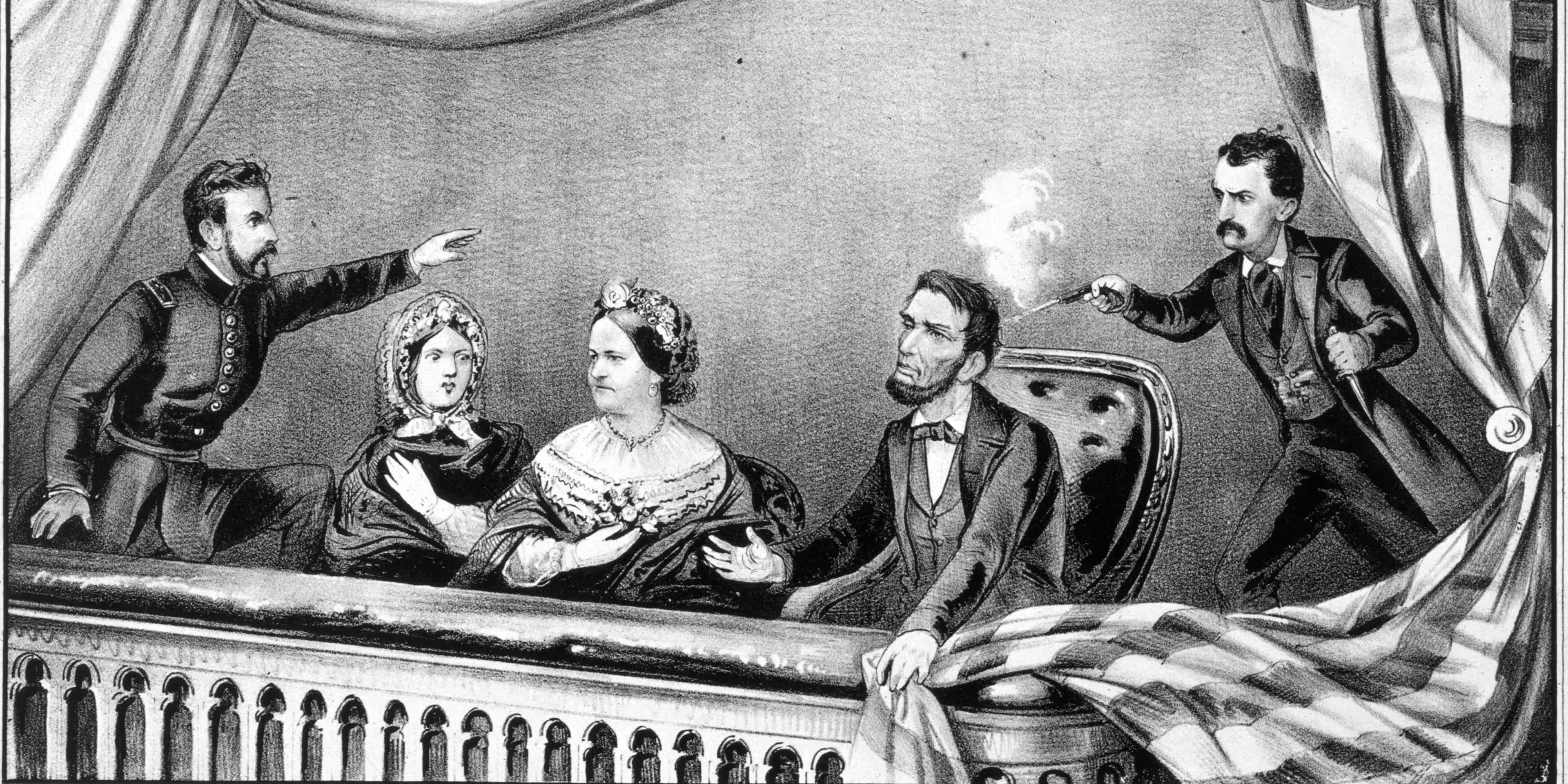
The next to die was Lincoln who was shot in the back of his head at Ford’s Theatre on 14 April 1865, just a month after his second inauguration. While the president and his wife were watching the play Our American Cousin, John Wilkes Booth, a famous actor and a Confederate spy, crept into Lincoln’s box and shot him at point blank. The president failed to recover consciousness and died nine hours later. Leaving aside the fatal shooting, Lincoln was not a healthy man, partly as a result of the exhaustion caused by taking his country through the Civil War. He suffered from depression and hypochondria, for which he took Blue Mass pills. The pills were a cure-all commonly prescribed for toothache, tuberculosis, constipation, syphillis, childbirth, and almost anything else. They contained mercury, which means they probably did more harm than good.
After Lincoln came Garfield. He had been in office for just four months when he was shot by Charles Guiteau, often described as a disgruntled office seeker and sometimes as a narcissistic sociopath. He had a grudge against Garfield for not favouring him with a cushy job. Garfield had no bodyguards, despite the assassination of Lincoln sixteen years earlier. Officials considered that assassination an anomaly due to the Civil War, so no close protection was offered to Garfield.
The president was shot from behind at a railway station on 2 July 1881. One shot grazed his arm and another entered his back, shattering a rib and ending up in his abdomen. That shot should not have been fatal, but doctors made certain that it was. They were determined to remove the bullet, but couldn’t find it, since x-rays had yet to be invented. They instead repeatedly probed the wound with unsterilised fingers, leading to serious infection.
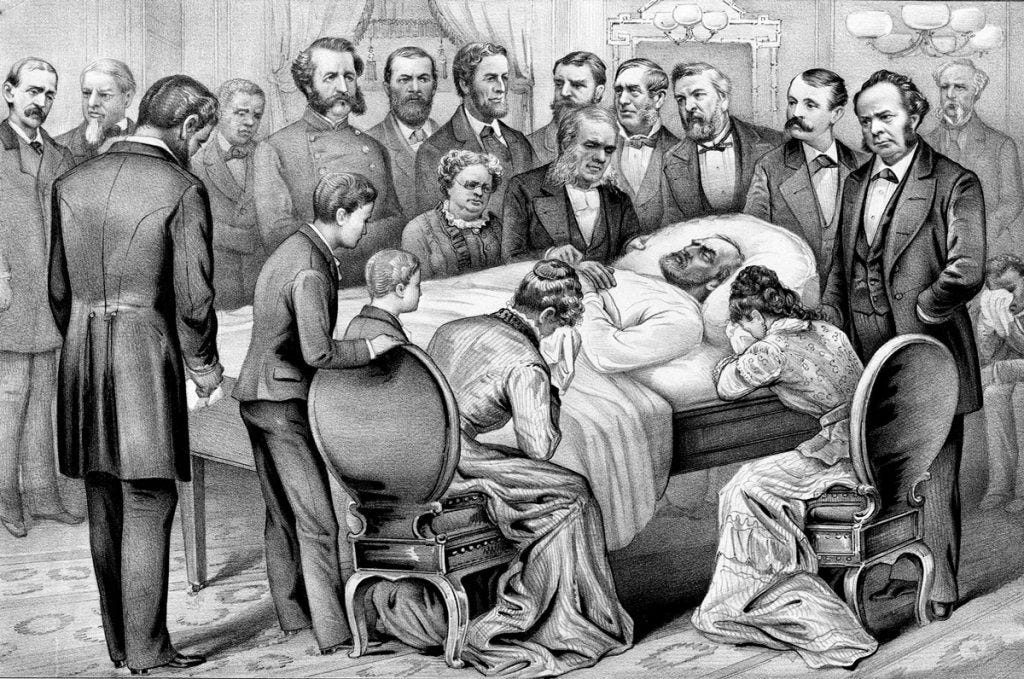
The inventor Alexander Graham Bell offered his recently invented metal detector, but his efforts proved unsuccessful, probably because Garfield was examined while lying on a mattress with metal springs which threw off the readings. The president lived for another two and a half miserable, feverish months before dying on 19 September. Argument still rages about the actual cause of death, with some experts speculating that he would have survived the shooting if doctors had simply bandaged the wound and left the bullet in his body.
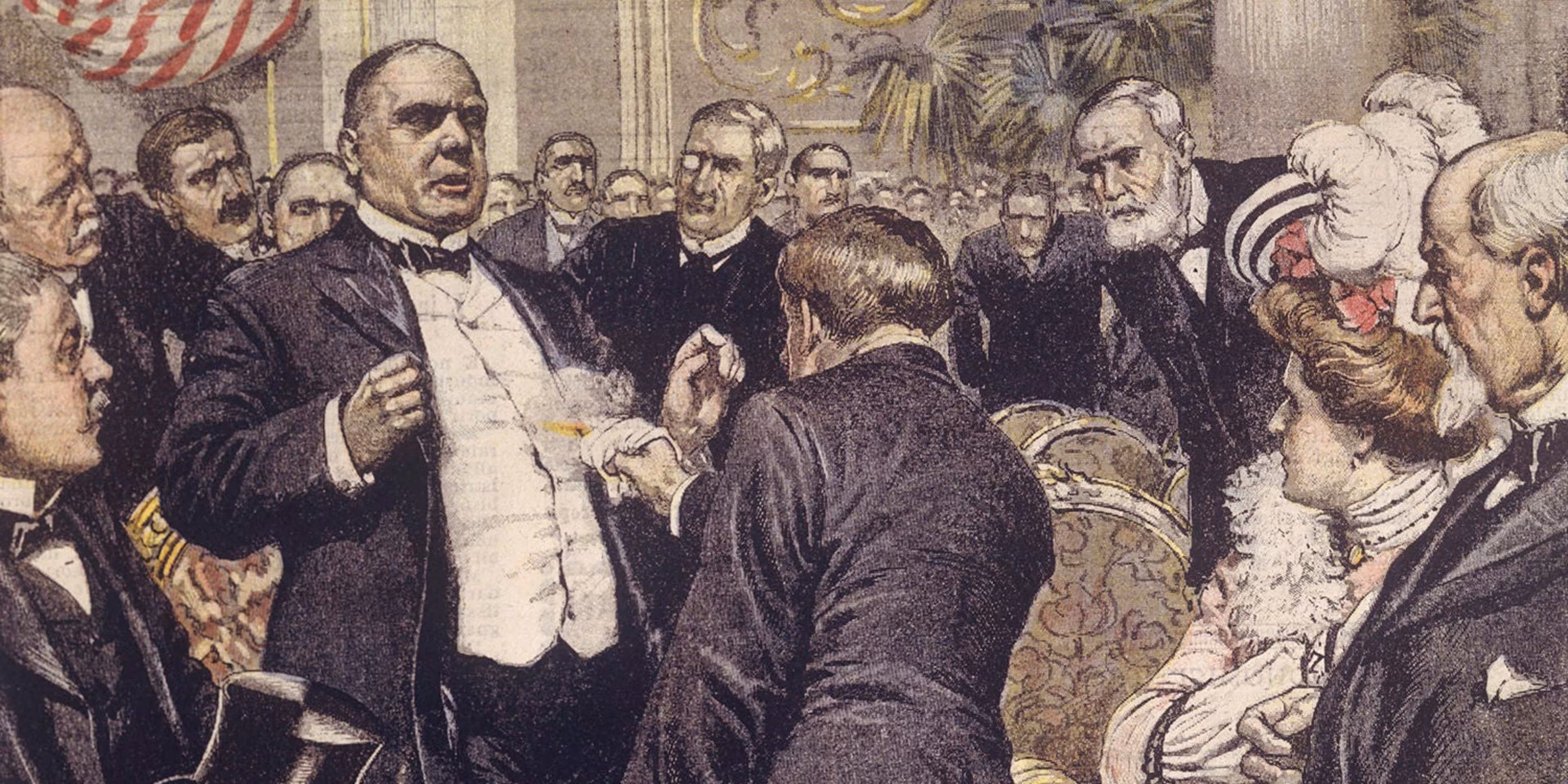
The anarchist Leon Czolgosz shot President William McKinley at the Pan-American Exposition in Buffalo on 6 September 1901. Since the president liked to mix with crowds, it was relatively easy for an assassin to approach and fire at close range. Security had improved a bit since the Garfield shooting, but clearly not enough. Again, doctors had difficulty locating one of the bullets and, again, hygiene was primitive. Ironically, a rudimentary x-ray machine was one of the more popular exhibits at the Exposition, but it was not used on McKinley. While at first he seemed to improve, infection inevitably set in and he died on 14 September.
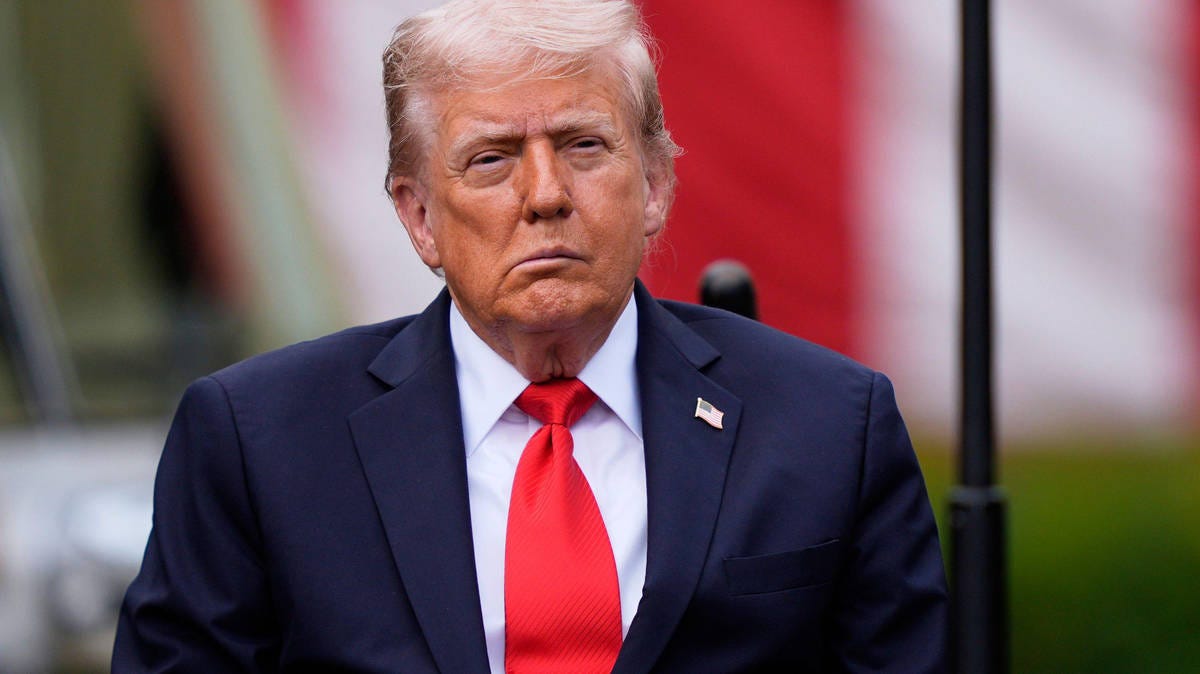
Warren Harding died on 2 August 1923, a few days after suffering a heart attack. He reminds me a bit of Donald Trump in the sense that his administration was riddled with corruption, but, unlike Trump, he doesn’t appear to have been an active player in the wrongdoing. Also like Trump, he was a sex pest who considered himself irresistibly attractive to women. He had an affair with a White House maid, Nan Britton, who claimed that she was made pregnant by him, an allegation confirmed via DNA testing in 2015. Britton wrote The President’s Daughter to raise money for the poor child, but critics dismissed her as a golddigger. In the book, she claimed that she and the president would have sex in a closet near the Oval Office, while Secret Service agents obligingly kept intruders away. The presence of those agents does at least suggest that presidential security had improved since the shooting of McKinley. So that’s progress.
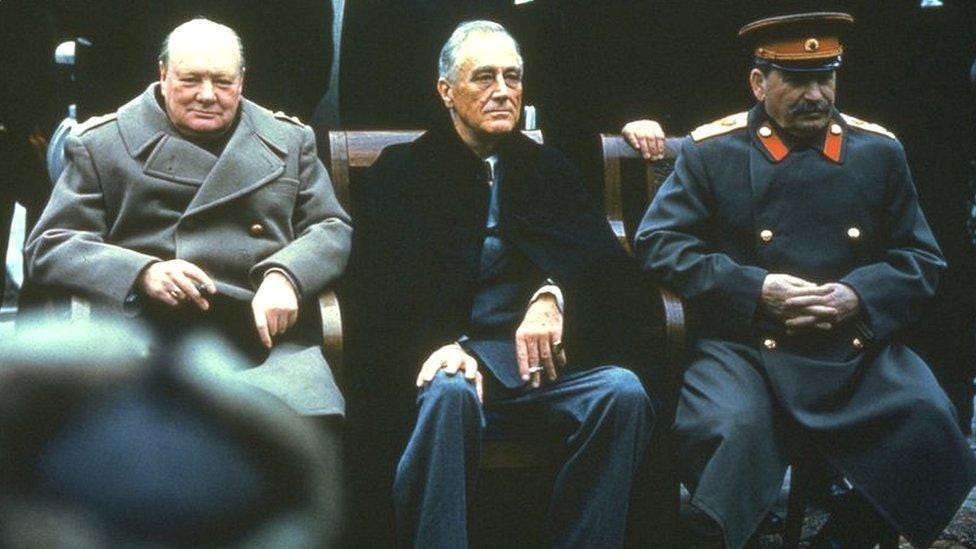
Poor Franklin Roosevelt. He was a vigorous, enormously strong man when he was struck down by polio at the age of 39. No vaccines back then, you see. The disease left him paralyzed from the waist down, but he was determined to make a comeback. His battle against paralysis is a deeply moving story which I’ll leave for another day. He was first elected to the presidency in 1932 and then re-elected in 1936, 1940 and 1944. A chain smoker and enthusiastic drinker, he seemed headed for an early death, especially considering the strains of being president during the Great Depression and the Second World War. A physical examination in March 1944 at Bethesda Hospital revealed that he was suffering from high blood pressure, atherosclerosis, coronary artery disease and congestive heart failure. On 12 April 1945, while resting at Warm Springs, Georgia, he suffered a massive stroke and died almost immediately. He was only 62.
Next up John Kennedy. There’s not much reason to go into details about his death, since we all know that he was shot in the neck and the back of the head while riding in a motorcade in Dallas on 22 November 1963, and some of us accept that there was just one gunman – Lee Harvey Oswald. What is less well known is just how ill Kennedy had been for most of his life and especially during his presidency. He was a sickly child and, later in life, suffered from Addison’s Disease, hypothyroidism and hypertension. He was also tormented by severe back pains caused by injuries during the Second World War. Since Kennedy was a sex addict, there’s also a suggestion of chronic sexually transmitted disease. Doctor’s notes described the cocktail of drugs he took to pretend that he was in robust health:
[Kennedy] injected and ingested corticosteroids for his adrenal insufficiency; procaine shots and ultrasound treatments and hot packs for his back; Lomotil, Metamucil, paregoric, phenobarbital, testosterone and trasentine to control his diarrhea, abdominal discomfort, and weight loss; penicillin and other antibiotics for his urinary-tract infections and an abcess: and Tuinal to help him sleep.
All of this suggests that Kennedy was a walking time bomb. Had he not been assassinated in 1963, it’s a fair assumption that he wouldn’t have survived a second term in the White House. Needless to say, his poor health was kept a secret; the public was fed a story of a vigorous president who loved sailing and playing touch football with his family.
And what of the presidents who didn’t die – those who managed to serve out their term of office despite severe health problems? Sticking just to the 20th century, we know that Woodrow Wilson suffered from severe cardiovascular disease, leading to a massive stroke in October 1919. During the last seventeen months of his presidency he was bedridden, with the duties of office assumed by his wife and senior cabinet members. Calvin Coolidge suffered from severe depression. Dwight Eisenhower had a major heart attack during his first term and had Crohn’s Disease. Lyndon Johnson had a near-fatal heart attack nine years before becoming president and had high blood pressure throughout his presidency. Richard Nixon was an alcoholic. Ronald Reagan had colon cancer, skin cancer, prostate issues and Alzheimer’s. The latter was not officially diagnosed until 1994, but it’s generally accepted that there was significant memory loss evident during his second term. In every case, the public was kept blissfully ignorant of the state of their president’s health. That was the default position back then and remains so now.
I suspect you can probably guess where I’m going with this. Let me make a bold statement that some of my readers will find depressing: I don’t think that Donald Trump is on death’s door, as many people are hoping. Hope can be a cruel thing, especially when it involves the prognosis of an evil, stupid, incompetent president.
Yes, there’s those bruises on his hands, but anyone who takes anti-coagulants (including me) is familiar with them. Yes, he falls asleep at Cabinet meetings, but I fall asleep during episodes of Yellowstone and I can guarantee that Beth Dutton is a lot more exciting than Howard Lutnick. He rambles, but that’s what old men do. He probably has early stage dementia, but he’s a lot more plugged in than Reagan was during his second term. I look at Trump and see a man who is remarkably fit for a person who has to shoulder the pressures of the presidency in his eightieth year. Like almost everyone in the world, I honestly don’t know the true state of Trump’s health and for that reason I’m reluctant to speculate on whether death is imminent. What I can say is that he’s probably healthier than Wilson, Roosevelt, Eisenhower, Kennedy and Johnson were during their presidencies. He also has access to much better medical care than any of those men ever enjoyed.
Presidents, as we have seen, have a tendency to carry on despite severe medical issues. They have doctors to give them drugs, assistants to do their work and PR people to cultivate the pretence of robust health. It seems a peculiar form of torture to read every rune of Trump’s health — every facial tic, every droopy mouth, every memory lapse — and conclude that the end is imminent, only to find that the bastard keeps buggering on. Some people are cockroaches; they’re impervious to every calamity. Winston Churchill had terrible health for most of his life, but he was still prime minister at the age of 81, despite all those cigars and a bottle of whisky a day. He lived to the age of 90, as I fear Trump will. Some people are just like that.
Trump will die when he dies. No amount of hoping or armchair diagnosis will bring that demise closer. I would, nevertheless, love to be proven wrong and will shout it to the mountaintops if I am.
Finally, all of the eight presidents who died in office, except Lincoln, had reasonably sound and trustworthy vice-presidents to take their place. In many cases, the state of the Union improved because they died. Can we be confident that the same holds true today? Be careful what you wish for.
Thanks. Yes, some interesting stuff on Nixon's drinking during his final months. Kissinger was running things a lot of the time.
Fascinating. I’m something of a disease junkie! I love to read about it. Perhaps a different career path would have been good. In any case, given MAHA, perhaps we’re headed back to mercury treatments and bloodletting. We’re well on our way re: vaccines. I agree with you though. Some people hang on remarkably long despite wretched health. We can stab all the voodoo dolls we want but it’s probably not going to hasten his demise.
I did not know that about Nixon.